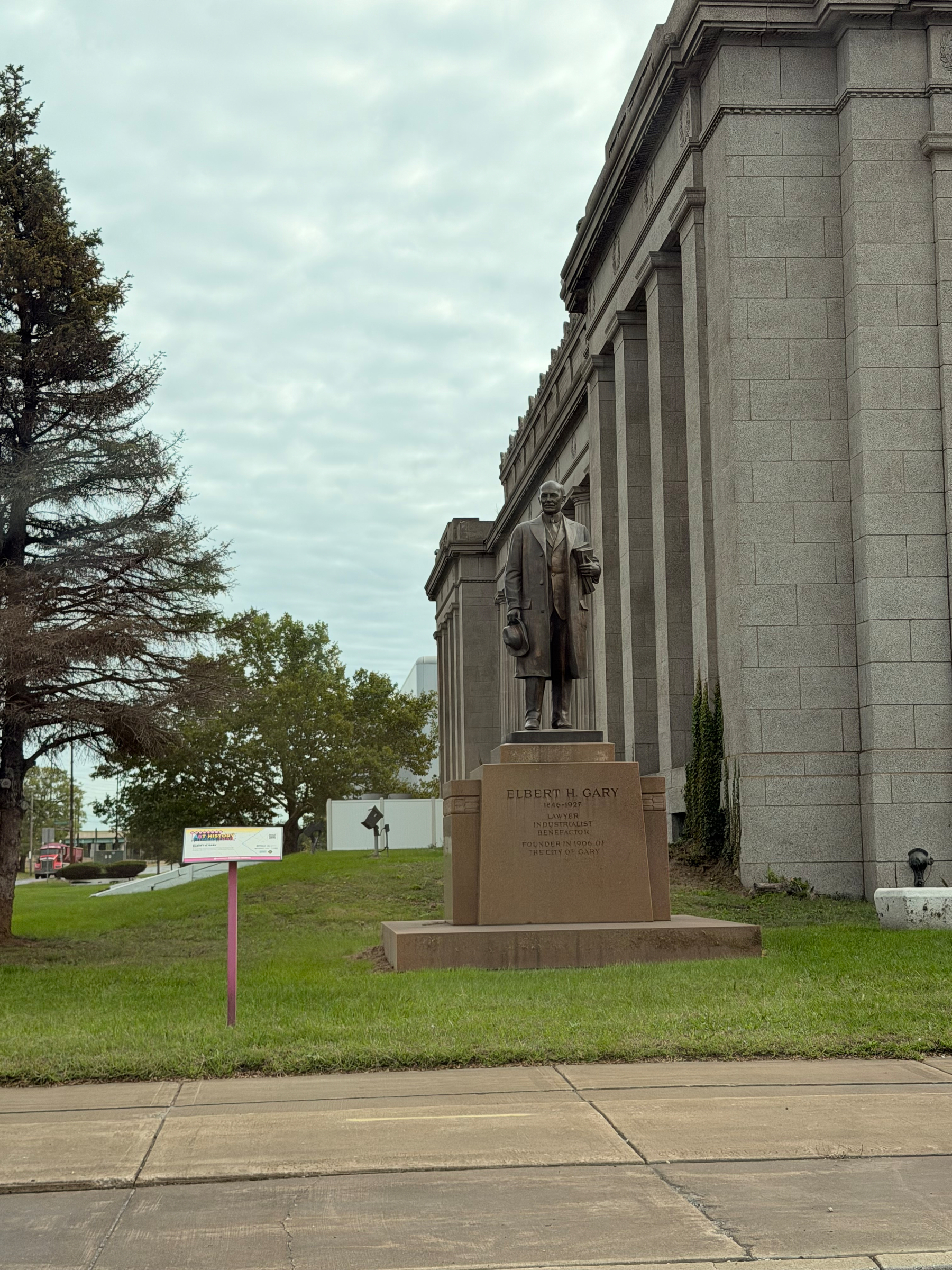
Yesterday I cut through Gary to get around a traffic jam on the toll road and picked up the Dan Ryan and the Skyway. Since living in Madison, I’ve made some version of that drive more times than I can count. I grew up south of Gary, at the edge of what a colleague called “the Chicago ombré,” and in my twenties my friends and I spent our weekends in The Region, thrifting our way across Lake County and hitting 18+ hip hop clubs in East Chicago. (King Von measured the same gradient from the city side in “Took Her to the O.”) To many, Gary is the city you drive through on the way to somewhere else.
The Skyway has a long political history: Chicago built it in 1958 with revenue bonds, then the bonds defaulted in 1963, and the city spent the next few decades catching up on deferred maintenance, according to Louise Nelson Dyble’s history of the road. In 2005, the Daley administration leased it for 99 years to Cintra and Macquarie for $1.83 billion, making it the first existing toll road in the country to be privatized. Eleven years later, the consortium sold the lease to three Canadian pension funds for $2.8 billion. The crossing now costs $8.10 in a car, and CBS Chicago reports that tolls have gone up more than 200 percent since the lease, about three and a half times the rate of inflation.
Indiana saw the incentives in this arrangement and followed along. In 2006, then-governor Mitch Daniels leased the Indiana Toll Road to the same Macquarie-Cintra group for 75 years and $3.8 billion, and he used the money to pay for Major Moves, his statewide highway program. Stateline’s 2012 retrospective called the lease one of the most divisive things Daniels did as governor. The bill passed without a single House Democrat, and the Region hated it. At a town hall in Crown Point, one resident told Daniels the deal amounted to taxation without representation. The operator went into Chapter 11 in 2014, and an Australian fund bought the lease the next year for $5.7 billion. A big share of the original money built I-69 between Evansville and the Crane Naval Base, at the other end of the state. When Eric Holcomb later approved a truck toll hike in exchange for another $1 billion, he had to deny in public that the Region was once again paying for highways its drivers would never use.
The state keeps the paperwork on deals like these. The Indiana State Archivesopened a new downtown building in Indianapolis on Thursday after 25 years in a “temporary” warehouse on East 30th Street, a former RCA record-stamping plant whose roof leaked partly because people shot holes in it. An old combination safe in the new building holds the state’s original constitutions, Jim Jones’s church incorporation papers, and Donald Trump’s application for a casino in Gary. Upstairs, a conservator expects to spend four to six weeks piecing together a Porter County survey map that had broken into fragments. The reading room is open to the public Tuesday through Saturday, and the staff asks you to make an appointment so they can pull the boxes before you arrive.
Freddie Gibbs grew up on Gary’s east side, and Jeff Weiss has profiled him twice. The 2021 profile in The Ringer catches Gibbs around his Grammy nomination for Alfredo and opens on a 2009 visit to his Van Nuys apartment, where Gibbs told Weiss that robbing freight trains was a popular hobby back home. Weiss’s earlier piece, The Miseducation of Freddie Gibbs, adds that one of Gibbs’s teachers got fired for robbing them too.
Gibbs’s father, Warren Tipton, spent about twenty years on the Gary police force and later sang with the Chi-Lites. He died in May, and AllHipHop’s obituary places him in the same Gary music scene that produced the Jacksons. That detail stuck with me because my ex-father-in-law was a police officer and chief of police downstate during the same years, and also played drums in a local band. Jamelle Bouie has historically described police departments as “jobs for the boys,” a steady public paycheck handed to working-class men, and that fits both of their careers better than anything about their relationships to law and order. In towns where the mills were shedding jobs, a badge was one of the few paychecks that came with a pension, and a man who could sing still needed that safety net.
Policing in the Region has uglier chapters than that. The Chicago Sun-Times has spent years covering the federal case against the Sin City Deciples, a motorcycle club founded in Gary in 1967. One member admitted he worked as a Gary police chaplain while killing two men, one of them the son of a former Gary police chief. The Chicago Reader’s Tiger King of the Midwest profiles Roy “Roy Boy” Cooper, who ran a tattoo shop called the Badlands with Bengal tigers in cages next to the chairs. Tattooing was illegal in Indiana then, and Cooper’s lawyer reportedly steered him to Gary because the police had bigger problems than a tattoo shop — as long as it paid its taxes. Media Burn has raw footage of Cooper setting a leashed tiger on a pool table while his wife runs through the rest of their animals, which included a grizzly bear and a baboon. In the video, Lady Cooper recommends taking the animals out in public, to the grocery store, socializing them on the locals.
Anderson went through the same collapse with auto parts. General Motors moved in during the 1920s and eventually ran two divisions there, Delco-Remy for electrical systems and Guide Lamp for headlights. By the time Jon Alpert made Dirty Driving: Thundercars of Indiana for HBO in 2008, a town that once had 33,000 GM jobs had empty factories and shuttered stores, and what was left of it went to the Anderson Speedway every Friday night. The Herald Bulletin caught up with one of the film’s drivers, Sammy Hawkins, as he flew home from the New York premiere to a Firestone job in Noblesville that he expected to lose. His line in the film is that Anderson doesn’t make cars anymore, but it can still race them and wreck them.
Music in Gary started in the mills. Joe Jackson ran a crane and played guitar in a band called the Falcons, which never got a record deal, so he kept the mill job and trained his sons into the Jackson 5 instead. Their first contract came from Steeltown Records, a Gary label, in 1967, and “Big Boy” was a local hit before Motown signed them. Most people in a mill town who can play keep the day job, and the ones who make it usually leave.
Akron went through its own version a decade later, with rubber instead of steel. Midstory’s history of how Akron became “the new Liverpool” describes Devo, Tin Huey, the Bizarros, and the Rubber City Rebels as kids from factory families trying not to follow their fathers into the plants. The scene got its home during one of the longest rubber workers’ strikes in the city’s history, when the Rubber City Rebels took over a rubber workers’ bar called the Crypt, as PBS Western Reserve tells it in It’s Everything, and Then It’s Gone. Chris Smith’s 2024 Devo documentary picks up the story from Kent State and follows the band into the early days of MTV.
Detroit turned its losses into techno. Juan Atkins, Derrick May, and Kevin Saunderson learned Kraftwerk and Parliament from a late-night DJ called the Electrifyin’ Mojo, and by 1987 more than half of Detroit’s manufacturing, retail, and wholesale base was gone, as SPIN reported in 1998. Midstory’s Built to Boom traces the line from the assembly plants through Motown to techno, and May describes sampling industrial noise, traffic, and construction into his tracks.
The techno ran straight into the rap Jorjiana grew up on. NPR’s piece on how Detroit and Flint became havens for rap dark horses credits the producer Helluva with a “basement sound” of ominous pianos and synth stabs, which he built by crossing West Coast gangsta rap with Detroit techno, and it describes the Flint rappers as a crew of flippant, vulgar jokers. Flintside’s history of the Flint scene shows how a co-sign from Detroit’s Peezy lifted Rio Da Yung OG and everyone around him. Lil Yachty spent years showing up on Michigan records, and he later vouched for Jorjiana too.
Jorjiana is 21, and a single mom, and from Michigan City, just down the shore from Gary. The Times of Northwest Indiana profiled her recently after “ILBB2” took off, and her Complex interview covers a childhood spent moving between relatives while her parents struggled with addiction. By her account, her music career started with screwing around with her friends around town. She and her friends were bored during the pandemic, so they freestyled in her car, and she posted the results, doing actual numbers. She told Justin Moran that her friends talked her into cross-posting the TikTok clips to Instagram, which she barely used, and that’s where the A&Rs found her. At the time she didn’t know what an A&R was. In a clip Complex posted, she admits she doesn’t know who Freddie Gibbs is either, so what ties her to Gary is the shoreline more than any influence. She should get familiar with his catalog.
Plenty of good bands started as friends goofing off, which “industry plant” commenters might keep in mind. Devo began as a satirical art project at Kent State. Ron and Russell Mael studied graphic design and film at UCLA before Sparks, and Edgar Wright’s The Sparks Brothers spends a lot of time on how they built their act for Top of the Pops closeups. Both bands treated the dominant screen of their time as part of the instrument. Jorjiana’s screen is the short-form feed, and I’ve been watching her work it for the last year or so: snippets of songs previewed, clips pushed to every platform, a freestyle on On The Radar at the end of 2024 that brought more than a dozen labels calling, a GloRilla remix, and co-signs from Lil Yachty and GloRilla.
If you want to know what Gary is doing now, read Capital B Gary, which covers the city more consistently than anyone else. Start with their feature on Koney King, a Broadway diner that has been serving chili for more than a century, and then look through their 2024 year in photos, which has residents cleaning up parks on the East Side and crowds on the beach for the eclipse.
When tech enthusiasts discuss federation today, they usually mean open protocols like ActivityPub or Mastodon. But in the 2000s, the feminist blogosphere was one of the earliest, most powerful examples of practical Web 2.0 federation, a decentralized, cross-site architectural network where open web standards powered a global ideas lab.
Instead of sitting inside a single corporate platform (like today’s X, Meta, or Substack), early blogs like Feministe, Reappropriate and Jezebel functioned as individual nodes in a federated ecosystem. Open protocols linked them, letting theory, critique and discussion travel seamlessly across independent servers, seeding some of the political conditions we face today.
1. Federated communication engine: CMS and protocol
Before quote-tweeting or tagging existed, the open web used Trackbacks and Pingbacks. If a post on Feministe analyzed an article about reproductive rights, a writer on Racialicious or Shakesville could respond on their own site. The underlying blogging software (Movable Type, WordPress) would automatically send an XML RPC “ping” back to Feministe.
Socially, this created architecture for ideas: a ping automatically listed the response essay in Feministe’s comment section or sidebar. Readers didn’t just consume one blogger’s singular and authoritative opinion; they could immediately follow the thread across five different independently hosted platforms. This created an inter-site conversation tree, allowing complex ideas to be cross-examined, refined, or challenged without any single person controlling the narrative.
2. Blogroll as federated curation and mutual discovery
Before algorithmic feeds dictated what readers saw, blogs relied on the Blogroll, a curated list of links in the site’s sidebar. Blogrolls formed a human-curated, decentralized routing layer. When a high-traffic node like Feministe added a smaller, independent blog (such as a disability rights blog like FWD or a smaller blog like Crunk Feminist Collective) to its blogroll, it directed server traffic directly to that independent domain.
Socially: This was a non-algorithmic way to expand the collective’s political consciousness. It allowed marginalized perspectives to build their own audiences and force mainstream feminist sites to engage with race, class, disability and queer theory. The blogroll mapped an intellectual community in real time – with strong caveats.
3. Open syndication protocols
The Architecture: Feeds ran on RSS (Really Simple Syndication), an open XML standard. Readers used independent RSS aggregators (like Google Reader or Bloglines) to subscribe directly to a site’s feed.
Socially: RSS meant no algorithm stood between the writer and the reader—no engagement bait, no rage-farming optimization, and no platform throttling links. Writers could publish 5,000-word, dense theoretical essays knowing their subscribers would receive the complete text in chronological order as designed. This structural stability gave writers the freedom to experiment with complex, “thick” personal narratives and political theory.
4. Real-time stress testing and spillover moderation
Because the blogosphere was a network of independent domains, each site maintained its own “house rules” and moderation policies. If a topic proved too controversial or toxic for one comment section, the conversation naturally federated outward. A reader who felt silenced or misunderstood in one blog’s comments could launch their own blog, write their response, and ping back into the original discussion.
Socially, this prevented any single author from monopolizing the narrative. It created a system of checks and balances where academic concepts (like intersectionality, rape culture, or microaggressions) were stress-tested across dozens of distinct, interconnected communities simultaneously.
Thinking about this architecture today
The feminist blogosphere proved that decentralized web protocols can generate deep, movement-building intellectual work. When platforms like Facebook, Twitter, and corporate media conglomerates centralized the internet in the 2010s, they broke those open connections. Conversations were locked behind platform walls, trackbacks were abandoned and RSS was marginalized, breaking, fencing and otherwise moderating independent community connections.
Rebuilding a modern “ideas lab” with modern federated protocols (like Webmentions, ActivityPub, RSS, and static site architecture) is simply picking up the technical blueprint OG feminist bloggers used to transform digital culture two decades ago.
El Wiscorican is a perennial fav, offering a short but very customizable menu. Vegetarian and vegan options are regularly available for those among us who like to keep it light. They’ll ask if you want it spicy – but whatever your expectations are around spice levels, dial it back. The great north is suspicious of the virtues of capsaicin. (I recommend the fried plantains.)
Saigon Sandwich has one of the best banh mi sandwiches in town, which is pretty wild given that this sandwich is produced by a single person in a box trailer. But with fresh bread and ultra-fresh ingredients, it’s a really good one. Nothing beats a fresh banh mi with good bread and snappy veggies.
Madison boasts (at least) two great fresh juice trucks – Fresh Cool Drinks and Natural Juice – and you’re as likely to find them at the end of State Street as you are at the Saturday farmers’ markets. They both make excellent juice concoctions on the spot, and sell delicious, fresh vegetable spring rolls packed with fresh, local produce.
A linklog is a dated list of outbound links, maybe a tag, and a note about why it’s worthwhile. But that little note does two things at once, and together they make for a better web.
First, it’s a way of organizing the web. The web doesn’t sort itself, so finding good information depends on someone curating and tracking interesting content, preferably on the open, free internet. It acts as a customizable bookmark library: newest at the top, tags to group items, and a line explaining why the link was worthwhile. This is similar to what del.icio.us did, where people grouped and tagged links, creating a rough filing system.
Second, it’s a social act. An outbound link points to someone else’s work, so a linklog is essentially a renewable engine for sending traffic to other people and places. It stays renewable because the content is easy to sort and remix: a URL’s relevance no longer depends on where an algorithm or activity feed happens to place it, so older links can keep resurfacing instead of scrolling out of reach. That’s the precise opposite of what big platforms design for audiences; platforms such as Twitter, Instagram and Facebook quietly bury posts with outbound links to keep your attention (and dollars) on their site and with their advertising customers, losing relevance after one interaction. A linklog explores the opposing dynamic: it willingly hands your audience and attention away while crediting your forebears, comrades, mentors and co-conspirators. It turns the rough digital filing system into a “folksonomy,” if you will.
Compare these dynamics to an algorithmic feed on a platform. An algo also sorts the flood of content, but computer magic does the sorting, and someone else monetizes your attention and relationships and hoards your data. “Engagement” for these companies is primarily a measure of how long you stay on their platform with their content. The goal is to keep you scrolling and the ad revenue rolling. But over here on the indie internet, our goal is to build human communities online and connect people to quality information, tools, ideas and processes.
In this sense, a linklog is an easy way to be an opinionated curator and a decent neighbor at once, by hosting and sharing with thoughtfulness and deliberation. Out here, my data is also likely being scraped, but I have far more control over what data is findable, shared, and shareable, and over what is investigable and degradable over time.
I spent a little time with the blog last night and pulled together two new site features using Claude Cowork. The last time I experimented significantly with Claude like this was to use Claude chat to build the link log from scratch, walking it through my thinking in plain language, then copying and pasting its suggestions into the backend of the site and hitting publish. This time I used Cowork, the tool that runs in the browser, and it clicked through the screens itself, fully taking on the execution of tasks. I have some coding skills, but not the kind these changes required. If I were taking this on, I would need YouTube, Hugo for Dummies, and my own personal IT guy, and still probably couldn’t pull it together.
Last night I asked a few things of Claude:
I asked Claude Cowork to get into the backend of the micro.blog site and change my theme to link each line in the linklog back to my original post. The date field in the right column now links back to the original post for each link logged. No problem, easy request with easy execution. I made the request, confirmed the plan, and went about my business while Claude made the edits.
I also asked it to analyze my post content and suggest category tags for groups of content, then to label that content correctly in the backend. Claude reviewed about 500 posts and suggested I add a few new categories to my blog: AI in Practice, Books & Reading and Writing & Language. Then I set up some auto-filters to run at publish time to automatically categorize posts based on keywords moving forward.
Finally, I manually added the archive page, which lets you sort posts by category or year. This means I now have a functional archive here. Enjoy my anodyne thoughts, dear reader.
Adjacent to my day job, I’ve been toying with Claude Pro now for about a year; in my experience, it has improved significantly within the last six months. It’s not perfect: my requested edits were completed, but it also changed the CSS on the linklog so some of the text is too light to read, which I didn’t ask for and don’t want. But it has arguably extended my ability to execute on work that requires skills I don’t otherwise have (such as design and coding). What I do bring to the table is an expansive practical background in publishing and production, and all the language to describe it.
Noble’s argument throughout is that the governance conversation has gotten too high-level and universalizing while the actual outputs of these systems have profound day-to-day consequences for specific people today. She named the role of AI in the recent gerrymandering of Louisiana and Indiana as examples, and called for tripling down on long-term social science research about AI’s impacts. She also pointed out that philanthropy is retreating from feminist academic and organizational work because that work originates from the same dynamics that critique philanthropy itself, precisely at a point when this research is sorely needed. A lot of money is moving in AI, and very little of it is funding the people best positioned to study how it impacts everyone downstream.
D’Ignazio was asked directly whether feminist generative AI at scale is possible. Her answer was no, with caveats, given who owns the technology today and the current emphasis on profit motive. She suggested it is more important to consider how to organize around our relationship to technology, and how we might approach questions of profit and ownership, policy and decision-making, and data and tech governance.
She provided an example of a reasonable use case by walking us through a project from her Data + Feminism Lab. The example is documented at length in her recent book “Counting Feminicide: Data Feminism in Action,” where her team partnered with activists who scour news reports to document the gender-related killing of women and girls, including cisgender and transgender women. The lab built a very lightweight AI-based approach that streamlines the scanning and identification of news stories as possible cases to include in their project, supercharging their work (note: very similar to how the NYT uses AI to analyze data for reporting). In this example, the AI’s job is task-scoped, democratically co-determined with the people who use it, and small. Smith picked this up: there is an idea baked into the current LLM moment that AI must scale to make it marketable, and the alternative is using purpose-built models that are right-sized against a body of work.
Christin spoke at length about how embodiment is one of the primary focuses of feminist theory, and how AI perpetuates the “disembodied” illusion of technology, and how this dynamic shows up in everything from the marketing to UX to user comprehension. This spoke to my thoughts on how the single-interface design of LLM chat reproduces Haraway’s “god trick,” knowledge that presents as universal while concealing the specific and situated position it comes from.
The parallel I kept returning to, listening to this, is one I think about often with my own cohort of early bloggers, women who grew up alongside the rise of the internet — and then the rise of ad tech. The internet of the late 1990s and early 2000s was being shaped by several camps: writers, students, information architects, and user-centric researchers who saw it as an information access network and a space of possibility; entrepreneurs and opportunists who saw it as a channel for marketing, monetization and extraction; and a smaller boycott camp that wanted to limit and refuse the whole personal computing and digital revolution altogether.
It was generally considered weird to be a girl on a computer or a woman on the internet — so weird that many of our peers didn’t recognize us at all — and we were there anyway, making stuff, witnessing, learning, advocating, producing, influencing. So when I watch some of my old peers, many of whom are professional writers and academics today, treat LLMs as a question of refusal rather than a condition to engage with critically, I worry we are abdicating a responsibility at precisely the moment when our technical and rhetorical expertise applies. Their refusal has good logic: user-centric researchers and communities engaged extensively with the early internet and the extractive camp won anyway, so why expect a different outcome here?
But Noble’s work on algorithmic bias attributes that failure not to engagement, but to the institutional and financial disadvantages that user-centric approaches operated under relative to gargantuan commercial interests. David and Goliath. That gap does not close through abstention. Understanding the trade-offs around tech, producing knowledge and analysis that does not depend on investors and marketers to frame the platform and the questions, requires presence. Refusal cedes so much ground.
Overall, the recommendations from the panel were practical. Noble called for people with capital (and the political will to spend it) to consider how to put money toward socially responsible research and development. D’Ignazio called for alternative funding infrastructure outside of venture capital logic, and pointed at European digital sovereignty models as worthy of consideration here. She also gestured at the popular AI Skeptics reading group as one current example of mad-and-commiserating-as-organizing that is creating safe psychological space for people to talk about AI and its tradeoffs. Christin’s recommendation was community organizing, on the grounds that LLMs are unpopular with a lot of people who feel there is no space to say so, and that finding those spaces is itself worthy because it provides shared language and awareness of others’ knowledge and experiences.
Personally, it was refreshing to hear reflections on the work (and the feelings) of being inside institutions that are being reshaped by AI, and being responsible for some of how that reshaping gets communicated and absorbed. I’m thinking about the incredible value of interdisciplinary governance, and how the commitment to governance is a specific position, and all the margins to consider.
Further reading:
Catherine D’Ignazio and Lauren Klein, Data Feminism. The foundational text on applying intersectional feminist thinking to data science practice.
When I was young, there was a pay phone on every corner and a central landline in every home. We don’t live in that world anymore – in our world, phones and other personal devices are part of our daily processes for school, work and family logistics and communication with friends, family and the broader world. Same for kids with devices.
While this issue roils locally, my kiddo’s locker was broken for two months this year, and while waiting for repair, she got dinged for having her device in her pocket in class when the locker wasn’t a secure option. She had shoes stolen from her locker in the meantime, proving the point.
I spoke with my kiddo at length to get her thoughts. Her takeaway as an 8th grader is that kids have second and third secret devices that they hide from parents and teachers already – often, mom and dad’s old devices slipped from a junk drawer and connected to wi-fi. She suggested we adults don’t fully appreciate the kids’ ingenuity around their devices, and how they view their phones and tablets as the means to get and stay connected with one another.
While talking, I was reminded of the dance between students and the school system’s IT department during the COVID-19 shutdown. In our community, the kids were in remote learning for a full year and a half, and the IT department chased them around their approved digital tools like a game of whack a mole, shutting down access to chat and collaboration. In the meantime, almost no socialization happened between students that wasn’t directly observed by teachers, on camera. By 2021, the kids were engaged in secret, digital note-passing, chatting within Google docs and slide decks to avoid teacher surveillance. Where there is a will, there is a way.
One of the more useful things you can do with an LLM is hold up a few ideas side by side and apply lenses to them. I know this history pretty well, so I asked a series of LLMs, why is Wisconsin’s cultural identity and cohesion stronger than Indiana’s, from a historical and business perspective?
Each LLM will give us more or less the same story, different flavor. Within the industry, the differences across the models reflect “model personality.” Asking “why” instead of “whether” will probably drive the answer to favor Wisconsin. Using multiple lenses (two states, historical + business, identity + cohesion) forces the LLM to cross-reference across more of its training data, which tends to produce a more comprehensive answer.
Functionally: all of them acknowledge hard historical truths within the subject matter and don’t shy away from critical perspectives, which is good. Both Gemini and Copilot include in-line links, which lets you judge the output’s authority in the moment as a reader. I liked Copilot’s more than I expected here. Claude’s answers are more lyrical and do provide more context, and yet do not encourage checking against outside sources by providing links within the output. And you can see that even with the good writing skill calling out hard bans on certain structure, Claude plows right through them.
Model personality: Claude favors sociological answers to Copilot’s economic answers. Claude is also highly intellectual and narrative by comparison, and that narrative style can mask nuance by sinking relative context within the storytelling. Gemini simplifies, boosts and cheerleads where the others don’t, and really goes hard on Wisconsin’s reputation as a drinking and Packers state when there are stronger structural arguments in play. Copilot is tricky because it looks authoritative like a briefing, which also makes it easily “extractible” for the user, but every citation requires authentication unless this is one of those “good enough” tasks.
As a writer, something I find annoying across the whole spread is the semantic reveal. LLMs are semantic machines, and it is persistently revealed in ways that are weird to the human ear. All of them go out of their way to describe things as “structural,” “connective” as in “connective tissue,” “load-bearing” and “legible.”
Finally, I included a second tab where I asked Claude for analysis across the four outputs, where it suggests that my framing of the question is altogether kind of problematic. It shows how a strong prompt is sometimes also a bad approach.
There are a lot of possible takeaways here, but I’d rather set aside the question of which tool is “good” or “bad” or “better” and think more about the patterns across the tools and their implications.
LLMs have a default house writing style with identifiable patterns: sentence fragments for emphasis, “not X, but Y” constructions, lots of hard contrast, atmospheric openings, heavy use of em dashes, and heavy use of marketing language. This reflects the semantic construction of an LLM. Custom instructions can override these defaults. A custom skill is a set of instructions within your account that modify how the model generates text. When you paste instructions into your profile settings, Claude reads them at the start of every conversation and adjusts its output accordingly.
I began using Claude daily for light writing tasks about six months ago, and over that time I started cataloging the patterns I was consistently editing out, including the terrible “not X, but Y” construction that showed up in nearly every response, and persistent em dashes used as all-purpose connectors when other punctuation is more appropriate.
I went through several iterations of bullying Claude into submission, narrowing the scope each time, before arriving at this version, which focuses specifically on writing mechanics and hard prohibitions.
You’ll need a paid Claude plan (Pro, Max, Team, or Enterprise). Free-tier accounts don’t have access to custom skills.
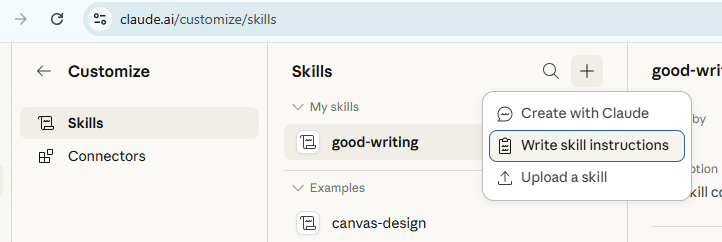
• Within the app, navigate to Customize > Skills and Create new skills
• Select add a new skill and Write skill instructions
• Copy and paste the copy from this file into the skill, making note of the name and description boxes. Feel free to tinker.
• Save your changes.
Note: The instructions in the linked file are Claude’s work, not mine. They came out of months of conversation, where Claude would analyze my style notes, and the file evolved from there. They read a little strangely because of that process. If I’d written them from scratch, they’d sound different. But looking at the file you can see what Claude responds to and how it works.
Claude will apply these instructions to every new conversation going forward. Existing conversations won’t pick up the change, so start a fresh chat to test it. If and when Claude struggles to apply the skill, call it out specifically in the prompt, such as, “Revise this for length using the good writing skill.”
The skill specifies constraints in a few categories and the instructions are plain text. As you go, you can also ask Claude to analyze previous conversations for suggested additions to the skill, which Claude will produce and implement within the chat. Each rule operates independently, so removing one doesn’t affect the others.
Claude processes custom instructions at the start of every conversation, before it generates any output. The instructions function as constraints on the model’s default behavior. The model doesn’t always follow every instruction perfectly and the results vary by task. You will still need to edit.
The move from a structuralist account in which capital is understood to structure social relations in relatively homologous ways to a view of hegemony in which power relations are subject to repetition, convergence, and rearticulation brought the question of temporality into the thinking of structure, and marked a shift from a form of Althusserian theory that takes structural totalities as theoretical objects to one in which the insights into the contingent possibility of structure inaugurate a renewed conception of hegemony as bound up with the contingent sites and strategies of the rearticulation of power.
This was my era in college, and I remember feeling challenged and overwhelmed as an undergrad trying to read theory for the first time. So today, I asked Claude.ai to put it in plain language, just to see what would happen. Here’s the after:
Scholars used to think that capitalism shaped society in consistent, predictable patterns. But newer thinking focuses on how power works—how it repeats, overlaps, and gets reshaped over time. This brought time into the picture and moved away from older theories that treated social structures as fixed. Instead, recognizing that structures can change opened up a new way of understanding power: it's tied to specific moments and strategies, and it's always being renegotiated.
“In short, decades of research have demonstrated that our political beliefs and behavior are thoroughly motivated and mediated by our social identities: i.e., the many cross-cutting social groupings we feel affinity with. And as long as we do not account for this profound and pervasive dependence, our attempts to address the epistemic failures threatening contemporary democracies will inevitably fall short. More than any particular institutional, technological, or educational reform, promoting a healthier democracy requires reshaping the social identity landscape that ultimately anchors other democratic pathologies.”
As always, this drives me back to Haraway’s cyborg, a useful metaphor for thinking about our political, environmental and social tangle and how it butts up against emerging tech and science. (In Haraway’s context, it was the rise of STEM as a driving force in academia at the dawn of the computer age.) Bagg’s argument lands in familiar territory for anyone who’s wrestled with the cyborg metaphor. Both reject the assumption that better information alone will save us from ourselves, whether from context collapse or the dualisms (binaries, heh) that structure how we think about technology, nature, humanity and politics.
Bagg arrives at something parallel from political science: We trust information that affirms the groups we belong to. (Business and marketing, for what it’s worth, tell us the same thing from a slightly different angle: you’re most likely to convert on a recommendation from a trusted friend. The next best thing in our current media landscape: a trusted influencer you identify with, which is why TikTok increasingly feels like QVC.) The problem isn’t that people lack access to truth, it’s that they’ve lost affinity with the experts, institutions and collaborative practices that produce expertise.
Both perspectives point toward the same conclusion: you have to recognize shared affinities through the slow work of creating conditions where people want to trust each other across differences.
Winer’s original script is pretty slick, and includes a list of all my feeds with titles, URLs, and categories; click-to-expand functionality to see the 5 most recent posts from each feed; clickable post titles that open articles in new tabs; sort options (by title or by update); and automatic updates when I change my FeedLand subscriptions.
The official documentation method didn’t initially work because Hugo (the blogging software behind micro.blog) was wrapping client-side templates around the script. The toolkit requires server-side dependencies that don’t exist on static sites like micro.blog, and we hit a cascade of missing JavaScript dependencies (jsonStringify, servercall, etc.). Each fix revealed another dependency, leading to some “sunk cost” frustrations for me. I kept trying because I wanted to see if Claude could pull it together. Through trial and error, I got to a point where the OPML file was rendered correctly without server dependencies or complex external libraries.
Time invested: ~3 hours (including wrong turns)
Time it should take: 10 minutes
AI extended my code reach beyond my practical skillset by quite a lot. I now have a dynamic and dedicated place to read and share news feeds as I wish. Though even when generative AI works and works well, I have significant concerns about the intellectual property implications of AI, and this project brought those tensions into sharp focus. The AI could only help me because it was trained on documentation and intellectual work from the open source community, contributions made freely in the spirit of knowledge sharing, not to train commercial AI systems. I tapped into their expertise by paying Anthropic $15 a month. While I’m grateful for the accessibility this provides to non-developers like me, I recognize there’s an unresolved ethical question about whether this use respects the intent and labor of the original creators. The feat is incredible; the foundation it’s built on deserves careful consideration.
After the exercise was complete, I asked Claude how I could have improved my prompting to make this process easier, and in short, Claude said I could have been a web developer. But since I’m not, here’s what it recommended:
✅ When the process isn’t working, question the process mid-stream. Most people either give up or keep following bad advice deeper into rabbit holes. Stop and question the LLM’s process and ask for alternatives to force a reset.
✅ Push for usability. Keep bringing the conversation back to what you actually need the end result to do, not what’s technically impressive or “correct.” In my case, this meant repeatedly asking “can I click through to the articles?” rather than getting lost in discussions about CORS proxies or JavaScript syntax. Focus on outcomes, not implementation details.
✅ Ask for complete solutions. Instead of trying to mentally patch together incremental changes across multiple responses, ask the LLM to provide fresh, complete code each time. This prevents copy-paste errors and ensures you’re always working with a coherent, tested solution. There’s more than one way to crack an egg, but you want the whole egg regardless.
After all that, I got it to work but can’t figure out how to make it show up in my header menu, with or without Claude. TBD.
While I’m cleaning up the cruft around my social presence, I’m finding more references to the heyday of blogging that explain how people organized online (Web 1.0) before the era of platforms (Web 2.0). One is this interview with Jill Filipovic, my one-time co-blogger and comrade at Feministe, with the folks at LGM who interviewed me on the subject a few years ago. Jill and I differed (and still do) on the meat of many issues, but have a lot of our thinking in common about how to handle disagreement and advance our ideas in common (and risky!) spaces. She’s welcome in my foxhole anytime.
I appreciate this oral history project by LGM because the articulation of our processes then (before automation) provides a lot of instruction about how to organize and think about communication outside of increasingly toxic and irresponsible social platforms today. One idea that is relevant today is around pluralism. In our case, we practiced pluralism on subjects and perspectives within a defined domain, “feminism.” In practice, making it work before true automation meant we lived with a lot of decision points around moderating a raucous community. Back then, we had our CMS and set up a list of community expectations, iterating as we went, then let the community rip. Collectively, this approach created a robust and vibrant interactive community of peers and moved our interests forward as a cohort. Between her interview, where she talks through the decision points we faced, and mine, where I talk more about the tools and their limitations, there is a lot for people who want to organize people digitally while thinking outside of the algorithm.
There are certain pieces of writing I return to when thinking about our relationship with technology. Donna Haraway’s “A Cyborg Manifesto,” published in 1985, is one of them. Despite being forty years old, it continues to offer insights into how we understand technology’s role in our lives.
Haraway used the cyborg, a hybrid of machine and organism, as a metaphor for understanding identity in an increasingly technological and scientific world. Her central argument was this: because the traditional boundaries we’ve relied on are breaking down with the rise of STEM, computers and factory automation, a tenuous new order is emerging, blurring the lines between human and machine, physical and digital, natural and artificial, gender and biology, moral and immoral. The world order was undergoing a remodel, the guys were designing the game board for the next era, and she worried that refusal meant catastrophic and strategic losses to research, creating the cyborg metaphor to challenge her cohort to consider her angle. Many women in academia resisted the political push for STEM, concerned about the impact on the humanities. This was critical stuff in the mid-1980s, especially in a global (and academic) context of collective civil rights struggle across very different coalitions, amid the science and all of its implications. She wrote it as a salvo appealing to fellow academic feminists not to be so skeptical of new and emerging computer technology that they lose on emerging opportunities. To her, the implication of these new technologies meant new political landscapes and platforms for discussion and iteration.
Haraway challenged the either/or categories that dominate these debates: online versus offline, human versus machine, authentic versus artificial, even good and bad. Instead, she proposed we’re already living in a world of hybrids and overlaps and contingencies and compromises, where identity and experience are shaped by our relationships with technology and science and capitalism rather than existing separately from it. Whether you wear glasses, take daily medicine, strum a guitar, drive a car, or regularly log into a device for work or leisure, our lives are heavily augmented by layers of tech already. Your cyborg self is already here. We are already deeply technical creatures, living in concert with machines.
Haraway invites us to dabble in the Matrix, to take off your trench coat and stay awhile, to see what it feels like in the moral relativism and ambiguity. Within this web of complexity lies a lot of opportunity.
Tl;dr: the cyborg metaphor is a permission structure and a thought exercise: Instead of asking if or whether to accept tech, she asks you to consider something more pragmatic, how your cyborg self might use and shape technology to assert your particular existence, politics and interests across the network. This is an if/then that is simultaneously empowering, cynical, dystopian, ironic and futurist, but allows us to set aside some limiting binaries and narratives when thinking about the specter of new technology.
I graduated from college right before the 2008 recession and bounced through some unpromising temp jobs until an opportunity emerged for a permanent position. Sometimes you just need to get in where you fit in, and so I did. That’s how I came to work for a regional cable company that used federal money to expand the new national broadband network, extending out to the rural communities dotting central Indiana.
It was a front row seat to the national broadband expansion efforts of the early 2000s. Our business ran right across the state, spanning the 80 or so miles from Attica to Kokomo, which included several small cities with large manufacturers, two public research universities, and several community and liberal arts colleges. The strip of broadband fiber at the core of our service followed existing highways and electrical lines that split the corn and soybean fields from town to town, feathering out to more rural areas from there.
I worked a variety of roles there that put me face-to-face with a classic technical problem: the last mile. On many occasions, someone would come in looking pensive, and explain that the fiber had been extended all the way from town to their hamlet, and yet there was no plan to connect their property to the pole. Over time the pattern was clear: while the network was expanded, the cost of running a physical line to each individual property was too expensive and specific at scale. These customers often left without a path forward despite all their efforts and ours.
The “last mile problem” refers to the logistical challenges and high costs associated with the final leg of delivering goods or services to the end customer. It’s often the most difficult and expensive part of the supply chain, despite being a relatively short distance. The pattern shows up everywhere: public transit can get commuters most of the way most of the time, but that final leg of the journey remains specific and individual and problematic. E-commerce companies promise drone delivery solutions, scooter and bike-share apps claim to solve urban mobility gaps, but these technological optimizations remain persistently stubborn at scale, running up against the messy realities of sidewalks, intersections, and actual human behavior.
Tl;dr: I’ve been turning over this suspicion that AI automation will hit a classic “last mile problem,” especially in the public sector.
AI systems, particularly LLMs, are like those systems—they work incredibly well in their intended domain, processing and manipulating information. But because they’re fundamentally an information-only approach, that creates their own last mile problem when we try to implement them in physical and context-specific environments. Public institutions are uniquely specific — they are often the originators and producers of knowledge and the keepers of original policy, tasked with making the rubber hit the road. Additionally, the need for comprehensive data protection required by public workers and institutions fundamentally hamstring potential applications.
Actually implementing recommendations is where you hit the last mile. This is the work of public administration.
Imagine an AI application trained on every facilities management manual ever written and tuned to synthesize best practices for HVAC optimization. It can analyze years of energy usage data and recommend precise temperature adjustments for different zones of a building, but can’t feel that the third floor is always stuffy, or know that the facilities manager retired last year and took decades of institutional knowledge with him. Building A’s HVAC system was installed in 1987 and has a manual keypad. Building B’s system interfaces with the campus-wide monitoring system, but unreliably, and investigation is slated for later, someday, when resources allow. Professor Smith has taught in Room 204 for 25 years and will blow up your spot before moving to a different classroom for maintenance. Your engineers who manage these spaces are balancing human teams, who have time off and training and other priorities they manage in life. So, you need staff who understand the quirks of each area, the history of each system, the politics of which departments will accept changes and which will flood your inbox with complaints. You need someone who knows that the third floor always runs hot because of a design flaw from 1974, and that the solution isn’t more precise control but a $50,000 renovation that’s been deferred for a decade because a glittering new project across campus takes priority.
Imagine this tangle of questions and contingencies times infinity on every university campus in existence. Universities are like cities—they’ve been built and rebuilt over decades or centuries, with layers of systems and fiefdoms that weren’t designed to work together. AI recommendations assume a level of standardization that simply doesn’t exist. Every AI implementation in higher ed requires navigating multiple constituencies with different priorities and power structures. It’s like trying to redesign traffic patterns in a neighborhood where the residents, business owners, commuters, and city planners all have veto power and conflicting interests.
So. When looking at efficiency efforts spinning up across the education sector, I’m feeling pensive, trying to understand how exactly the house gets connected to the pole.
The promise of new tech in higher ed needs to more deeply consider the translation costs: the human labor, institutional knowledge, knowledge documentation and local adaptation required to bridge between the usefulness of tech and specific realities of public university work. Public employees want modernization and don’t want to fall behind. We want systems that work. We are also balancing a great deal of change and pressure as a sector, with fewer material resources than ever. We need less marketing and more right-sizing in the claims around AI against the political and tech realities of public administration.
This disconnect between technological promise and implementation reality becomes even more critical as higher education faces increased political scrutiny. When tech vendors promise that AI will solve efficiency problems or reduce administrative costs, institutions are under immense pressure to deliver measurable results quickly. But the translation costs we experience don’t disappear just because the political pressure to modernize increases.
The institutions that thread this needle will be the ones that accurately assess these translation costs upfront and set expectations accordingly—not the ones that assume the technology will magically bridge the gap between digital and physical, abstract and specific.
As communications professionals in higher education, we work for institutions built on the pursuit of knowledge and innovation, yet many of us feel uncertain about how to thoughtfully integrate one of the most significant technological advances of our time: artificial intelligence.
Over the past year, my team has wrestled with questions that didn’t exist in our profession just a few years ago. Should we use AI to draft articles and email copy? How do we disclose AI-generated content, or do we? When does AI assistance cross the line from helpful tool to ethical concern?
These aren’t abstract questions any longer. Over the last year, I had to overcome AI resistance of my own to develop practical, hands-on approaches to AI use that align with our institutional values while acknowledging the realities of modern communications work (more on that below). What I’ve learned is that the answers aren’t found in blanket policies or rules, but in applying our existing professional ethics to these new tools. Here is where I am today on the journey from AI praxis to practice.
Mission first
The foundation of responsible AI use in our field starts with a principle we already know: everything we do should advance our institution’s educational mission. Higher education exists to create, share, and preserve knowledge while fostering critical thinking and diverse perspectives, in service of students, faculty, researchers, workers and the world.
The bulk of our work comes from conversations with colleagues, understanding of our campus dynamics and processes, and professional judgment about what our community needs to hear. This inevitably means more work upfront, but it maintains the authenticity and institutional knowledge that our audience deserves, regardless of whether AI tools are part of the process.
Transparency without paranoia
Do I need to mention AI every time I use it? The answer isn’t simple, but I’ve found a helpful framework: consider whether your audience would feel misled if they knew how AI was involved in creating the content.
When I use AI to polish grammar and shape format, that feels similar to using spell-check – it’s helpful but not something that changes the fundamental nature of the content we wish to communicate. But when AI helps generate the main structure for a story about campus policy changes, that’s a different ball game. The audience expects those priorities and framing decisions to come from human judgment about what matters to our community.
Internally, we differentiate between the two by defining whether or not you are “automating” processes using AI, or “augmenting” processes using AI. Full disclosure, my area of experience is in augmentation, not automation. That said.
I’ve started recommending simple disclosures when AI plays a substantial role in content creation. A line like “This article was developed with AI assistance” maintains trust while allowing us to thoughtfully benefit from these tools. It’s not about being defensive, it’s about being transparent with the people we serve, especially as the tech and attitudes around it evolve over time. Additional qualifications can be included here, such as how the information was shaped and shared by AI or not (privacy implications abound).
Here, it’s important to remember to only use your university-approved tools, because university enterprise AI tools are modified to meet campus rules and requirements related to data handling.
The accuracy imperative
Perhaps nowhere are the stakes higher than with accuracy. In higher education communications, we’re not just sharing information—we’re stewarding public trust in our institutions and, by extension, in higher education itself. In addition, much of the information we are communicating is original, in that it’s new information that cannot be generated using the limitless soup of generative AI.
Every piece of AI-generated content requires human verification, especially anything involving numbers, research findings, or claims about institutional achievements. This means checking sources, confirming statistics, and ensuring that quotes are accurate and properly sourced. It’s more work, but the alternative—publishing incorrect information—could undermine years of relationship-building with community stakeholders and partners.
The promise of speed and efficiency that comes with generative AI must be balanced with the work of close reading, the skill and practice of carefully analyzing a passage’s language, content, structure, and patterns in order to understand what a passage means, what it suggests, and how it connects to our larger body of work. I firmly believe that close reading, learned in the Humanities and Social Sciences, will become increasingly important to understand, shape and steer AI output, especially with regard to public communication best practices.
Inclusion as a practice
AI bias isn’t an abstract concern—it shows up in subtle but significant ways in the work. I’ve noticed that AI tools often default to formal, academic language that might exclude first-generation college students, or suggest examples and metaphors that assume certain cultural backgrounds, for example.
This has made me more intentional about prompt engineering—the way I request AI assistance. I build digital accessibility and plain language best practices into my prompts, in alignment with institutional best practices. One tip is to draft the original using my chosen, intentional language, then ask for revisions using as much of the original verbiage as possible. The difference in output is significant and it allows me to focus on higher-order communication strategy while demonstrating both accuracy and inclusive values in our output.
Privacy and the long view
Working at a public university means balancing transparency with appropriate privacy protections. We work within strict guidelines about what information can be included in AI prompts, particularly around student data, personnel information, and strategic planning discussions. Again, it’s important to only use your university-approved tools, because university enterprise AI tools are modified to meet campus rules and requirements related to data handling.
The challenge is that AI tools work best with context, but providing that context can sometimes mean sharing information inappropriately. I’ve learned to be creative about how I frame requests to AI tools—giving enough context for useful output while protecting sensitive information about individuals and institutional operations.
I focus AI prompts on publicly available information rather than including details from internal planning discussions or individual faculty concerns. It requires more thoughtful preparation, but it ensures we’re protecting appropriate confidentiality.
Speed vs. strategy
The efficiency of AI is seductive, especially when facing tight deadlines and endless communication requests. But I’ve learned that speed can’t come at the expense of quality or authenticity.
Authentic institutional voice and authority doesn’t emerge from algorithms—it requires the deliberate application of human judgment to ensure our plans and communications reflect our campus culture, embody our values, and resonate with our specific audiences. The strategic thinking we bring—our ability to read context, navigate relationships, and understand the subtle dynamics of higher education communication—cannot be automated.
Consider my own practice: I frequently engage AI as a collaborative thinking tool, particularly for structural planning and format development. However, AI’s default tendency toward comprehensive, multi-layered approaches often produces unnecessarily complex frameworks for university communication realities. This is where professional judgement becomes critical. Strong strategic foundations and institutional knowledge allow us to right-size AI’s expansive suggestions into focused, contextually appropriate communication plans that actually serve our goals and communities.
Looking ahead
What I’ve learned over this past year is that responsible AI use isn’t about following a rigid set of rules. It’s about applying the professional ethics we already have to new technological capabilities. The core principles that guide good communications work—accuracy, transparency, service to mission, respect for audience—remain the same.
What’s different is that we now have tools that can enhance our ability to live up to those principles, if we use them thoughtfully. AI can help us communicate more clearly, research more efficiently, and reach broader audiences. But only if we maintain our professional judgment about when, how, and why to use these tools.
As our field continues to evolve, I’m convinced that the communications professionals who thrive will be those who can harness the power of AI while maintaining the human insight, ethical judgment, and institutional knowledge that define excellence in our profession. The technology will keep changing, but our commitment to serving our institutions and communities through ethical, effective communication remains constant. That’s the foundation we build on, whether we’re writing with pen and paper, collaborating in a digital document, or prompting the most sophisticated AI tool on campus.
*This post reflects my ongoing learning about AI ethics in communications practice and was generated using the assistance of AI (Claude, Gemini). Cross-posted on LinkedIn.
The internet says Joann fabrics is going to declare bankruptcy, putting a huge market of individual crafters without access to in-person retail craft spaces into a tailspin. It’s likely they will ask their creditors to restructure their debt, making them able to keep some stores open. The whole market relies heavily on in-person shopping (it’s a textural and sensory shopping experience, which is the point!) and hasn’t pivoted well to e-commerce.
This is one of my favorite pet subjects. Globally, the arts and crafts market overwhelmingly caters to women and children and it’s HUGE, commanding a very dedicated and loyal customer base. And still, it struggles.
Despite an influx of crafters during the shutdown, retail craft stores have struggled to strike a balance between sustainable e-commerce and in-person retail strategies. Other issues: For months after the pandemic, the Joann’s in my neighborhood struggled to keep the place stocked and staffed, exacerbated by skyrocketing shipping costs and shifts in the retail worker market after the shutdowns. Kids went back to school, cooling the market for arts and crafts activities on which to spend their time. And with lagging incomes and cost of living increases eating into people’s spending money, customers just don’t have the bandwidth they may be used to.
In my experience, customers don’t love shopping at a Michaels or a Joann’s, but they appreciate the ability to get what they need, mostly on demand, and to do so in-person where you can handle the materials before you buy them. Fiber arts people, for example, put a lot of importance on the weight, texture and color of their tools and materials - and for good reason! Pleasant tools make for a pleasant experience - and for pleasant outcomes. Indie retailers corner this market by keeping inventory low, building relationships with customers, creating affinity using social media marketing and by nurturing community with digital learning and forums. Crafters from around the world can share tricks, tools, patterns and finished items with like-minded people. The large-scale retailers can’t compete with that and haven’t really tried.
It’s unclear what’s next, but I’m thinking of all the people who live in places that can’t sustain a standalone fabric or yarn store. Rural makers can sometimes find tools and materials in resale markets like Facebook Marketplace, and sometimes you can find decent stuff at the local flea, or at specialty shop, such as a small machine repair shop that works on sewing machines. A lot of those folks won’t have a store to go to, and will have to travel to shop in person or resort to online retailers that don’t meet their needs.
After a stint as an English major and as a writer myself, I got into a habit of reading dozens of articles a day instead of longer form writing: books. I spent a lot of energy in 2023 getting back to books. Thanks to a great book club (you know who you are) and making space to settle in with a great book in a cozy spot, here are my favs from 2023:
I’ve followed Potts’ career since she was a student blogger turned journalist in the aughts, so seeing her publish this book was a little personally gratifying, too. Potts brings her reporting background to this memoir about coming of age in Arkansas, one of the poorest, reddest states, with lengthy explorations of the economic and social policies that create conditions in which women struggle to thrive. She compares her childhood against a friend who didn’t get out of dodge, and explores what makes the difference in areas where people get left behind.
I really enjoyed this read for so many reasons, and was pleased that Potts’ voice is empathetic, smart and searching despite the challenging material. A mix of memoir and sociology. Very recommended.
In the roaring twenties, my home state of Indiana was a hotbed of racist activity. The KKK rose to their peak power with something like one in three adult Hoosiers counting themselves among their ranks, by leveraging evangelical churches, law enforcement, and local politicians to curry influence and power. This is ultimately a story about a deathbed testimony that broke the spell, when the telling of the Grand Dragon’s secrets, cruelties and perversions finally brought a public reckoning with the Klan.
📚 Barbara Kingsolver, “Demon Copperhead”
Like Dickens did with “Copperfield,” Kingsolver does with “Copperhead.” This novel explores how institutional poverty harms children, set in an American South that, frankly, felt familiar coming from the lower Midwest. It lives up to the hype and was vindicating and familiar. I listened to this audiobook on a long road trip and the narrator nailed it.
(I forgot how much I love Kingsolver. I finished this and turned around and reread “Poisonwood Bible” - about the hubris of American missionaries in Congo - on a camping trip. It holds up.)
Yanno, I didn’t think this would be on my list either, but here we are. Come for the juicy tell-all, stay for the damning details on how Britney’s abusive father, codependent mother and opportunist sister ensnared one of the world’s biggest stars into an abusive conservatorship and stole her time, money and autonomy. Consider at length why we ask young starlets to run through these gauntlets in exchange for our attention. It’s neither the complete portrait of the artist nor the feminist manifesto I wish it was, but I came away from it with more empathy and respect for her and what horrors she’s weathered right under our noses. It’s giving “Yellow Wallpaper,” but pop. Free Britney.
📚 Patrick Radden Keefe, “Empire of Pain: The Secret History of the Sackler Dynasty”
This is a giant tome of a book that nevertheless provides a riveting and thorough history of who knew what when and why it matters. It’s also a study of impunity among the super-rich, and how their money and influence reaches into the public commons. It turns out a lot of modern fiction deals with addiction, opioids in particular, so this became a foundational book for a lot of other reads on this year’s list.
If you don’t want to read the book, but want to know more about the Sacklers and their terrible, coercive global influence, don’t miss the documentary “All the Beauty and the Bloodshed,” which follows artist, activist and addict Nan Goldin as she fights against and grieves for all that opioids have taken from her, and from us. It’s a beautiful testament to art, community and the disenfranchised - and currently streaming on MAX.
I’m building my list for 2024, so let me know what you recommend!
Despite being from Indiana, I feel like I’ve heard very little about this book, which covers the rise of the Indiana KKK in the early 1900s. The book’s central story revolves around the Grand Dragon, a bad man whose bad acts finally land him in enough trouble that the powers that be couldn’t ignore his non-KKK activities any longer. The point, however, is that they ignored most of his activities because institutional power was both in the Klan’s pocket and was leveraged to recruit members up and down the state. Egan takes a powerful, uncomfortable look at how the KKK organized white, Protestant people against everyone else using social and professional organizations and churches, and how they helped shape neighborhood vigilantes into police forces tasked with protecting property and morality.
Fellow Hoosiers will recognize a lot of familiar names, towns and players. That photo in the NYT book review was taken in Marion, Indiana, for example. I’m finishing up an anecdote that takes place in Logansport. New Castle, Muncie, Ft. Wayne, Terre Haute are also places of interest. A reader on Twitter reminded me that the KKK tried to purchase Valparaiso University, once one of the most prestigious private universities this side of the Mississippi. Examples abound. It’s unsurprising to read that Indianapolis was nearly taken over by the Klan in the 1920s, considering how many in the statehouse openly endorse exclusionary opinions today.