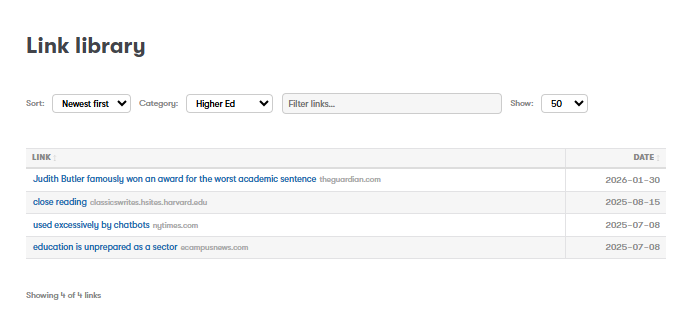
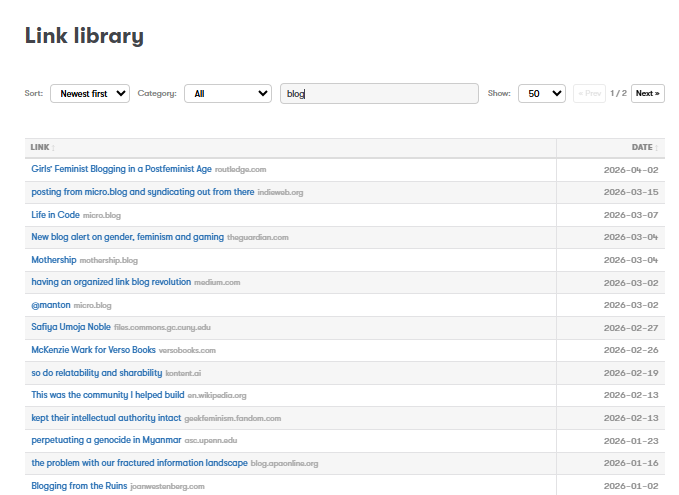
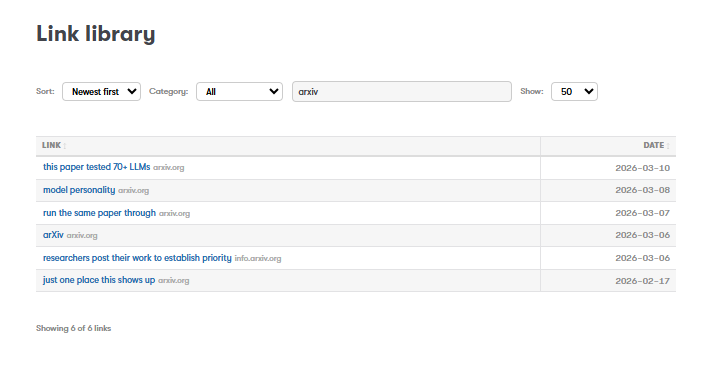
Testing a new feature I created using a mix of open source code and Claude, hoping I didn’t break my own site. I pulled together a dynamic link library using a Hugo partial and some shortcode that automatically catalogs all of my outbound links into sortable lists.
Both books were published on March 10, and both authors are talented, with impressive bylines, with significant followings baked in. Incidentally, they come from the same cohort we loosely refer to as “feminist blogging,” though both would probably bristle at the description. And both use autoethnographic methods to leverage their personal lives to tell bigger stories about social, cultural and economic dynamics (a common method among feminists, where the personal is often made explicitly political). Lemieux goes further by including a series of essays by other Black single mothers at the end of her book, expanding the frame from memoir into something more collective, a full bloom.
West’s book has gone ultra viral over the last few weeks while Lemieux’s has found significantly less footing. West’s work is being spectacularized in real time, while Lemieux’s support has been mostly grassroots, respectful (thankfully), and largely limited to Black media outlets and NPR. This reproduces one of the oldest patterns in feminist media: a white woman’s confessional work circulates as universal or spectacular (West is being treated like a spectacle currently, which is great for sales and visibility but comes with negative trade-offs), while a Black woman doing rigorous, arguably more structurally ambitious work gets categorized as niche, an outlier. That this is happening within the very audience that would generally name and critique this dynamic in any other context makes it worth sitting with.
While I respect both authors and their bodies of work, I am looking forward to Lemieux’s book because I know firsthand how difficult it is to get a publisher and an audience for serious, foundational work like this. I suspect it will prove relevant long after the viral moment is over.
Rapper Afroman is going ultra viral this week as his “Lemon Pound Cake” trial plays out in the news. He captured the raid on security cameras in his home and used the footage in a series of songs, videos and merch. He ultimately did not face charges after the search, and argues (with evidence) that the police broke his door and stole $400, which provides the platform and substance for everything that followed. He argues the police shouldn’t have been there at all, and didn’t follow protocol when they were, and that as a citizen and artist he’s expressing his feelings about it in his preferred medium. Is this a winning legal strategy? Time will tell.
In the meantime he’s winning at public opinion. The trial is shaping up in the public view as a defamation vs. free speech trial, with the artist’s prolific work about this no-knock raid performed at his house, itself arguably unethical, held up as harassment by the officers who did the job. True crime, legal experts and court watcher accounts are going gangbusters providing cultural and legal analysis alongside video of court testimony. It helps that the court footage is a rich text — both hilarious and revealing.
NYT on the trend of “Luddite teens.” I have a growing suspicion that various neo-Luddist trends will largely map to class identity. In some areas of the world, in some areas of the US, Facebook is the internet, yellow pages and water cooler, and the internet experience is entirely mediated by apps.
One of the more useful things you can do with an LLM is hold up a few ideas side by side and apply lenses to them. I know this history pretty well, so I asked a series of LLMs, why is Wisconsin’s cultural identity and cohesion stronger than Indiana’s, from a historical and business perspective?
Each LLM will give us more or less the same story, different flavor. Within the industry, the differences across the models reflect “model personality.” Asking “why” instead of “whether” will probably drive the answer to favor Wisconsin. Using multiple lenses (two states, historical + business, identity + cohesion) forces the LLM to cross-reference across more of its training data, which tends to produce a more comprehensive answer.
Functionally: all of them acknowledge hard historical truths within the subject matter and don’t shy away from critical perspectives, which is good. Both Gemini and Copilot include in-line links, which lets you judge the output’s authority in the moment as a reader. I liked Copilot’s more than I expected here. Claude’s answers are more lyrical and do provide more context, and yet do not encourage checking against outside sources by providing links within the output. And you can see that even with the good writing skill calling out hard bans on certain structure, Claude plows right through them.
Model personality: Claude favors sociological answers to Copilot’s economic answers. Claude is also highly intellectual and narrative by comparison, and that narrative style can mask nuance by sinking relative context within the storytelling. Gemini simplifies, boosts and cheerleads where the others don’t, and really goes hard on Wisconsin’s reputation as a drinking and Packers state when there are stronger structural arguments in play. Copilot is tricky because it looks authoritative like a briefing, which also makes it easily “extractible” for the user, but every citation requires authentication unless this is one of those “good enough” tasks.
As a writer, something I find annoying across the whole spread is the semantic reveal. LLMs are semantic machines, and it is persistently revealed in ways that are weird to the human ear. All of them go out of their way to describe things as “structural,” “connective” as in “connective tissue,” “load-bearing” and “legible.”
Finally, I included a second tab where I asked Claude for analysis across the four outputs, where it suggests that my framing of the question is altogether kind of problematic. It shows how a strong prompt is sometimes also a bad approach.
There are a lot of possible takeaways here, but I’d rather set aside the question of which tool is “good” or “bad” or “better” and think more about the patterns across the tools and their implications.
A note on Ezra Klein: I’ve been looking across the NYT’s breathless reporting on the AI industry and seeing very few women represented across the commentary. Klein’s tech coverage tends to center a fairly narrow circuit of sources: founders, researchers, and policy thinkers who are overwhelmingly male and concentrated in a few institutions, and generally assert the inevitability of disruptive AI as a matter of course. Meanwhile, Anthropic and others are anticipating that career ladders where women are concentrated will be impacted, some claiming professional women’s jobs will dry up or disappear entirely.
I looked over his podcast guests for the last year and noticed that among his tech-focused guests, almost all white, almost all men, almost none of them are women. A rough count of eight podcasts (nine if you stretch) with accompanying commentary only produced two women, both economists. Klein’s brand is the guy who does the reading, the big ideas guy. So it’s worth asking what he’s reading and whose ideas he considers big. While he probably wouldn’t disagree with Gebru or Crawford or Noble on the substance, his current body of commentary is pulled toward the perspectives of people who have the most to gain from the technology’s expansion and the least exposure to its costs.
One of the tricky things about consumer AI tools like Claude and Gemini is that the experience varies widely depending on the person using it, and it’s not always clear why. I have spent a lot of time learning the tools so I can advise on them in my work, and this variance of experience has become a frustrating part of the deal.
I manage a team of writers and creatives at work, and we are expected to be familiar with the tools, despite complex and sometimes hostile feelings about the political and environmental implications of this sector. That’s quite a pickle, organizationally, managerially. Borrowing from Haraway, I thought, okay, what if we take these tools seriously as a team of writers and creatives and put our professional standards up against them?
Among other exercises, I did a couple of comparisons on my team that help create discussion around the “plausibility” question. People dismiss LLM outputs as being merely plausible answers, rather than accurate or factual ones. And that’s correct; they are, and that’s the design. In many cases, plausibility is fine. Take Wikipedia, for example, which we understand to be a pretty good source, a plausible source, unless you’re writing a formal paper requiring original sources.
I digress. Ultimately, we needed to understand together that LLMs are not a WYSIWYG tool and talk through the implications.
I asked everyone to run the same paper through their LLM of choice, prompting it for a plain language summary. We then copied and pasted it into a shared doc, and compared and contrasted for discussion. Upon discussion, we had several takeaways, including that they were all similar in spirit but sometimes varying wildly in style and approach.
Knowing that algorithms are responsive and not static, we did it again later in the day and copied and pasted our outputs into the shared doc. We compared and contrasted the difference between AM and PM. Again, it was similar in spirit but varied in style and approach. Some changed dramatically. One team member whose morning summary had been jokey and conversational received a much more staid and serious version in the afternoon.
At the time, I asked Claude to explain the variance: “Even with the same prompt and source material, LLMs don’t produce identical outputs each time. This is by design — there’s a degree of randomness (called “temperature”) in how the model selects words, which means each run produces a slightly different path through the text.”
Anyway, this got our gears turning on how (and whether) to approach LLMs as a team and as individuals and led to good group discussion. (It’s important to create space for criticism and critical approaches here.) It also gave us more confidence as a team responding to this new layer of complexity in our work, and helping our professional contacts and peers think about how to approach the tools and when and whether to use them. There will be tasks where AI-based tools are “good enough,” and tasks where they are not.
The swirl of mystery and speculation around this sector has people up in arms, and it’s useful to have approaches that give people firsthand experience and to see how the experience works for others. The god trick of the singular interface turns out to be a bear for navigating it in the workplace, where our work is foundational, prosocial and specific.
She draws on Acemoglu and Restrepo’s concept of “so-so” technologies and traces a pattern from MOOCs to DOGE, where each iteration promises transformation but delivers incremental improvements at best and labor displacement at worst. The real danger, she argues, is that AI’s most compelling use case in the current political environment is threatening, demoralizing workers and justifying cuts, not revolutionizing how work gets done.
Cottom has been one of the writers I keep returning to because she is not dismissing the technology or retreating into reactionary nostalgia. She looks past the product announcements to the political economy underneath them. Who benefits from the hype cycle? What happens to the institutional infrastructure (education, research, public expertise) that AI claims to augment and simultaneously threatens to starve? She’s also very active on Instagram (and promoting a new documentary) and tracing the news around AI and higher ed in real time.
LLMs have a default house writing style with identifiable patterns: sentence fragments for emphasis, “not X, but Y” constructions, lots of hard contrast, atmospheric openings, heavy use of em dashes, and heavy use of marketing language. This reflects the semantic construction of an LLM. Custom instructions can override these defaults. A custom skill is a set of instructions within your account that modify how the model generates text. When you paste instructions into your profile settings, Claude reads them at the start of every conversation and adjusts its output accordingly.
I began using Claude daily for light writing tasks about six months ago, and over that time I started cataloging the patterns I was consistently editing out, including the terrible “not X, but Y” construction that showed up in nearly every response, and persistent em dashes used as all-purpose connectors when other punctuation is more appropriate.
I went through several iterations of bullying Claude into submission, narrowing the scope each time, before arriving at this version, which focuses specifically on writing mechanics and hard prohibitions.
You’ll need a paid Claude plan (Pro, Max, Team, or Enterprise). Free-tier accounts don’t have access to custom skills.
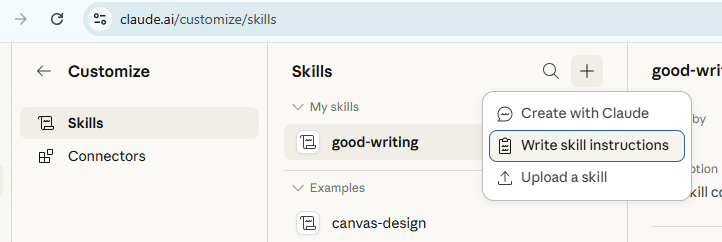
• Within the app, navigate to Customize > Skills and Create new skills
• Select add a new skill and Write skill instructions
• Copy and paste the copy from this file into the skill, making note of the name and description boxes. Feel free to tinker.
• Save your changes.
Note: The instructions in the linked file are Claude’s work, not mine. They came out of months of conversation, where Claude would analyze my style notes, and the file evolved from there. They read a little strangely because of that process. If I’d written them from scratch, they’d sound different. But looking at the file you can see what Claude responds to and how it works.
Claude will apply these instructions to every new conversation going forward. Existing conversations won’t pick up the change, so start a fresh chat to test it. If and when Claude struggles to apply the skill, call it out specifically in the prompt, such as, “Revise this for length using the good writing skill.”
The skill specifies constraints in a few categories and the instructions are plain text. As you go, you can also ask Claude to analyze previous conversations for suggested additions to the skill, which Claude will produce and implement within the chat. Each rule operates independently, so removing one doesn’t affect the others.
Claude processes custom instructions at the start of every conversation, before it generates any output. The instructions function as constraints on the model’s default behavior. The model doesn’t always follow every instruction perfectly and the results vary by task. You will still need to edit.
This new report from Anthropic is depressing at best, as it tries to measure which employment sectors carry the most exposure around AI expansion into the economy. In short, the tech is likely to impact two groups the hardest: educated professional women, and young workers for whom the career ladder will never materialize. In a right-side-up world, this would change the political dynamics of any policy response considerably. In this one, I don’t know.
Anthropic’s positioning here is curious, very god tricky. They are claiming the mantle of responsibility and transparency while predicting an inevitable end nobody wants, that they’re also selling as a service.
I still think much of the forecasting is oversold – the tech performs well in optimized environments, and last mile issues are a perennial concern in any engineering venture because the practical world is non-optimal. Time will tell, and there are big incentives in play. But the hunger and animus around the forecast feel bad.
You might call this a taste test: Obsessed with the story about the McDonald’s CEO and how his LinkedIn-style videos selling the McD’s franchise have escaped containment, leading to one of the funnier CEO/product marketing dynamics in recent history. Burger King’s CEO swooped in, holding widely-marketed listening sessions with customers and to demonstrate his love for the Whopper in contrast with the deeply weird McD’s videos. Must read: Internet long-hauler Katie Notopoulos on how direct-to-public marketing works when the public is more familiar with the product than the org’s leaders.
My teenager thinks fast food is cool and subversive (cue the sound of one hundred moms groaning) and she and her friends regularly talk shop. They are Taco Bell fans and think burger stops are kind of gauche. Not gauche: Baja Blast.
The last time I went truly viral was in April of 2020 in the height of the COVID shutdown. I posted a tweet and walked away from my phone. By the time I checked back, my notifications were out of control.
The next morning, I got a message from an old friend familiar with my handle. “I think I saw your account on Good Morning America?” Hilariously, there I was, and I couldn’t even claim responsibility for the meme.
I’ve spent most of my time on the internet as a pseudonymous account, using my first name only, or using a handful of handles (incl feministe, fauxrealtho, flotisserie, paired with punny names like “Petty White” and “Frieda People,” a convention from the Tumblr years). Even as a visible personality online, I was only known by my first name and URL and/or handle. In recent years I de- and reactivated some of my socials, so some of these breadcrumbs no longer exist, but I’ll do my best.
Pseudonymity allows writers to explore complex ideas in digital spaces while protecting their identity, location, and other identifying factors, while also maintaining a throughline of identity and storytelling.
There are a lot of trade offs in using a pseudonym, especially around how to claim credit for your work. But people use them because they give you the privacy to be honest, real, weird, authentic, and to escape the creep of modern social media presence into high stakes spaces like the workplace. This dynamic was kind of the impetus behind the era of “weird Twitter,” where people using pseudonymous social handles routinely threw out funny, absurdist one-liners to impress their friends and followers, while taking a turn at the social media slot machine. Not every post or joke lands in a way that converts to numbers, but some do, and it’s fun to try.
I’ve written a little previously about how the English program I was a part of used fiber arts to illustrate the fundamentals of technical writing, but one of their other methods of teaching the internet was through board games. Games, like the internet, and much like writing, provide rules and structure for communication and engagement, but everything that happens inside the container of game board and game play is a mystery until it emerges through human interaction. So goes the internet (and to some extent, so goes AI). Games and gaming were used as a method to think through what it means to create rules of play, then let a community rip through the model – and many of the thinking and skills involved around game design apply in social digital spaces, from chat rooms and Teams channels to the open seas of the WWW. The longer you’ve been playing the slot machine, the more you get a feel for the kind of thing that will get seen and read, and who among your readership will take your content to the next level.
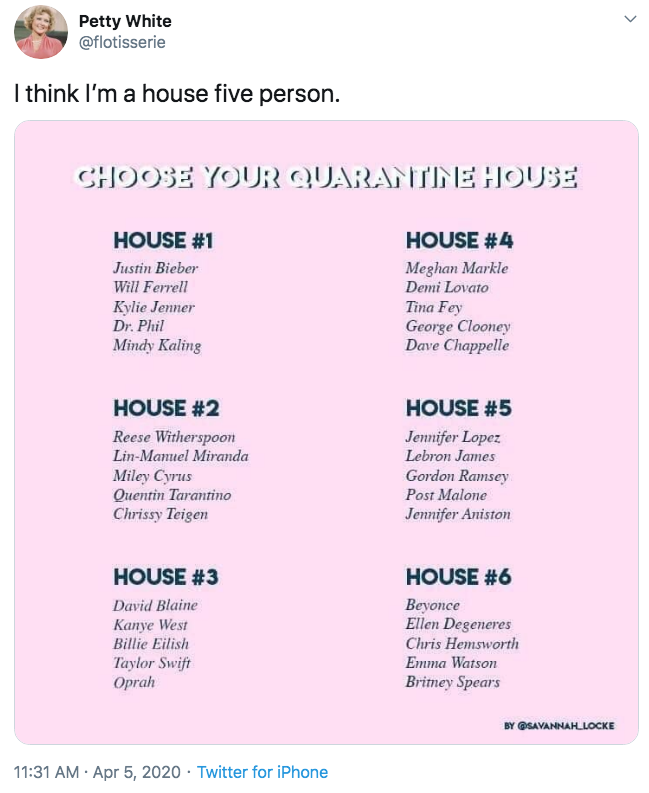
The meme was a list of six hypothetical celebrity households: pick one to quarantine in.
It had been circulating on Facebook, started by a Christian influencer named Savannah Locke. I encountered it deep in a Real Housewives fan group, and felt the pull of a good parlor game. In April 2020, everyone I knew was sitting at home, fretting about the COVID-19 pandemic looming over all of us, so I shared it with minimal ceremony, a couple of buddies with a slightly larger following hit retweet, and within two days the tweet was being cited by The Cut, Time, the Washington Post, CBS, and others. Know Your Meme documented it for posterity. Several outlets named me as the originator, but trust, I was only trying to delight my friends with low grade Facebook content. I couldn’t find the original meme at the time – Locke appears to have had a name change that scrambled my search. But hey, as these things go, nobody earned a dime or promoted anything weird, so no harm, no foul. Business Insider managed to credit it correctly, so a special kudos to their editor.
The core game mechanism behind the meme is forced choice: constraints generate opinions and opinions generate activity. Each “house” also represents a personality type. House 3 is chaos, House 6 is aspirational, House 5 is the one where someone is definitely cooking and someone is definitely yelling about it. The choices are arbitrary, which invites curiosity about who grouped what and why. In short, this meme offered a light conversation starter at the right time, with low stakes, high personal reveal, and endlessly discussable combinations. It also drew from existing memes and games that are popular online, like “where you sitting” in the proverbial lunch room. This one became news because of the timing and gamability, not because I was particularly clever, but hey.
What does it feel like to go so viral? It’s hilarious, strangely affirming, and also a little crazy-making. It opens the door to a whole lot of wild people and ideas on the internet, not all of them flattering or welcome. Virality is sometimes paired with incredible harassment and requires “more condolences than congratulations.” But as far as this particular experience went – hilarious, whoops, and wow. It just felt like a Lebron James, Post Malone and Jennifer Aniston hang would be a good time.
Tiktok is not much better or worse than other major social platforms, I say. The primary arguments against TikTok, including data collection, algorithmic manipulation, potential foreign government access, addiction and influence on public opinion, apply with equal or greater force to American platforms. Meta has faced billions in fines for allowing privacy violations, enabled documented election interference, and its algorithms have been linked to mental health harms and the amplification of extremist content globally, including perpetuating a genocide in Myanmar. Google and other domestic platforms vacuum up vastly more user data with fewer restrictions.
The distinguishing factor isn’t the behavior but the ownership: TikTok’s parent company ByteDance is subject to Chinese law and intelligence relationships, while Meta and Google are subject to U.S. law and intelligence relationships. That’s a legitimate policy distinction, but rarely articulated honestly. Instead, the debate has been framed around purportedly unacceptable harms that American tech companies perpetrate routinely, creating a kind of security theater that lets domestic platforms escape equivalent scrutiny while positioning a foreign competitor for a forced sale or ban.
The TikTok deal means American users will see a US-only algorithm. Brands and creators will likely see smaller audiences and higher costs for domestic reach. ByteDance faces split algorithms, divided workforces and parallel governance, complicating product delivery across global markets.
“In short, decades of research have demonstrated that our political beliefs and behavior are thoroughly motivated and mediated by our social identities: i.e., the many cross-cutting social groupings we feel affinity with. And as long as we do not account for this profound and pervasive dependence, our attempts to address the epistemic failures threatening contemporary democracies will inevitably fall short. More than any particular institutional, technological, or educational reform, promoting a healthier democracy requires reshaping the social identity landscape that ultimately anchors other democratic pathologies.”
As always, this drives me back to Haraway’s cyborg, a useful metaphor for thinking about our political, environmental and social tangle and how it butts up against emerging tech and science. (In Haraway’s context, it was the rise of STEM as a driving force in academia at the dawn of the computer age.) Bagg’s argument lands in familiar territory for anyone who’s wrestled with the cyborg metaphor. Both reject the assumption that better information alone will save us from ourselves, whether from context collapse or the dualisms (binaries, heh) that structure how we think about technology, nature, humanity and politics.
Bagg arrives at something parallel from political science: We trust information that affirms the groups we belong to. (Business and marketing, for what it’s worth, tell us the same thing from a slightly different angle: you’re most likely to convert on a recommendation from a trusted friend. The next best thing in our current media landscape: a trusted influencer you identify with, which is why TikTok increasingly feels like QVC.) The problem isn’t that people lack access to truth, it’s that they’ve lost affinity with the experts, institutions and collaborative practices that produce expertise.
Both perspectives point toward the same conclusion: you have to recognize shared affinities through the slow work of creating conditions where people want to trust each other across differences.
The CEO of Instagram says that social media platforms will be under mounting pressure to help users tell the difference between human-made and AI content, and that going forward, it will be more practical to label real content over AI.
I suspect these three trends are connected: Women reportedly use AI at significantly lower rates than men—25 percent lower on average—in part because they’re more concerned about ethics, including privacy, consent and intellectual property. At the same time, countries with more positive social media experiences tend to be more open to AI, while Americans’ distrust is shaped by years of watching tech platforms erode trust. Meanwhile, one of the largest social platforms has turned its AI chatbot into a harassment tool—generating roughly one nonconsensual sexualized deepfake image per minute, disproportionately targeting women and girls.
When platforms enable abuse at scale, it makes sense that people most likely to be harmed would be most attuned to ethical concerns, and would thus be the most cautious about AI adoption.
Winer’s original script is pretty slick, and includes a list of all my feeds with titles, URLs, and categories; click-to-expand functionality to see the 5 most recent posts from each feed; clickable post titles that open articles in new tabs; sort options (by title or by update); and automatic updates when I change my FeedLand subscriptions.
The official documentation method didn’t initially work because Hugo (the blogging software behind micro.blog) was wrapping client-side templates around the script. The toolkit requires server-side dependencies that don’t exist on static sites like micro.blog, and we hit a cascade of missing JavaScript dependencies (jsonStringify, servercall, etc.). Each fix revealed another dependency, leading to some “sunk cost” frustrations for me. I kept trying because I wanted to see if Claude could pull it together. Through trial and error, I got to a point where the OPML file was rendered correctly without server dependencies or complex external libraries.
Time invested: ~3 hours (including wrong turns)
Time it should take: 10 minutes
AI extended my code reach beyond my practical skillset by quite a lot. I now have a dynamic and dedicated place to read and share news feeds as I wish. Though even when generative AI works and works well, I have significant concerns about the intellectual property implications of AI, and this project brought those tensions into sharp focus. The AI could only help me because it was trained on documentation and intellectual work from the open source community, contributions made freely in the spirit of knowledge sharing, not to train commercial AI systems. I tapped into their expertise by paying Anthropic $15 a month. While I’m grateful for the accessibility this provides to non-developers like me, I recognize there’s an unresolved ethical question about whether this use respects the intent and labor of the original creators. The feat is incredible; the foundation it’s built on deserves careful consideration.
After the exercise was complete, I asked Claude how I could have improved my prompting to make this process easier, and in short, Claude said I could have been a web developer. But since I’m not, here’s what it recommended:
✅ When the process isn’t working, question the process mid-stream. Most people either give up or keep following bad advice deeper into rabbit holes. Stop and question the LLM’s process and ask for alternatives to force a reset.
✅ Push for usability. Keep bringing the conversation back to what you actually need the end result to do, not what’s technically impressive or “correct.” In my case, this meant repeatedly asking “can I click through to the articles?” rather than getting lost in discussions about CORS proxies or JavaScript syntax. Focus on outcomes, not implementation details.
✅ Ask for complete solutions. Instead of trying to mentally patch together incremental changes across multiple responses, ask the LLM to provide fresh, complete code each time. This prevents copy-paste errors and ensures you’re always working with a coherent, tested solution. There’s more than one way to crack an egg, but you want the whole egg regardless.
After all that, I got it to work but can’t figure out how to make it show up in my header menu, with or without Claude. TBD.