The last time I went truly viral was in April of 2020 in the height of the COVID shutdown. I posted a tweet and walked away from my phone. By the time I checked back, my notifications were out of control.
The next morning, I got a message from an old friend familiar with my handle. “I think I saw your account on Good Morning America?” Hilariously, there I was, and I couldn’t even claim responsibility for the meme.
I’ve spent most of my time on the internet as a pseudonymous account, using my first name only, or using a handful of handles (incl feministe, fauxrealtho, flotisserie, paired with punny names like “Petty White” and “Frieda People,” a convention from the Tumblr years). Even as a visible personality online, I was only known by my first name and URL and/or handle. In recent years I de- and reactivated some of my socials, so some of these breadcrumbs no longer exist, but I’ll do my best.
Pseudonymity allows writers to explore complex ideas in digital spaces while protecting their identity, location, and other identifying factors, while also maintaining a throughline of identity and storytelling.
There are a lot of trade offs in using a pseudonym, especially around how to claim credit for your work. But people use them because they give you the privacy to be honest, real, weird, authentic, and to escape the creep of modern social media presence into high stakes spaces like the workplace. This dynamic was kind of the impetus behind the era of “weird Twitter,” where people using pseudonymous social handles routinely threw out funny, absurdist one-liners to impress their friends and followers, while taking a turn at the social media slot machine. Not every post or joke lands in a way that converts to numbers, but some do, and it’s fun to try.
I’ve written a little previously about how the English program I was a part of used fiber arts to illustrate the fundamentals of technical writing, but one of their other methods of teaching the internet was through board games. Games, like the internet, and much like writing, provide rules and structure for communication and engagement, but everything that happens inside the container of game board and game play is a mystery until it emerges through human interaction. So goes the internet (and to some extent, so goes AI). Games and gaming were used as a method to think through what it means to create rules of play, then let a community rip through the model – and many of the thinking and skills involved around game design apply in social digital spaces, from chat rooms and Teams channels to the open seas of the WWW. The longer you’ve been playing the slot machine, the more you get a feel for the kind of thing that will get seen and read, and who among your readership will take your content to the next level.
Why does it matter? Because understanding what “works” to make ideas travel further online, the more you can tap into it. Big Tech is under fire right now for amplifying some of the worst impulses of the internet, by cranking engagement algorithms to exploit messages that produce outrage. Yes, big emotions create virality, but so do relatability and sharability.
So back to the meme: here’s how it went down.
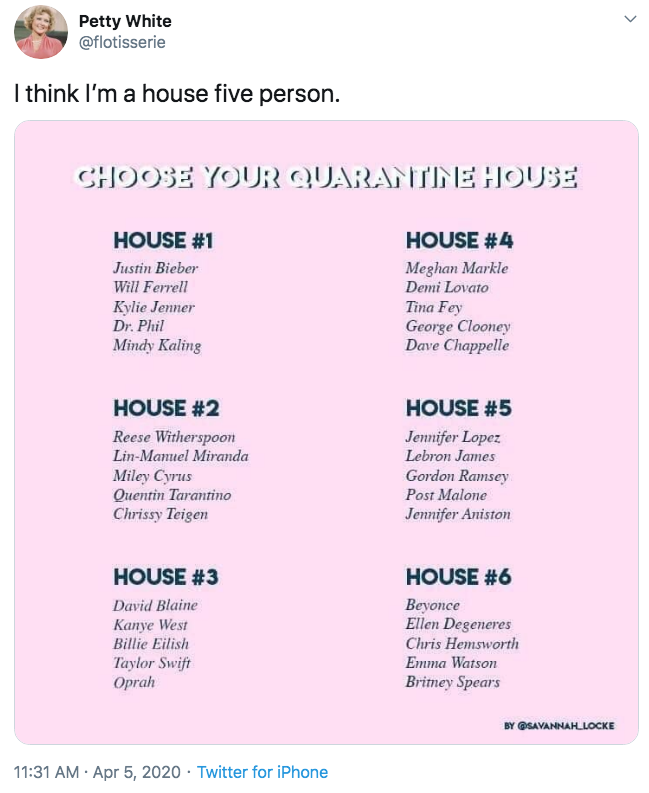
The meme was a list of six hypothetical celebrity households: pick one to quarantine in.
It had been circulating on Facebook, started by a Christian influencer named Savannah Locke. I encountered it deep in a Real Housewives fan group, and felt the pull of a good parlor game. In April 2020, everyone I knew was sitting at home, fretting about the COVID-19 pandemic looming over all of us, so I shared it with minimal ceremony, a couple of buddies with a slightly larger following hit retweet, and within two days the tweet was being cited by The Cut, Time, the Washington Post, CBS, and others. Know Your Meme documented it for posterity. Several outlets named me as the originator, but trust, I was only trying to delight my friends with low grade Facebook content. I couldn’t find the original meme at the time – Locke appears to have had a name change that scrambled my search. But hey, as these things go, nobody earned a dime or promoted anything weird, so no harm, no foul. Business Insider managed to credit it correctly, so a special kudos to their editor.
The core game mechanism behind the meme is forced choice: constraints generate opinions and opinions generate activity. Each “house” also represents a personality type. House 3 is chaos, House 6 is aspirational, House 5 is the one where someone is definitely cooking and someone is definitely yelling about it. The choices are arbitrary, which invites curiosity about who grouped what and why. In short, this meme offered a light conversation starter at the right time, with low stakes, high personal reveal, and endlessly discussable combinations. It also drew from existing memes and games that are popular online, like “where you sitting” in the proverbial lunch room. This one became news because of the timing and gamability, not because I was particularly clever, but hey.
What does it feel like to go so viral? It’s hilarious, strangely affirming, and also a little crazy-making. It opens the door to a whole lot of wild people and ideas on the internet, not all of them flattering or welcome. Virality is sometimes paired with incredible harassment and requires “more condolences than congratulations.” But as far as this particular experience went – hilarious, whoops, and wow. It just felt like a Lebron James, Post Malone and Jennifer Aniston hang would be a good time.
Art and Craft Blogs AI Gender Platforms Photos Digital Rhetoric