Does this feel slimy? I concede it may. But it demonstrates the value of personal writing and thoughtful design in digital spaces despite its many gaps and flaws.
Enjoy and tinker. Feedback is welcome. I’ll have some notes on my approach and why many of these findings remain heavily qualified in the coming weeks.
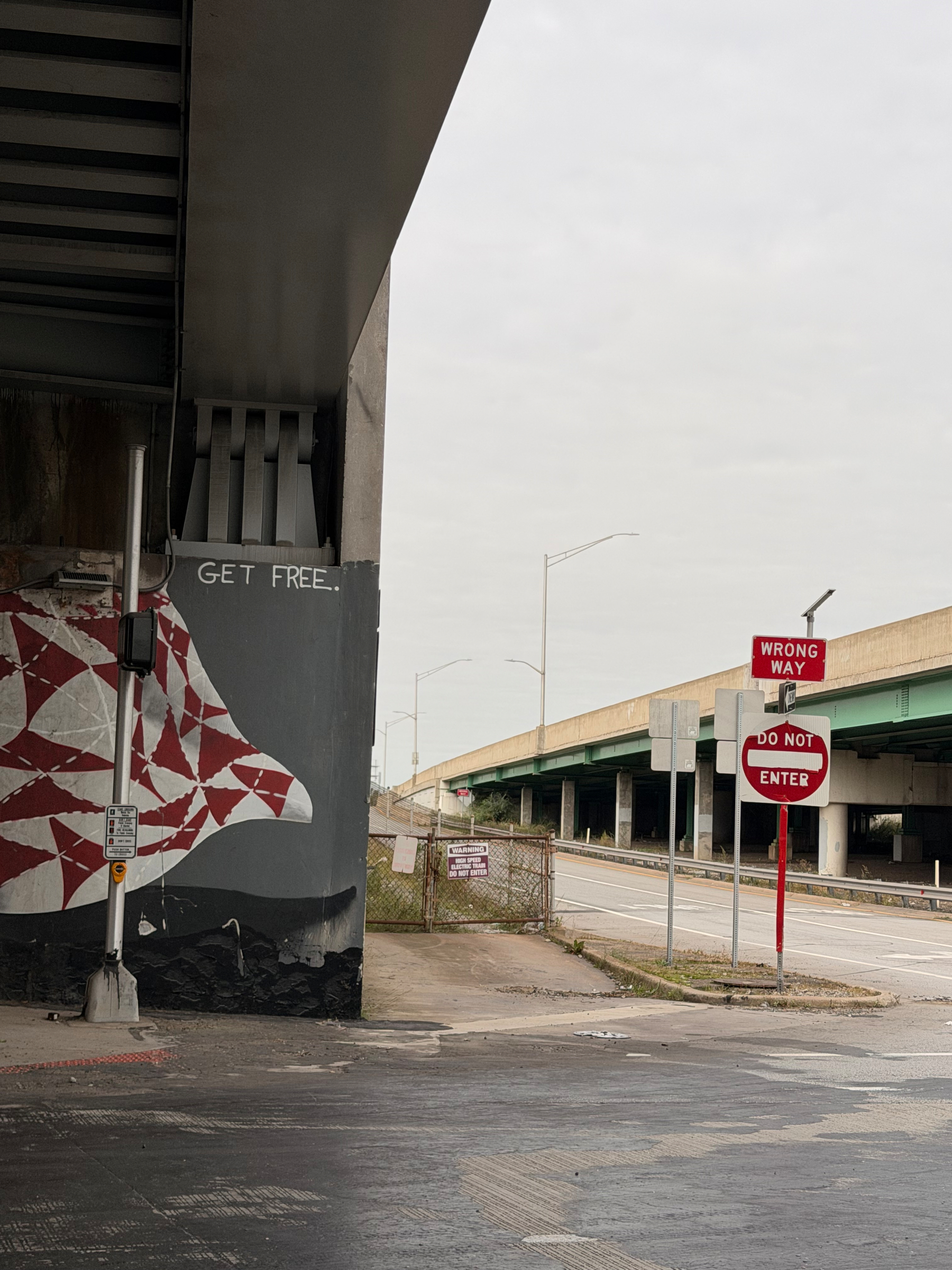
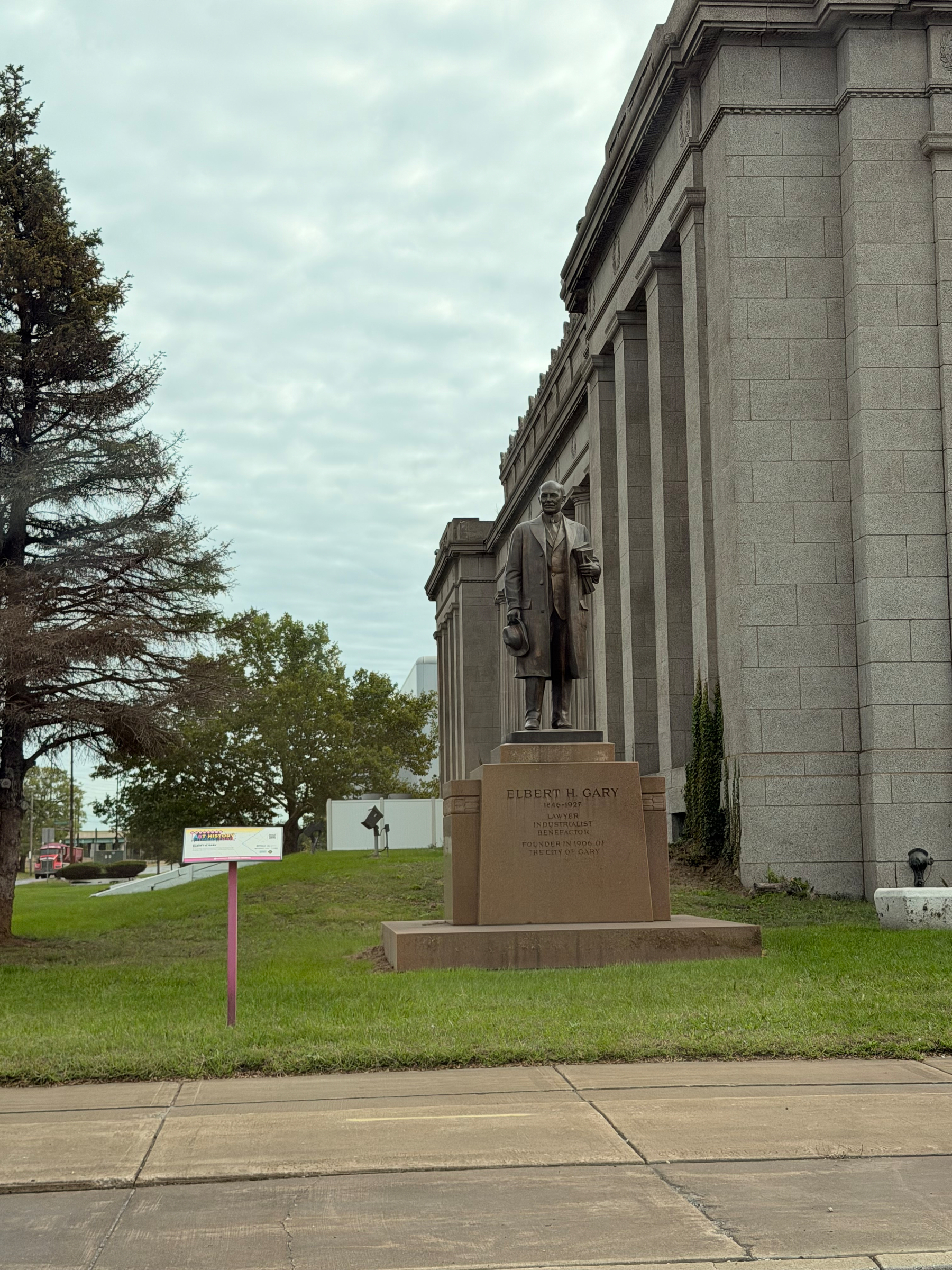
Yesterday I cut through Gary to get around a traffic jam on the toll road and picked up the Dan Ryan and the Skyway. Since living in Madison, I’ve made some version of that drive more times than I can count. I grew up south of Gary, at the edge of what a colleague called “the Chicago ombré,” and in my twenties my friends and I spent our weekends in The Region, thrifting our way across Lake County and hitting 18+ hip hop clubs in East Chicago. (King Von measured the same gradient from the city side in “Took Her to the O.”) To many, Gary is the city you drive through on the way to somewhere else.
The Skyway has a long political history: Chicago built it in 1958 with revenue bonds, then the bonds defaulted in 1963, and the city spent the next few decades catching up on deferred maintenance, according to Louise Nelson Dyble’s history of the road. In 2005, the Daley administration leased it for 99 years to Cintra and Macquarie for $1.83 billion, making it the first existing toll road in the country to be privatized. Eleven years later, the consortium sold the lease to three Canadian pension funds for $2.8 billion. The crossing now costs $8.10 in a car, and CBS Chicago reports that tolls have gone up more than 200 percent since the lease, about three and a half times the rate of inflation.
Indiana saw the incentives in this arrangement and followed along. In 2006, then-governor Mitch Daniels leased the Indiana Toll Road to the same Macquarie-Cintra group for 75 years and $3.8 billion, and he used the money to pay for Major Moves, his statewide highway program. Stateline’s 2012 retrospective called the lease one of the most divisive things Daniels did as governor. The bill passed without a single House Democrat, and the Region hated it. At a town hall in Crown Point, one resident told Daniels the deal amounted to taxation without representation. The operator went into Chapter 11 in 2014, and an Australian fund bought the lease the next year for $5.7 billion. A big share of the original money built I-69 between Evansville and the Crane Naval Base, at the other end of the state. When Eric Holcomb later approved a truck toll hike in exchange for another $1 billion, he had to deny in public that the Region was once again paying for highways its drivers would never use.
The state keeps the paperwork on deals like these. The Indiana State Archivesopened a new downtown building in Indianapolis on Thursday after 25 years in a “temporary” warehouse on East 30th Street, a former RCA record-stamping plant whose roof leaked partly because people shot holes in it. An old combination safe in the new building holds the state’s original constitutions, Jim Jones’s church incorporation papers, and Donald Trump’s application for a casino in Gary. Upstairs, a conservator expects to spend four to six weeks piecing together a Porter County survey map that had broken into fragments. The reading room is open to the public Tuesday through Saturday, and the staff asks you to make an appointment so they can pull the boxes before you arrive.
Freddie Gibbs grew up on Gary’s east side, and Jeff Weiss has profiled him twice. The 2021 profile in The Ringer catches Gibbs around his Grammy nomination for Alfredo and opens on a 2009 visit to his Van Nuys apartment, where Gibbs told Weiss that robbing freight trains was a popular hobby back home. Weiss’s earlier piece, The Miseducation of Freddie Gibbs, adds that one of Gibbs’s teachers got fired for robbing them too.
(Weiss, bless him, professes not to understand the rabbit metaphor present throughout Gibbs’ work, yet confidently persists.)
Gibbs’s father, Warren Tipton, spent about twenty years on the Gary police force and later sang with the Chi-Lites. He died in May, and AllHipHop’s obituary places him in the same Gary music scene that produced the Jacksons. That detail stuck with me because my ex-father-in-law was a police officer and chief of police downstate during the same years, and also played drums in a local band. Jamelle Bouie has historically described police departments as “jobs for the boys,” a steady public paycheck handed to working-class men, and that fits both of their careers better than anything about their relationships to law and order. In towns where the mills were shedding jobs, a badge was one of the few paychecks that came with a pension, and a man who could sing still needed that safety net.
Policing in the Region has uglier chapters than that. The Chicago Sun-Times has spent years covering the federal case against the Sin City Deciples, a motorcycle club founded in Gary in 1967. One member admitted he worked as a Gary police chaplain while killing two men, one of them the son of a former Gary police chief. The Chicago Reader’s Tiger King of the Midwest profiles Roy “Roy Boy” Cooper, who ran a tattoo shop called the Badlands with Bengal tigers in cages next to the chairs. Tattooing was illegal in Indiana then, and Cooper’s lawyer reportedly steered him to Gary because the police had bigger problems than a tattoo shop — as long as it paid its taxes. Media Burn has raw footage of Cooper setting a leashed tiger on a pool table while his wife runs through the rest of their animals, which included a grizzly bear and a baboon. In the video, Lady Cooper recommends taking the animals out in public, to the grocery store, socializing them on the locals.
Anderson went through the same collapse with auto parts. General Motors moved in during the 1920s and eventually ran two divisions there, Delco-Remy for electrical systems and Guide Lamp for headlights. By the time Jon Alpert made Dirty Driving: Thundercars of Indiana for HBO in 2008, a town that once had 33,000 GM jobs had empty factories and shuttered stores, and what was left of it went to the Anderson Speedway every Friday night. The Herald Bulletin caught up with one of the film’s drivers, Sammy Hawkins, as he flew home from the New York premiere to a Firestone job in Noblesville that he expected to lose. His line in the film is that Anderson doesn’t make cars anymore, but it can still race them and wreck them.
Music in Gary started in the mills. Joe Jackson ran a crane and played guitar in a band called the Falcons, which never got a record deal, so he kept the mill job and trained his sons into the Jackson 5 instead. Their first contract came from Steeltown Records, a Gary label, in 1967, and “Big Boy” was a local hit before Motown signed them. Most people in a mill town who can play keep the day job, and the ones who make it usually leave.
Akron went through its own version a decade later, with rubber instead of steel. Midstory’s history of how Akron became “the new Liverpool” describes Devo, Tin Huey, the Bizarros, and the Rubber City Rebels as kids from factory families trying not to follow their fathers into the plants. The scene got its home during one of the longest rubber workers’ strikes in the city’s history, when the Rubber City Rebels took over a rubber workers’ bar called the Crypt, as PBS Western Reserve tells it in It’s Everything, and Then It’s Gone. Chris Smith’s 2024 Devo documentary picks up the story from Kent State and follows the band into the early days of MTV.
Detroit turned its losses into techno. Juan Atkins, Derrick May, and Kevin Saunderson learned Kraftwerk and Parliament from a late-night DJ called the Electrifyin’ Mojo, and by 1987 more than half of Detroit’s manufacturing, retail, and wholesale base was gone, as SPIN reported in 1998. Midstory’s Built to Boom traces the line from the assembly plants through Motown to techno, and May describes sampling industrial noise, traffic, and construction into his tracks.
The techno ran straight into the rap Jorjiana grew up on. NPR’s piece on how Detroit and Flint became havens for rap dark horses credits the producer Helluva with a “basement sound” of ominous pianos and synth stabs, which he built by crossing West Coast gangsta rap with Detroit techno, and it describes the Flint rappers as a crew of flippant, vulgar jokers. Flintside’s history of the Flint scene shows how a co-sign from Detroit’s Peezy lifted Rio Da Yung OG and everyone around him. Lil Yachty spent years showing up on Michigan records, and he later vouched for Jorjiana too.
Jorjiana is 21, and a single mom, and from Michigan City, just down the shore from Gary. The Times of Northwest Indiana profiled her recently after “ILBB2” took off, and her Complex interview covers a childhood spent moving between relatives while her parents struggled with addiction. By her account, her music career started with screwing around with her friends around town. She and her friends were bored during the pandemic, so they freestyled in her car, and she posted the results, doing actual numbers. She told Justin Moran that her friends talked her into cross-posting the TikTok clips to Instagram, which she barely used, and that’s where the A&Rs found her. At the time she didn’t know what an A&R was. In a clip Complex posted, she admits she doesn’t know who Freddie Gibbs is either, so what ties her to Gary is the shoreline more than any influence. She should get familiar with his catalog (and a metronome!).
Plenty of good bands started as friends goofing off, which “industry plant” commenters might keep in mind. Devo began as a satirical art project at Kent State. Ron and Russell Mael studied graphic design and film at UCLA before Sparks, and Edgar Wright’s The Sparks Brothers spends a lot of time on how they built their act for Top of the Pops closeups. Both bands treated the dominant screen of their time as part of the instrument. Jorjiana’s screen is the short-form feed, and I’ve been watching her work it for the last year or so: snippets of songs previewed, clips pushed to every platform, a freestyle on On The Radar at the end of 2024 that brought more than a dozen labels calling, a GloRilla remix, and co-signs from Lil Yachty and GloRilla.
If you want to know what Gary is doing now, read Capital B Gary, which covers the city more consistently than anyone else. Start with their feature on Koney King, a Broadway diner that has been serving chili for more than a century, and then look through their 2024 year in photos, which has residents cleaning up parks on the East Side and crowds on the beach for the eclipse.
(I am sad to hear that Soraya passed away last month. During her research for this article, I enjoyed discussing the technical details that created these spaces and how our collective work facilitated everything that came afterward, or didn’t. I know Soraya was hanging a lot of her career on this article and felt it was poorly handled at the time, speculating it was because the voices most implicated by the research now manage the levers of publishing.)
Knowing Google has the juice for search, including all the missing bits deprecated over time, I asked it what technical and social lessons were learned, assuming Gemini could treat that work like a portfolio and provide a business analysis with the full benefits of hindsight.
Per Gemini, links added by me:
Looking back at the mid-2000s, the feminist blogosphere achieved extraordinary cultural breakthroughs, but it also operated with distinct technical and social failings and prejudices. By treating cyberspace as a purely ethereal or detached realm, bloggers unintentionally reproduced offline power dynamics, a phenomenon known as the “digital twinning” of cyberspace.
Viewed through a critical, retrospective lens, four major areas show where different choices around technology, institutional strategy, and social solidarity could have altered digital feminism’s trajectory.
1. Technical: platforms are not neutral
The early blogosphere largely treated technical tools (like WordPress, Blogspot, Google Search, and ad networks) as neutral pipes rather than profit-driven entities with embedded incentives. Bloggers built incredible social capital on free or cheap third-party services without owning the underlying code or digital infrastructure. When Web 2.0 shifted toward algorithmic feeds and centralized social media (Twitter, Facebook), bloggers willingly migrated their engagement to those platforms to chase larger audiences.
Protocol-Level Investment: Instead of relying on proprietary platforms, the cohort could have invested in building and maintaining independent digital commons, including federated software, cooperative hosting collectives and shared digital archives owned directly by the movement.
Data Sovereignty: Early writers rarely anticipated how their essays, comment sections and personal narratives would be scraped, monetized, and eventually used as training data for commercial algorithms and search engines. Establishing strict open-source licensing (such as Copyleft or peer-production licenses) and sovereign archiving practices could have protected intellectual labor from platform extraction.
Many of the highest-profile blogs were anchored by white, college-educated, urban writers who inadvertently treated their lived experiences as the “default” feminist lens. Marginalized writers, particularly Black, Indigenous, AAPI, disabled, and trans writers, frequently had to demand inclusion, fight for citation, or build separate spaces (Racialicious, Crunk Feminist Collective, Reappropriate, FWD/Disabled Feminists) to address the dominant blogs’ weak spots.
Resource and Power Redistribution: Rather than treating traffic and ad revenue as individual metric wins, major sites could have operated as resource-redistribution networks—directly funding, platforming, and sharing domain authority with writers from marginalized backgrounds from the outset. This is what Feministe.us aimed to do with our rotating lineup of guests, with mixed results.
Rethinking “public” vulnerability: The blogosphere heavily rewarded raw, highly personal exposure (“confessional blogging”). However, this cost was asymmetric: white, middle-class bloggers often parlayed personal exposure into book deals, while marginalized bloggers faced severe offline economic risk, doxxing and targeted harassment for sharing the same level of personal detail. Many of us also needed to earn a paycheck with benefits. Depending on your demographics, angles and timing, writing opportunities were limited, and only a small fraction of the talent generated in the collective saw durable career impacts. A more intentional approach would have prioritized pseudonyms, pen names, shared authorship, and safety-first rhetoric.
3. The siren song of individual upward mobility
The most consequential structural shift was how the blogosphere interacted with traditional media and corporate capital. As more corporate outlets (Jezebel, HuffPost, The Guardian) realized feminist commentary drove clicks, they offered individual bloggers lucrative staff jobs, book deals and column spaces. This transformed a collective political movement into a pipeline for individual career advancement. As top talent moved into legacy media, independent blogs lost the labor needed to sustain them.
Building cooperative media outlets: Instead of individual writers accepting staff roles at corporate outlets, the cohort could have formed reader-owned media cooperatives (similar to worker-owned publishing models today). This would have allowed writers to earn a sustainable living while keeping their intellectual output in a community-controlled space.
Resisting algorithmic speed: Legacy media required bloggers to output somewhere between 3-10 quick, hot-take posts per day to satisfy ad-driven impression quotas. Resisting this pressure in favor of slower, deeper, “thick” theory would have preserved the intellectual rigor of the spaces instead of reducing feminism to consumable digital commentary.
4. Politics: Hesitancy to be the “fly in the ointment”
Beyond technical tools and corporate pipelines, there was a profound rhetorical hesitation within many of the era’s flagship blogs to comfortably occupy the role of the “fly in the ointment,” the deliberate, disruptive presence that insists on disrupting false consensus to center genuinely aggrieved interests.
Because major blogs faced constant, bad-faith attacks from right-wing media and anti-feminists, an implicit pressure emerged to project a unified “united front.” This often created an environment where internal dissent, particularly from disabled, working-class, trans, or non-white women pointing out the movement’s ongoing failures, was framed as unhelpful infighting or a distraction from the broader political battle. The push for a polished, accessible and broadly appealing “Feminism 101” frequently smoothed over the jagged edges of critique.
Sanctifying disruption as methodology: The blogosphere could have explicitly framed the “fly in the ointment” not as a threat to solidarity, but as the primary engine of accountability. Rather than managing or policing internal conflict to maintain a clean editorial brand, blogs could have deliberately designed their platforms to hold open space for radical and uncomfortable grievances within the plurality of feminist thought.
Protecting uncommodifiable voices: Corporate platforms favor palatable, easily shareable commentary by design. By shying away from deeply uncomfortable, non-mainstream grievances, the blogosphere left a vacuum filled with endless explainers. A more resilient model would have actively protected and amplified the most uncompromising, “unmarketable” voices, including those whose positions could not be sanitized for an ad sponsor or a cable news segment.
By failing to fully institutionalize the “fly in the ointment” as an essential, protected role within digital spaces, the early blogosphere left itself vulnerable to the corporate absorption that eventually dismantled it. When mainstream media stepped in, it easily plucked away the polished, palatable commentary while abandoning the uncomfortable, dissenting labor that keeps a political movement expansive and honest.
When tech enthusiasts discuss federation today, they usually mean open protocols like ActivityPub or Mastodon. But in the 2000s, the feminist blogosphere was one of the earliest, most powerful examples of practical Web 2.0 federation, a decentralized, cross-site architectural network where open web standards powered a global ideas lab.
Instead of sitting inside a single corporate platform (like today’s X, Meta, or Substack), early blogs like Feministe, Reappropriate and Jezebel functioned as individual nodes in a federated ecosystem. Open protocols linked them, letting theory, critique and discussion travel seamlessly across independent servers, seeding some of the political conditions we face today.
1. Federated communication engine: CMS and protocol
Before quote-tweeting or tagging existed, the open web used Trackbacks and Pingbacks. If a post on Feministe analyzed an article about reproductive rights, a writer on Racialicious or Shakesville could respond on their own site. The underlying blogging software (Movable Type, WordPress) would automatically send an XML RPC “ping” back to Feministe.
Socially, this created architecture for ideas: a ping automatically listed the response essay in Feministe’s comment section or sidebar. Readers didn’t just consume one blogger’s singular and authoritative opinion; they could immediately follow the thread across five different independently hosted platforms. This created an inter-site conversation tree, allowing complex ideas to be cross-examined, refined, or challenged without any single person controlling the narrative.
2. Blogroll as federated curation and mutual discovery
Before algorithmic feeds dictated what readers saw, blogs relied on the Blogroll, a curated list of links in the site’s sidebar. Blogrolls formed a human-curated, decentralized routing layer. When a high-traffic node like Feministe added a smaller, independent blog (such as a disability rights blog like FWD or a smaller blog like Crunk Feminist Collective) to its blogroll, it directed server traffic directly to that independent domain.
Socially: This was a non-algorithmic way to expand the collective’s political consciousness. It allowed marginalized perspectives to build their own audiences and force mainstream feminist sites to engage with race, class, disability and queer theory. The blogroll mapped an intellectual community in real time – with strong caveats.
3. Open syndication protocols
The Architecture: Feeds ran on RSS (Really Simple Syndication), an open XML standard. Readers used independent RSS aggregators (like Google Reader or Bloglines) to subscribe directly to a site’s feed.
Socially: RSS meant no algorithm stood between the writer and the reader—no engagement bait, no rage-farming optimization, and no platform throttling links. Writers could publish 5,000-word, dense theoretical essays knowing their subscribers would receive the complete text in chronological order as designed. This structural stability gave writers the freedom to experiment with complex, “thick” personal narratives and political theory.
4. Real-time stress testing and spillover moderation
Because the blogosphere was a network of independent domains, each site maintained its own “house rules” and moderation policies. If a topic proved too controversial or toxic for one comment section, the conversation naturally federated outward. A reader who felt silenced or misunderstood in one blog’s comments could launch their own blog, write their response, and ping back into the original discussion.
Socially, this prevented any single author from monopolizing the narrative. It created a system of checks and balances where academic concepts (like intersectionality, rape culture, or microaggressions) were stress-tested across dozens of distinct, interconnected communities simultaneously.
Thinking about this architecture today
The feminist blogosphere proved that decentralized web protocols can generate deep, movement-building intellectual work. When platforms like Facebook, Twitter, and corporate media conglomerates centralized the internet in the 2010s, they broke those open connections. Conversations were locked behind platform walls, trackbacks were abandoned and RSS was marginalized, breaking, fencing and otherwise moderating independent community connections.
Rebuilding a modern “ideas lab” with modern federated protocols (like Webmentions, ActivityPub, RSS, and static site architecture) is simply picking up the technical blueprint OG feminist bloggers used to transform digital culture two decades ago.
Eli Lilly redux: Thinking about the democratization of information and the removal of gatekeepers alongside this story I saw first at Boys’ Club. This Harvard PhD is vibe-manufacturing schizophrenia drugs in his garage. Are we vibe-coding medicine?
A composition teacher friend shared this paper on social media: Lester Faigley’s “Literacy after the Revolution”, the essay version of his 1996 CCCC Chair’s address. In it, the author argues that the economic impacts of the digital revolution had begun to undo an older commitment, formed in the Civil Rights era, to teaching literacy as a path toward equality. He further argues that writing instruction was being reorganized around tools owned by a few firms (then: Netscape, Microsoft) at a moment when wealth was concentrating upward. Faigley left us with the question of whether educators can hold onto literacy-for-equality while the tides run against it.
Thirty years later, the worry has a new face: AI will do young people’s writing for them and their thinking with it. Ultimately, Faigley believed the need for the skills that composition teaches will keep growing, not despite, but because of our need to convey information in and around that technology and the humanity it serves in a complex society. Does that suspicion hold water today?
In our community, the kids were in remote learning for a full year and a half, and the IT department chased them around their approved digital tools like a game of whack a mole, shutting down access to chat and collaboration. In the meantime, almost no socialization happened between students that wasn’t directly observed by teachers. By 2021, the kids were engaged in secret, digital note-passing, chatting within Google docs and PPT slide decks and Pinterest DMs to avoid teacher surveillance on their approved tools. Where there is a will to socialize, there is a way.
Business Insider provides an update on how teen social media bans are going in Australia, and it’s not great! After a few months, kids steadily got back online, nearing or matching pre-ban levels.
Question for parents: How are you teaching your teens to stay safe and think about safety and security while they surf, shop, chat and learn on their digital apps and devices? Are you sharing books, articles and videos with one another? If so, which ones? I’m asking for a friend; the friend is me.
A linklog is a dated list of outbound links, maybe a tag, and a note about why it’s worthwhile. But that little note does two things at once, and together they make for a better web.
First, it’s a way of organizing the web. The web doesn’t sort itself, so finding good information depends on someone curating and tracking interesting content, preferably on the open, free internet. It acts as a customizable bookmark library: newest at the top, tags to group items, and a line explaining why the link was worthwhile. This is similar to what del.icio.us did, where people grouped and tagged links, creating a rough filing system.
Second, it’s a social act. An outbound link points to someone else’s work, so a linklog is essentially a renewable engine for sending traffic to other people and places. It stays renewable because the content is easy to sort and remix: a URL’s relevance no longer depends on where an algorithm or activity feed happens to place it, so older links can keep resurfacing instead of scrolling out of reach. That’s the precise opposite of what big platforms design for audiences; platforms such as Twitter, Instagram and Facebook quietly bury posts with outbound links to keep your attention (and dollars) on their site and with their advertising customers, losing relevance after one interaction. A linklog explores the opposing dynamic: it willingly hands your audience and attention away while crediting your forebears, comrades, mentors and co-conspirators. It turns the rough digital filing system into a “folksonomy,” if you will.
Compare these dynamics to an algorithmic feed on a platform. An algo also sorts the flood of content, but computer magic does the sorting, and someone else monetizes your attention and relationships and hoards your data. “Engagement” for these companies is primarily a measure of how long you stay on their platform with their content. The goal is to keep you scrolling and the ad revenue rolling. But over here on the indie internet, our goal is to build human communities online and connect people to quality information, tools, ideas and processes.
In this sense, a linklog is an easy way to be an opinionated curator and a decent neighbor at once, by hosting and sharing with thoughtfulness and deliberation. Out here, my data is also likely being scraped, but I have far more control over what data is findable, shared, and shareable, and over what is investigable and degradable over time.
Community Notes was meant to democratize moderation power (and spare platforms the burden of thinking through moderation). Instead, a new paper shows that 20% of users cast 80% of ratings, and removing just ten active note writers from the pool changes what happens to nearly 5,000 community notes.
One of the tricky things about consumer AI tools like Claude and Gemini is that the experience varies widely depending on the person using it, and it’s not always clear why. I have spent a lot of time learning the tools so I can advise on them in my work, and this variance of experience has become a frustrating part of the deal.
I manage a team of writers and creatives at work, and we are expected to be familiar with the tools, despite complex and sometimes hostile feelings about the political and environmental implications of this sector. That’s quite a pickle, organizationally, managerially. Borrowing from Haraway, I thought, okay, what if we take these tools seriously as a team of writers and creatives and put our professional standards up against them?
Among other exercises, I did a couple of comparisons on my team that help create discussion around the “plausibility” question. People dismiss LLM outputs as being merely plausible answers, rather than accurate or factual ones. And that’s correct; they are, and that’s the design. In many cases, plausibility is fine. Take Wikipedia, for example, which we understand to be a pretty good source, a plausible source, unless you’re writing a formal paper requiring original sources.
I digress. Ultimately, we needed to understand together that LLMs are not a WYSIWYG tool and talk through the implications.
I asked everyone to run the same paper through their LLM of choice, prompting it for a plain language summary. We then copied and pasted it into a shared doc, and compared and contrasted for discussion. Upon discussion, we had several takeaways, including that they were all similar in spirit but sometimes varying wildly in style and approach.
Knowing that algorithms are responsive and not static, we did it again later in the day and copied and pasted our outputs into the shared doc. We compared and contrasted the difference between AM and PM. Again, it was similar in spirit but varied in style and approach. Some changed dramatically. One team member whose morning summary had been jokey and conversational received a much more staid and serious version in the afternoon.
At the time, I asked Claude to explain the variance: “Even with the same prompt and source material, LLMs don’t produce identical outputs each time. This is by design — there’s a degree of randomness (called “temperature”) in how the model selects words, which means each run produces a slightly different path through the text.”
Anyway, this got our gears turning on how (and whether) to approach LLMs as a team and as individuals and led to good group discussion. (It’s important to create space for criticism and critical approaches here.) It also gave us more confidence as a team responding to this new layer of complexity in our work, and helping our professional contacts and peers think about how to approach the tools and when and whether to use them. There will be tasks where AI-based tools are “good enough,” and tasks where they are not.
The swirl of mystery and speculation around this sector has people up in arms, and it’s useful to have approaches that give people firsthand experience and to see how the experience works for others. The god trick of the singular interface turns out to be a bear for navigating it in the workplace, where our work is foundational, prosocial and specific.
The last time I went truly viral was in April of 2020 in the height of the COVID shutdown. I posted a tweet and walked away from my phone. By the time I checked back, my notifications were out of control.
The next morning, I got a message from an old friend familiar with my handle. “I think I saw your account on Good Morning America?” Hilariously, there I was, and I couldn’t even claim responsibility for the meme.
I’ve spent most of my time on the internet as a pseudonymous account, using my first name only, or using a handful of handles (incl feministe, fauxrealtho, flotisserie, paired with punny names like “Petty White” and “Frieda People,” a convention from the Tumblr years). Even as a visible personality online, I was only known by my first name and URL and/or handle. In recent years I de- and reactivated some of my socials, so some of these breadcrumbs no longer exist, but I’ll do my best.
Pseudonymity allows writers to explore complex ideas in digital spaces while protecting their identity, location, and other identifying factors, while also maintaining a throughline of identity and storytelling.
There are a lot of trade offs in using a pseudonym, especially around how to claim credit for your work. But people use them because they give you the privacy to be honest, real, weird, authentic, and to escape the creep of modern social media presence into high stakes spaces like the workplace. This dynamic was kind of the impetus behind the era of “weird Twitter,” where people using pseudonymous social handles routinely threw out funny, absurdist one-liners to impress their friends and followers, while taking a turn at the social media slot machine. Not every post or joke lands in a way that converts to numbers, but some do, and it’s fun to try.
I’ve written a little previously about how the English program I was a part of used fiber arts to illustrate the fundamentals of technical writing, but one of their other methods of teaching the internet was through board games. Games, like the internet, and much like writing, provide rules and structure for communication and engagement, but everything that happens inside the container of game board and game play is a mystery until it emerges through human interaction. So goes the internet (and to some extent, so goes AI). Games and gaming were used as a method to think through what it means to create rules of play, then let a community rip through the model – and many of the thinking and skills involved around game design apply in social digital spaces, from chat rooms and Teams channels to the open seas of the WWW. The longer you’ve been playing the slot machine, the more you get a feel for the kind of thing that will get seen and read, and who among your readership will take your content to the next level.
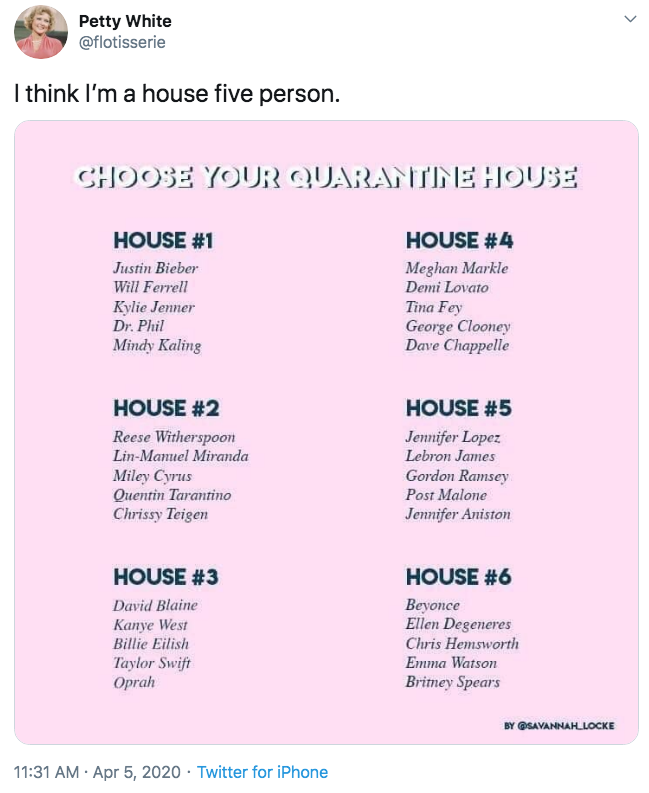
The meme was a list of six hypothetical celebrity households: pick one to quarantine in.
It had been circulating on Facebook, started by a Christian influencer named Savannah Locke. I encountered it deep in a Real Housewives fan group, and felt the pull of a good parlor game. In April 2020, everyone I knew was sitting at home, fretting about the COVID-19 pandemic looming over all of us, so I shared it with minimal ceremony, a couple of buddies with a slightly larger following hit retweet, and within two days the tweet was being cited by The Cut, Time, the Washington Post, ABC News, and others. Know Your Meme documented it for posterity. Several outlets named me as the originator, but trust, I was only trying to delight my friends with low grade Facebook content. I couldn’t find the original meme at the time – Locke appears to have had a name change that scrambled my search. But hey, as these things go, nobody earned a dime or promoted anything weird, so no harm, no foul. Business Insider managed to credit it correctly, so a special kudos to their editor.
The core game mechanism behind the meme is forced choice: constraints generate opinions and opinions generate activity. Each “house” also represents a personality type. House 3 is chaos, House 6 is aspirational, House 5 is the one where someone is definitely cooking and someone is definitely yelling about it. The choices are arbitrary, which invites curiosity about who grouped what and why. In short, this meme offered a light conversation starter at the right time, with low stakes, high personal reveal, and endlessly discussable combinations. It also drew from existing memes and games that are popular online, like “where you sitting” in the proverbial lunch room. This one became news because of the timing and gamability, not because I was particularly clever, but hey.
What does it feel like to go so viral? It’s hilarious, strangely affirming, and also a little crazy-making. It opens the door to a whole lot of wild people and ideas on the internet, not all of them flattering or welcome. Virality is sometimes paired with incredible harassment and requires “more condolences than congratulations.” But as far as this particular experience went – hilarious, whoops, and wow. It just felt like a Lebron James, Post Malone and Jennifer Aniston hang would be a good time.
My undergrad experience in college really shaped my approach to the internet. I was an English Education major at the time, in the early 00s, when the internet was around but mostly the wheelhouse of scholars and nerds. I was a nerd, learning code as a vehicle for writing, primarily to amuse myself and my friends.
The English department was an embattled unit within a school within a college of a STEM-centric university whose administration was perennially annoyed by the Humanities and their writing requirements. One of the English department’s survival tactics was to grow their approach to technical writing, getting deep into the question of how technology changes, shapes and shifts reading, writing and literacy. Thus they organized loosely around an emerging field called “digital rhetoric.”
For a time this was the top rhetoric and composition program in the field, populated by scholars from scrappy programs. My closest mentor, an English PhD from Wayne State in Detroit, studied race and gender representation in video games and how programmers (particularly Black and trans programmers) write themselves into existence through code, design and other aesthetic and storytelling choices. Outsiders had a really hard time understanding how this work belonged in an English department, but ultimately, she was focused on the question of authorship and how the author is projected throughout her work, a classic literary debate. She treated video games as texts and gamers as an audience, an approach that foretold many things about our current political era.
In this space, “digital” doesn’t just mean content on a screen. The concept is more complex, including social, cultural and rhetorical dimensions, in addition to shifts through time. Digital “texts” and practices exist on a continuum with print and other media, rather than in isolation, transforming how persuasion and communication work, both separately and together.
I took all these lessons and ran with them. This is where my approach to the internet is situated, and there are a few truisms that I learned from that time and era that further position my writing and approach.
Writing is code, code is writing
Writing and code are fundamentally the same thing in digital contexts. Both are systems of symbols that create meaning and action through semantic rules. The line between “content” and “container” blurs in digital spaces. A blog post is the copy on the page – and it’s also the metadata, the responsive design that adapts to different screens, the accessibility markup that makes it readable by screen readers. Each of these elements is written (coded) and each carries rhetorical weight and communicates something to the audience, intended or not. If you understand these relationships, you understand how the internet works as a social and information system.
This convergence of digital and material amplifies the concept of intertextuality, the idea that all texts reference, respond to and build upon other texts. In the classroom, intertextuality often focuses on plays and novels, and explores how authors speak and refer to one another’s work over time. In music, this is the study of sampling and referencing and why.
In digital environments, intertextuality becomes literal and functional. Code libraries reference other code libraries. Websites link to and embed other websites. APIs allow different platforms to communicate and share data. A single digital text might pull content from multiple sources simultaneously – a Twitter embed, a YouTube video, a Google Map – creating a networked document that exists across multiple platforms and authors. Virality builds rhetorical velocity through layers of meaning being added by individual users in real time, creating new texts and contexts through iteration and sharing.
Writing makes reality
A lot of students of this era took up knitting. It was trendy, yes, but the professors also taught knitting as an applied example of technical writing, and how writing produces a material reality.
Knitting patterns are technical writing in its purest form. A pattern is a set of instructions that must be precise, unambiguous, and reproducible, the same goals as any technical document. Pattern writers use specialized notation (K2tog, SSK, yo) that functions like code, compressing complex physical actions into standardized symbols that individuals interpret using sticks and string. The pattern must account for different skill levels, anticipate common errors, and provide enough context for the knitter to understand not just what to do, but why.
Good instructions and an able translator may result in a wearable delight: a sweater, a scarf, a cozy and colorful pair of socks. When a pattern fails the result is the same as failed technical documentation: confusion, wasted time and an unusable product. Piles of string. Dumb, useless sticks. It is an incredibly strong reminder that technical writing isn’t confined to manuals and protocols. It exists anywhere complex processes need to be communicated clearly and consistently so others can replicate results – including in your granny’s yarn basket.
So that’s how I learned to knit. Digital rhetors link physical practices to digital ones to illustrate highly conceptual ideas about writing and social networks. And one reason why digital spaces like Ravelry deserve recognition as thoughtful, functional social platforms is that this link between conceptual and material is made explicit in the digital knitting community. Designed for information sharing among a particular audience, decisions about information architecture and community management reasonably cascade from the mission, so Ravelry has remained a reasonably healthy community experience for most users despite its massive size and sprawling discussion. It remains an example of positive social dynamics online, unlike its behemoth competitors.
Always returning to Haraway
Many thinkers and texts built out this field of thought, but Cyborg Manifesto sits at the forefront for me. Writing during the Reagan era, with the populace freaking out about the rise of biotechnology and personal computing all around her, Haraway entered debates about whether women should enter male-dominated, militaristic fields like engineering and computer science, bringing an overtly feminist lens to questions of technology and power.
One major takeaway from Haraway’s work is the importance of rejecting binary thinking around technology and science. This approach aligns with other humanist and feminist perspectives that foundationally believe technology is by, about, and for the human experience, thus providing new and novel sites for political struggle. This gave people frustrated by tech a permission structure for interacting with technology rather than avoiding or abstaining from it entirely.
If these questions of knowledge and power remain central to technology, we want the people making those decisions to share our values and interests, and to be in the room when decisions are made. This argument is ripe for various challenges, which is why it was such a provocative starting point for cyberpunks and cyberfeminists alike.
Sharing is caring
This was an open source culture that meant sharing not just finished products, but the breadcrumbs and other attempts at learning along the way. It requires the safety that supports a yes/and culture, where people can collaborate with transparency, in spite of, or in consideration of, the ugly stuff and the many unknowns.
We let public and private live alongside each other without rigid boundaries about professionalism and polish. Your serious professional work could sit next to a meme, which could sit next to a picture of your cat, and none of it diminished the other.
This was an intentional acknowledgment that people are multifaceted, and that the digital spaces we inhabit should reflect that complexity. Putting the personal and the real alongside the artificiality of digital communications builds a relationship between the viewer and creator in ways that carefully curated, brand-managed presences just can’t (also: yawn).
Vulnerability, humor, expertise, horror, scholarship, and joy coexist, as in real life.
I am pro-games and gaming (and partake in gaming myself), and both of my kids had a generally positive experience on various gaming platforms over the years, but stuff like this still gives me pause.
In recent history I stopped posting on most social media and moved to the fediverse. I still browse the social platforms to keep up with trends and friends, but I only post on my private IG and here.
What I share here is separate from but related to my professional life — I’m thinking out loud and making room for rough, unfinished ideas. I write mainly for myself, but if others find it useful, that’s great. The practice of reading and reflecting makes your thinking stick, and I am from a certain time and place, so this is how I approach learning and communicating about what I’m learning. It’s a habit.
While this is my preferred approach, I acknowledge that sharing unfinished ideas publicly is risky and you have to accept accountability for the messiness that comes with that. But I also know that working through your vulnerability through the act of writing lets you tap into your most creative, innovative self and test your ideas against an evolving sense of what’s good. The potential for an audience, however real or implied, keeps you more honest and less self-indulgent. Despite the trade offs, I think it’s worthwhile.
More on rhetorical velocity and the art of the remix. As Lawrence Lessig says, “Remix is how we as humans live and everyone within our society engages in this act of creativity.”
Writing for the public in an age of anxiety: “This article identifies five topoi of this new rhetorical landscape—presence, persistence, permeability, promiscuity, and power—describing the anxieties and affordances they present for student writers, the dispositions toward writing they foster, and the challenges and opportunities they pose for composition. This framework provides a critical vocabulary for compositionists seeking to help those who negotiate emerging networked publics.”