Speaking of autoethnographies, I just heard about Dorothy Roberts’ latest and it looks intriguing.
Speaking of autoethnographies, I just heard about Dorothy Roberts’ latest and it looks intriguing.
The belief that LLMs are intelligent is based on the idea that language and intelligence are equivalent. From November, this article from The Verge argues that idea is a misnomer, instead arguing that we should think of language as a cultural tool we evolved to share our thoughts with one another.
This writer suggests that LLMs used to be pretty cool and creative — read: exceedingly weird — and that corporate tinkering to prepare the tech for a broader market took away some of the magic.
The “stochastic parrot” argument against LLMs has some rhetorical limits.
Author Margaret Atwood plays with Claude and reports back on her experience.
Brooke Warner grapples with the implications around authorship and ownership in relation to AI writing, and how it’s showing up in the small publishing business.
A good essay on writing and communication in this time. Ultimately the pickle of AI writing is that meaning is something best made through collaboration.
Through a new quiz, NYT asks readers to rate passages of writing against AI. Despite thinking I could spot the AI writing, my results were 50/50.
Come look over my shoulder while I explore how and whether LLMs are good writing tools: Here’s a wee version of the LLM comparison exercise I did with my team. We’ll make it a two-fer so you can see how the “good writing” skill works in practice, though we’ll see how that actually goes.
One of the more useful things you can do with an LLM is hold up a few ideas side by side and apply lenses to them. I know this history pretty well, so I asked a series of LLMs, why is Wisconsin’s cultural identity and cohesion stronger than Indiana’s, from a historical and business perspective?
Here are the answers in one doc, for comparison.
Each LLM will give us more or less the same story, different flavor. Within the industry, the differences across the models reflect “model personality.” Asking “why” instead of “whether” will probably drive the answer to favor Wisconsin. Using multiple lenses (two states, historical + business, identity + cohesion) forces the LLM to cross-reference across more of its training data, which tends to produce a more comprehensive answer.
For all the chatter about consciousness and whatever, remember that an LLM is an infinite series of if/then/elses applied to human language and semantics, so being able to talk about language and communication, getting meta with the tool and how you think through language, helps a lot when using one. This is maybe the one thing I like about experimenting so hard with the tools. I’m thinking about the technical side of writing and enjoying it quite a lot.
Functionally: all of them acknowledge hard historical truths within the subject matter and don’t shy away from critical perspectives, which is good. Both Gemini and Copilot include in-line links, which lets you judge the output’s authority in the moment as a reader. I liked Copilot’s more than I expected here. Claude’s answers are more lyrical and do provide more context, and yet do not encourage checking against outside sources by providing links within the output. And you can see that even with the good writing skill calling out hard bans on certain structure, Claude plows right through them.
Model personality: Claude favors sociological answers to Copilot’s economic answers. Claude is also highly intellectual and narrative by comparison, and that narrative style can mask nuance by sinking relative context within the storytelling. Gemini simplifies, boosts and cheerleads where the others don’t, and really goes hard on Wisconsin’s reputation as a drinking and Packers state when there are stronger structural arguments in play. Copilot is tricky because it looks authoritative like a briefing, which also makes it easily “extractible” for the user, but every citation requires authentication unless this is one of those “good enough” tasks.
As a writer, something I find annoying across the whole spread is the semantic reveal. LLMs are semantic machines, and it is persistently revealed in ways that are weird to the human ear. All of them go out of their way to describe things as “structural,” “connective” as in “connective tissue,” “load-bearing” and “legible.”
Finally, I included a second tab where I asked Claude for analysis across the four outputs, where it suggests that my framing of the question is altogether kind of problematic. It shows how a strong prompt is sometimes also a bad approach.
There are a lot of possible takeaways here, but I’d rather set aside the question of which tool is “good” or “bad” or “better” and think more about the patterns across the tools and their implications.
LLMs have a default house writing style with identifiable patterns: sentence fragments for emphasis, “not X, but Y” constructions, lots of hard contrast, atmospheric openings, heavy use of em dashes, and heavy use of marketing language. This reflects the semantic construction of an LLM. Custom instructions can override these defaults. A custom skill is a set of instructions within your account that modify how the model generates text. When you paste instructions into your profile settings, Claude reads them at the start of every conversation and adjusts its output accordingly.
I began using Claude daily for light writing tasks about six months ago, and over that time I started cataloging the patterns I was consistently editing out, including the terrible “not X, but Y” construction that showed up in nearly every response, and persistent em dashes used as all-purpose connectors when other punctuation is more appropriate.
I went through several iterations of bullying Claude into submission, narrowing the scope each time, before arriving at this version, which focuses specifically on writing mechanics and hard prohibitions.
You’ll need a paid Claude plan (Pro, Max, Team, or Enterprise). Free-tier accounts don’t have access to custom skills.
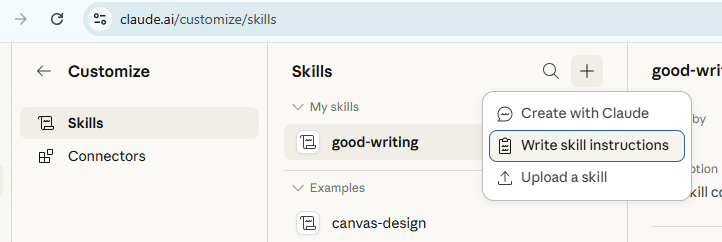
• Within the app, navigate to Customize > Skills and Create new skills
• Select add a new skill and Write skill instructions
• Copy and paste the copy from this file into the skill, making note of the name and description boxes. Feel free to tinker.
• Save your changes.
Note: The instructions in the linked file are Claude’s work, not mine. They came out of months of conversation, where Claude would analyze my style notes, and the file evolved from there. They read a little strangely because of that process. If I’d written them from scratch, they’d sound different. But looking at the file you can see what Claude responds to and how it works.
Claude will apply these instructions to every new conversation going forward. Existing conversations won’t pick up the change, so start a fresh chat to test it. If and when Claude struggles to apply the skill, call it out specifically in the prompt, such as, “Revise this for length using the good writing skill.”
The skill specifies constraints in a few categories and the instructions are plain text. As you go, you can also ask Claude to analyze previous conversations for suggested additions to the skill, which Claude will produce and implement within the chat. Each rule operates independently, so removing one doesn’t affect the others.
Claude processes custom instructions at the start of every conversation, before it generates any output. The instructions function as constraints on the model’s default behavior. The model doesn’t always follow every instruction perfectly and the results vary by task. You will still need to edit.
WaPo on the many issues of LLM house writing styles. I have much to add. Here are some notes on applying a writing skill to override house style on Claude.
A thorough look at the loss of institutional hip-hop media archives and what it means for culture writing today.
“A brief history on writing, a forgotten technology: how the challenges we face in today’s digital age can be traced back to one of the most significant yet underrated innovations of all time.”
My life is work right now, so I’ve been training my reading and writing habits in that direction in the hope it will be additive. So when a friend who works in tech suggested I pick up some Ellen Ullman, I snapped it up. Ullman was a programmer who wrote about her experience as a woman in tech in the 1990s, a diligent personal accounting of the early days of Silicon Valley that foreshadows so much of what people are worried about today. Through her first person account of life as a programmer, she consistently reminds the reader that computers are made of boxes and wires, with choices made by mortals (often imbued with dreams of immortality) written on chips and tape, and are limited to only know what we tell them. The Y2K essay was an especially welcome reminder in the era of “singularity” — we’ve been here before.
There are many hyperbolic essays on AI going viral this week. This essay gets into some of the emerging politics around AI in the United States and how they map onto electoral politics, and is irritated with the American left’s approach to AI.
I agree on one angle, that as a cohort, abstaining entirely from new tech is a bad approach.
Haraway (obvs) suggests we stick with the trouble, that sometimes our very presence in the room is what’s required to trouble existing narratives, and that it’s important that share what we learn back to our people at home, whatever that means in our context.
For me: I spend a lot of time at work translating technical ideas and projects in an institutional voice, but on nights and weekends, I’m explaining the ins and outs of the internet to my working class friends and family. Increasingly, I’m asked to explain LLMs and AI and how it relates to their needs around business, the news, entertainment, and as a legal aid.
The “cyborg’s mark” is a metaphor for writing, our duty to translate, and the inevitability of translation through experience. Perhaps staying with the trouble allows us to articulate our experiences in and around the science in ways that both advance our interests and that keep our communities safer. For those of us who straddle multiple worlds, translation is a responsibility.
I’ve been writing about how writing and code are the same thing in digital environments, and about how that equivalence shaped the early web. AI changes that relationship.
The dominant conversation is about whether LLMs can write well, but I suspect that’s the wrong frame. Human storytelling will probably always be more interesting than generated storytelling, because humans love quirks and novelty that can’t be produced artificially.
The more consequential change is that AI-generated text doesn’t just sit on the web waiting to be read, and instead feeds back into the system that produced it. It becomes training data, source material, and eventually, architecture. Remember: When an LLM generates text, it’s producing word sequences based on statistical patterns. The output is one plausible version to your prompt, not a definitive one — but it gets indexed, linked, and cited like any other writing. Nothing about its surface tells you it doesn’t carry the same authority.
Researchers call what follows “model collapse,” a feedback loop where models trained on AI-generated content lose touch with the range of human-produced data. The rare and specific details disappear first, then the middle narrows. Eventually what’s left is smooth, confident, increasingly generic text that sounds authoritative whether it’s accurate or not, which becomes the training data for the next round.
I’m thinking about it in terms of the shift from SEO to GEO. SEO preserved a connection between writing and human judgment. Someone wrote content, search engines indexed it, readers got a list of links and decided which to trust by comparing to their own experience and knowledge. This system was gameable through various sleights of hand, but it assumed a reader with agency. The creator’s job was to be easy to find and worth finding. Streaming video complicated this process but still worked with the same basic ideas. Meanwhile, GEO operates on a different premise. The goal isn’t to get found by a person, but to be found by an algorithm assembling a response the user may or may not independently verify.
(Sad news: today, only about 8% of LLM users verify their output against source material.)
(This does not bode well.)
Consider what happens to the same piece of writing in each system. In the SEO world, your article gets indexed, shows up in search results, someone clicks through, reads it, evaluates whether you or your institution is credible on the topic, maybe skeets it or sends it to a colleague. A human encountered your work, weighed it and decided it was useful, the algo responds and indexes accordingly.
In GEO, an AI system parses that same article, extracts the most clearly structured claims, and drops them into a synthesized answer alongside fragments from other sources the user never sees individually. The reader gets a confident, blended paragraph.
In the old way, the reader moved through the web. AI yanks that experience into a single response from a single interface. We don’t fully understand how AI systems decide what to cite, which makes this power shift feel especially risky. Worse, different people will get different responses from LLMs, even using the same prompts and source materials. We don’t know why.
Fewer entry points to the web means fewer opportunities for diverse or unexpected sources to gain traction, which means the training data gets narrower, which means the outputs get more generic, which means the architecture narrows further, which means fewer perspectives represented in the output. For the reader, it accelerates context collapse in much the same way. Fewer inputs means fewer opportunities to stress test your ideas against new information.
So, what to do?
If generative AI grows as predicted, SEO and GEO will coexist for awhile, and working developers and communicators will need to understand both and how they layer. Strong SEO foundations give you a great head start in AI visibility too, so the fundamentals of good writing and web taxonomy still matter a lot.
But the production of knowledge, the keeping of data, and how it’s all indexed are subjects that are about to become very important, and very political. So I suspect that any fields that touch those topics will also become very important, and very political, very soon.
When I started building websites in the late ’90s, the line between writing and coding didn’t really exist. A person probably learned HTML because she had something to say and needed a place to put it. The internet was free and anonymous and it felt audacious to put your stuff online, like flinging a message in a bottle out to sea. The code was a container for the ideas that rendered them onscreen, and every post and page you published was both a piece of your thinking and a brick in something larger.
People forget that the early web was a writing community. Writers, or bloggers, built their own sites, maintained their own archives, linked to each other deliberately. A blogroll was both a reading list and a show of solidarity, a trackback was a way of saying, “I see you, I’m thinking with you.” The technical architecture - RSS feeds, permalinks, comment threads - existed to organize the writing and the writers’ thoughts, and to push their ideas forward on the open web.
This worked for a time. Communities of writers, most of them without institutional backing or media credentials, built new bodies of knowledge together through interacting as readers and writers, communicating across a foundation of code. The work didn’t stay online. It spilled into conference halls and state houses and newsrooms and policy discussions. As the body of communication built, it created something that accumulated over time. These people influenced mainstream journalism, shaped public conversations, launched careers and movements. In many ways, the national political conditions we face today are a reaction to that movement, and how it allowed regular people to influence the world through the democratization of mass communication.
Midway through the aughts, the brick and mortar publishers and venture capitalists started looking across the landscape, at all the writers creating fantastic content, largely for free, and sucked them into their content and editorial teams. Google Reader lost institutional and financial support as writers moved off the open web and onto publishing platforms, often backed by VC money, that measured the quality of your work by engagement. The addition of algorithmic feeds further broke down this structure – the algorithm doesn’t measure whether your work contributed to shared understanding, but whether it generated a click, a share. The code changed, and the writing changed with it.
The writers changed with it, too. The blogger became the influencer. Bloggers operated in a gift economy of ideas: you wrote to think, to argue, to contribute, and your standing in the wider community came from the quality of your work and contributions over time. Was it a meritocracy? No, but the conditions made it possible for a regular person to talk with experts as peers, which upended traditional power structures around authority and expertise (in both directions, good and bad). Meanwhile, influencers operate in a heavily capitalized attention economy where engagement converts to dollars. The audience is a market to press for money.
The gendered dimension of this shift matters as well. The early blogosphere was full of women writing sharp, rigorous work about politics, culture, parenthood, identity, and technology — work that was explicitly feminist and anti-racist and genuinely moved public conversations. This was the community I helped build (Feministe.us was my project, a community platform of writers and commenters whose coverage and discussion broadly fell under, but was certainly not limited to, the topic of feminism). When the monetized platforms absorbed that energy, the commercial model recast women’s online authority almost entirely in terms of consumer influence. What could we sell? And to whom? The framing around our work went from “this person has important ideas” to “this person can sell things to a niche market.” Meanwhile, men who’d built audiences through tech or political blogging were more likely to be absorbed into mainstream media as columnists and analysts, roles that kept their intellectual authority intact. The influencer label, with all its connotations of superficiality, landed disproportionately on women, and it stuck.
There’s a class piece here, too. The platform model offered something the early blogosphere mostly didn’t — a way to get paid. For women who’d been doing enormous amounts of unpaid intellectual labor building online communities, the question of monetization wasn’t shallow. The implications of information centralization and monetization were as present then as they are now with LLMs and AI. Some people figured out the social platforms and worked their way into viable digital careers. Platforms offered a lot of perks, but all of the perks had a backstop. Corporate interests introduced the problems of advertising, audience and sponsorship, which meant reorienting your individual practice around maximizing your commercial value over and above your intellectual contribution and community management skills. It often meant giving away some or all of your IP rights.
For most people, new system didn’t offer a viable way to get from “respected independent writer” to “respected, protected and compensated writer.” Many of us found ourselves in positions too precarious to take the leap into freelancing and social media, and some, like me, got regular jobs doing regular stuff. Some married money. And in the meantime, some folks figured out how to get into real journalism, which looks much different in 2026.
Great storytelling helps people understand themselves and their world. We let some of that depth go on the Internet with the onslaught of digital marketing and all of its implications, and today the internet feels less useful and less trustworthy than it once did.
It feels like there’s something to take forward from the experience.
I asked Claude.ai for a plain language summary of this buzzy new research paper. Claude offers the following:
Researchers from Caltech and Stanford conducted the first comprehensive survey of how and why large language models (LLMs) — AI systems like ChatGPT or Claude — fail at reasoning tasks. Rather than focusing on what AI can do well, they cataloged and organized the ways it goes wrong.Why it matters
LLMs are increasingly used in high-stakes settings, but their reasoning failures are often unpredictable and poorly understood. The researchers argue that systematically studying failures — like accident investigations in aviation — is essential for building more reliable AI.The researchers created a framework with two dimensions:
• Type of reasoning: informal (intuitive, social), formal (logic, math), and embodied (physical, spatial)
• Type of failure: fundamental flaws built into the architecture; domain-specific weaknesses; and robustness problems (inconsistent performance when small details change)Informal/intuitive reasoning
LLMs exhibit human-like cognitive biases — confirmation bias, anchoring, framing effects — but without human ability to recognize and correct for them. They also struggle with “theory of mind” (understanding what others believe or intend), and with applying consistent moral or ethical reasoning.Formal/logical reasoning
LLMs often can’t reverse simple logical relationships (if they know “A is B,” they may not infer “B is A”). They struggle to chain multiple reasoning steps together. Basic counting and arithmetic fail in ways that seem surprising given their other capabilities.Embodied/physical reasoning
LLMs have poor intuitions about the physical world — gravity, spatial relationships, object properties — because they’ve learned only from text, not from physical experience. This extends to visual AI systems as well.Many failures trace back to how LLMs are trained: they predict the next word in a sequence rather than reasoning deliberately. This makes them good at pattern-matching but unreliable when tasks require genuine logical inference, especially under slight variations in how a question is phrased.
Researchers have proposed fixes including better training data, techniques that force step-by-step reasoning (like “chain-of-thought” prompting), connecting LLMs to external tools like calculators or physics simulators, and architectural changes. However, no single fix is comprehensive — many improvements in one area don’t transfer to others.
A survey of 1200 authors on how they are thinking about and using AI
My undergrad experience in college really shaped my approach to the internet. I was an English Education major at the time, in the early 00s, when the internet was around but mostly the wheelhouse of scholars and nerds. I was a nerd, learning code as a vehicle for writing, primarily to amuse myself and my friends.
The English department was an embattled unit within a school within a college of a STEM-centric university whose administration was perennially annoyed by the Humanities and their writing requirements. One of the English department’s survival tactics was to grow their approach to technical writing, getting deep into the question of how technology changes, shapes and shifts reading, writing and literacy. Thus they organized loosely around an emerging field called “digital rhetoric.”
For a time this was the top rhetoric and composition program in the field, populated by scholars from scrappy programs. My closest mentor, an English PhD from Wayne State in Detroit, studied race and gender representation in video games and how programmers (particularly Black and trans programmers) write themselves into existence through code, design and other aesthetic and storytelling choices. Outsiders had a really hard time understanding how this work belonged in an English department, but ultimately, she was focused on the question of authorship and how the author is projected throughout her work, a classic literary debate. She treated video games as texts and gamers as an audience, an approach that foretold many things about our current political era.
In this space, “digital” doesn’t just mean content on a screen. The concept is more complex, including social, cultural and rhetorical dimensions, in addition to shifts through time. Digital “texts” and practices exist on a continuum with print and other media, rather than in isolation, transforming how persuasion and communication work, both separately and together.
I took all these lessons and ran with them. This is where my approach to the internet is situated, and there are a few truisms that I learned from that time and era that further position my writing and approach.
Writing and code are fundamentally the same thing in digital contexts. Both are systems of symbols that create meaning and action through semantic rules. The line between “content” and “container” blurs in digital spaces. A blog post is the copy on the page – and it’s also the metadata, the responsive design that adapts to different screens, the accessibility markup that makes it readable by screen readers. Each of these elements is written (coded) and each carries rhetorical weight and communicates something to the audience, intended or not. If you understand these relationships, you understand how the internet works as a social and information system.
This convergence of digital and material amplifies the concept of intertextuality, the idea that all texts reference, respond to and build upon other texts. In the classroom, intertextuality often focuses on plays and novels, and explores how authors speak and refer to one another’s work over time. In music, this is the study of sampling and referencing and why.
In digital environments, intertextuality becomes literal and functional. Code libraries reference other code libraries. Websites link to and embed other websites. APIs allow different platforms to communicate and share data. A single digital text might pull content from multiple sources simultaneously – a Twitter embed, a YouTube video, a Google Map – creating a networked document that exists across multiple platforms and authors. Virality builds rhetorical velocity through layers of meaning being added by individual users in real time, creating new texts and contexts through iteration and sharing.
Knitting patterns are technical writing in its purest form. A pattern is a set of instructions that must be precise, unambiguous, and reproducible, the same goals as any technical document. Pattern writers use specialized notation (K2tog, SSK, yo) that functions like code, compressing complex physical actions into standardized symbols that individuals interpret using sticks and string. The pattern must account for different skill levels, anticipate common errors, and provide enough context for the knitter to understand not just what to do, but why.
Good instructions and an able translator may result in a wearable delight: a sweater, a scarf, a cozy and colorful pair of socks. When a pattern fails the result is the same as failed technical documentation: confusion, wasted time and an unusable product. Piles of string. Dumb, useless sticks. It is an incredibly strong reminder that technical writing isn’t confined to manuals and protocols. It exists anywhere complex processes need to be communicated clearly and consistently so others can replicate results – including in your granny’s yarn basket.
So that’s how I learned to knit. Digital rhetors link physical practices to digital ones to illustrate highly conceptual ideas about writing and social networks. And one reason why digital spaces like Ravelry deserve recognition as thoughtful, functional social platforms is that this link between conceptual and material is made explicit in the digital knitting community. Designed for information sharing among a particular audience, decisions about information architecture and community management reasonably cascade from the mission, so Ravelry has remained a reasonably healthy community experience for most users despite its massive size and sprawling discussion. It remains an example of positive social dynamics online, unlike its behemoth competitors.
One major takeaway from Haraway’s work is the importance of rejecting binary thinking around technology and science. This approach aligns with other humanist and feminist perspectives that foundationally believe technology is by, about, and for the human experience, thus providing new and novel sites for political struggle. This gave people frustrated by tech a permission structure for interacting with technology rather than avoiding or abstaining from it entirely.
If these questions of knowledge and power remain central to technology, we want the people making those decisions to share our values and interests, and to be in the room when decisions are made. This argument is ripe for various challenges, which is why it was such a provocative starting point for cyberpunks and cyberfeminists alike.
We let public and private live alongside each other without rigid boundaries about professionalism and polish. Your serious professional work could sit next to a meme, which could sit next to a picture of your cat, and none of it diminished the other.
This was an intentional acknowledgment that people are multifaceted, and that the digital spaces we inhabit should reflect that complexity. Putting the personal and the real alongside the artificiality of digital communications builds a relationship between the viewer and creator in ways that carefully curated, brand-managed presences just can’t (also: yawn).
Vulnerability, humor, expertise, horror, scholarship, and joy coexist, as in real life.
I have a confession. While experimenting with AI over the last year, I wondered what would happen if I crammed an unfinished novel draft, one I actually care about, into Claude. Claude is pitched as the LLM for writers, with Claude 3.7 Sonnet and 3 Opus widely regarded as the premier LLMs for writers, including creative writing, long-form content and human-like prose. Meanwhile, I majored in English and work in mass communications, so I’m trained to think about writing creatively, strategically and tactically. Writing and personal expression have been part of my daily life for most of my life. If this tool could in fact produce a quality story, someone like me should be able to make it happen. Instead, the experience left me confident that AI isn’t a good vehicle for creative, narrative writing.
Here’s what I found:
On the technical side, Claude struggled to maintain a narrative thread over time. The longer the chat, the more the bot drifted and eventually lost track of details and claims made about characters earlier in the plotline. It’s not a sustainable approach for narrative writers because continuity matters: outsource too much plotline to the bot and your characters lose relationship to one another.
LLMs like Claude work fine for writing support—they can function something like a synonym machine, helping writers work through technical questions of redundancy, register, length, and other semantic needs while drafting. But when you outsource world-building and meaning-making to an LLM, it becomes narratively confusing fast. Despite giving Claude extensive background on my primary characters and the world they live in, it would confidently declare that a character’s relationship to another was X, then claim the opposite on the next page. Dialogue was thin and expository. It preferred a sort of “maid and butler” style of dialogue where two characters artificially recap shared knowledge for the reader. Meanwhile Claude does not do feelings well, which is arguably the point of much narrative writing.
Ultimately my drafts were worse off than what I started with – less organized, more confusing, with so much narrative drift that almost nothing was usable, even as a first draft. A devil’s advocate might argue that my prompting wasn’t sophisticated enough to produce the results I wanted. Sure.
But then we have the second problem: Claude’s approach to storytelling isn’t narratively interesting. Fiction and narrative writers put tremendous energy into world-building and sensory experiences. The goal is to immerse the reader in a sensory experience so total that they can experience another world entirely – the original VR, if you will. A great writer even exploits your higher-level cognitive functions by reusing parts of the brain that evolved for action and perception, which is why a good story makes you think, feel, and wonder.
Claude does not feel or wonder. Claude collates.
A key part of this essay suggests that LLMs create meaning through triangulation – that by pinging other ideas and vocabulary, an LLM can get a human reader close, or close enough, to suffice in many cases of writing. In my experience, this is true enough in business writing, where tinkering with approach and register can become as important as precise verbiage.
But this misses the pleasure and the point of good storytelling, which is myriad but usually centers on the satisfaction of expanding your imagination and experience through narrative, by seeing your own messy, striving, failing, hopeful, and collective human experience reflected in another person’s expression. That kind of meaning-making doesn’t happen through triangulation. It happens through the labor of human thought, experience and skilled articulation. That’s art, babes.
This article gets into the mess of AI and creative writing, within the domain of the romance genre, which famously cranks out variations on romance themes at a rapid clip. It drills down into some of the debates about writing, authority and authorship in relationship to LLMs that are playing out across the publishing sector now. Remember: early research suggests that most writers who use LLMs as part of their workflow ultimately retain their sense of authorship in and around the tools, suggesting that even when writers adopt AI assistance, they still see themselves, not the tool, as the creative and accountable source. So based in my experience above, I suspect that if an AI approach to creative writing is successful, it’s because the author is linking her approach to emerging tech, not because the work is good, and that’s a difference worth distinction.
Something else I noticed in my experimentation with AI and creative writing: Claude prefers a mid-length, declarative sentence, while I prefer a lot of variety in my prose. Sentence variety is a primary consideration in any text-based communication approach. Write accordingly.
🍿Watched: Toni Morrison: The Pieces I Am
This PBS doc recently came to Netflix, and I tucked in expecting a nice but predictably boring documentary about one of my favorite authors. To the contrary, it really plumbs Morrison’s writing craft, not only as an author but as an editor who brought a generation of incredible thinkers into the limelight. She talks in depth about her writing process, her approach to authorship and editing, and how she kept these roles separate at the peak of her midcentury literary career in NYC’s publishing industry.
There’s something so powerful about hearing her discuss the craft, her deliberate choices, the refusal to center whiteness, and the insistence that Black readers were her intended audience. She saw her critics and wrote around their critiques with authority and confidence. This was a breath of fresh air since I’m so immersed in the AI era, which threatens to change our perceptions around value of writing, the choices and experiences behind the author, and how we consider the influence and responsibility of authorship.
“Evidence from a study about workplace writers who use AI suggests that writers are outsourcing some of their research, editing, or drafting to AI, but that they retain responsibility for their writing.”
In 1999, academic and theorist Judith Butler famously won an award for the worst academic sentence, raising good questions about how we read difficult texts, who gets to access academic ideas, and the role of academic and plain language in and around the academy:
The move from a structuralist account in which capital is understood to structure social relations in relatively homologous ways to a view of hegemony in which power relations are subject to repetition, convergence, and rearticulation brought the question of temporality into the thinking of structure, and marked a shift from a form of Althusserian theory that takes structural totalities as theoretical objects to one in which the insights into the contingent possibility of structure inaugurate a renewed conception of hegemony as bound up with the contingent sites and strategies of the rearticulation of power.
This was my era in college, and I remember feeling challenged and overwhelmed as an undergrad trying to read theory for the first time. So today, I asked Claude.ai to put it in plain language, just to see what would happen. Here’s the after:
Scholars used to think that capitalism shaped society in consistent, predictable patterns. But newer thinking focuses on how power works—how it repeats, overlaps, and gets reshaped over time. This brought time into the picture and moved away from older theories that treated social structures as fixed. Instead, recognizing that structures can change opened up a new way of understanding power: it's tied to specific moments and strategies, and it's always being renegotiated.
A lot of readers are fascinated with the “black box” of AI writing, and trying to reverse engineer what it does and why. John Gallagher goes down the rabbit hole and articulates some credible theories about why LLMs use lists and listing to create meaning, and why it matters.
While conspiring with a friend about life and work in these trying times, both of us confessed that we believe, at the root, that reading and writing are ultimately the cure for everything that ails us: collectively, individually, epistemically, existentially. Maybe that’s naive, but I’ll take it.
“Writing is a practical skill—particularly since most of our online communication is text-based to begin with. …Done well, it means you’re contributing signal, instead of noise.”
In recent history I stopped posting on most social media and moved to the fediverse. I still browse the social platforms to keep up with trends and friends, but I only post on my private IG and here.
What I share here is separate from but related to my professional life — I’m thinking out loud and making room for rough, unfinished ideas. I write mainly for myself, but if others find it useful, that’s great. The practice of reading and reflecting makes your thinking stick, and I am from a certain time and place, so this is how I approach learning and communicating about what I’m learning. It’s a habit.
While this is my preferred approach, I acknowledge that sharing unfinished ideas publicly is risky and you have to accept accountability for the messiness that comes with that. But I also know that working through your vulnerability through the act of writing lets you tap into your most creative, innovative self and test your ideas against an evolving sense of what’s good. The potential for an audience, however real or implied, keeps you more honest and less self-indulgent. Despite the trade offs, I think it’s worthwhile.
As I add to this page, I’ll be thinking out loud about digital rhetoric and communication alongside emerging technology, and linking back to foundational ideas I see reflected online today. Occasionally I’ll say something longer.