A composition teacher friend shared this paper on social media: Lester Faigley’s “Literacy after the Revolution”, the essay version of his 1996 CCCC Chair’s address. In it, the author argues that the economic impacts of the digital revolution had begun to undo an older commitment, formed in the Civil Rights era, to teaching literacy as a path toward equality. He further argues that writing instruction was being reorganized around tools owned by a few firms (then: Netscape, Microsoft) at a moment when wealth was concentrating upward. Faigley left us with the question of whether educators can hold onto literacy-for-equality while the tides run against it.
Thirty years later, the worry has a new face: AI will do young people’s writing for them and their thinking with it. Ultimately, Faigley believed the need for the skills that composition teaches will keep growing, not despite, but because of our need to convey information in and around that technology and the humanity it serves in a complex society. Does that suspicion hold water today?
I’m following a guy in TX who is using AI to write and illustrate children’s books whole cloth, then self-publishes using Amazon, and getting recognition in his region as a laudable children’s author. The books are categorically not good. It’s like people are rewarding his content strategy.
Another AI writing tell that annoys me is the preoccupation with describing what “exists,” and what is “structural” or “architectural” to an ephemeral idea. LLMs seem tuned to describing physical presence and connections even where they aren’t appropriate and don’t make sense.
The belief that LLMs are intelligent is based on the idea that language and intelligence are equivalent. From November, this article from The Verge argues that idea is a misnomer, instead arguing that we should think of language as a cultural tool we evolved to share our thoughts with one another.
This writer suggests that LLMs used to be pretty cool and creative — read: exceedingly weird — and that corporate tinkering to prepare the tech for a broader market took away some of the magic.
A friend of the blog told me a story about a Substacker who uses AI to summarize books and then publishes AI-generated content about those summaries, never reading the books herself, and yet has a ton of followers. I’d guess at least some of those are purchased, betting that a high follower count will beget more followers by suggesting clout and credibility she didn’t earn as a reader talking to fellow readers. And followers aren’t subscribers, but that’s the business bet.
People are lookie-loos, they get curious when something is doing numbers and creating activity, so inflating follower counts is a real and persistent strategy. None of this is new. But best practices still hold regardless of which technologies you layer on top. Marketing erodes trust when it prioritizes short-term gains over honesty and reliability.
It’s strange to live in a time when you can’t reliably distinguish someone who has engaged with ideas from someone who automated the appearance of engaging with them.
One of the more useful things you can do with an LLM is hold up a few ideas side by side and apply lenses to them. I know this history pretty well, so I asked a series of LLMs, why is Wisconsin’s cultural identity and cohesion stronger than Indiana’s, from a historical and business perspective?
Each LLM will give us more or less the same story, different flavor. Within the industry, the differences across the models reflect “model personality.” Asking “why” instead of “whether” will probably drive the answer to favor Wisconsin. Using multiple lenses (two states, historical + business, identity + cohesion) forces the LLM to cross-reference across more of its training data, which tends to produce a more comprehensive answer.
Functionally: all of them acknowledge hard historical truths within the subject matter and don’t shy away from critical perspectives, which is good. Both Gemini and Copilot include in-line links, which lets you judge the output’s authority in the moment as a reader. I liked Copilot’s more than I expected here. Claude’s answers are more lyrical and do provide more context, and yet do not encourage checking against outside sources by providing links within the output. And you can see that even with the good writing skill calling out hard bans on certain structure, Claude plows right through them.
Model personality: Claude favors sociological answers to Copilot’s economic answers. Claude is also highly intellectual and narrative by comparison, and that narrative style can mask nuance by sinking relative context within the storytelling. Gemini simplifies, boosts and cheerleads where the others don’t, and really goes hard on Wisconsin’s reputation as a drinking and Packers state when there are stronger structural arguments in play. Copilot is tricky because it looks authoritative like a briefing, which also makes it easily “extractible” for the user, but every citation requires authentication unless this is one of those “good enough” tasks.
As a writer, something I find annoying across the whole spread is the semantic reveal. LLMs are semantic machines, and it is persistently revealed in ways that are weird to the human ear. All of them go out of their way to describe things as “structural,” “connective” as in “connective tissue,” “load-bearing” and “legible.”
Finally, I included a second tab where I asked Claude for analysis across the four outputs, where it suggests that my framing of the question is altogether kind of problematic. It shows how a strong prompt is sometimes also a bad approach.
There are a lot of possible takeaways here, but I’d rather set aside the question of which tool is “good” or “bad” or “better” and think more about the patterns across the tools and their implications.
LLMs have a default house writing style with identifiable patterns: sentence fragments for emphasis, “not X, but Y” constructions, lots of hard contrast, atmospheric openings, heavy use of em dashes, and heavy use of marketing language. This reflects the semantic construction of an LLM. Custom instructions can override these defaults. A custom skill is a set of instructions within your account that modify how the model generates text. When you paste instructions into your profile settings, Claude reads them at the start of every conversation and adjusts its output accordingly.
I began using Claude daily for light writing tasks about six months ago, and over that time I started cataloging the patterns I was consistently editing out, including the terrible “not X, but Y” construction that showed up in nearly every response, and persistent em dashes used as all-purpose connectors when other punctuation is more appropriate.
I went through several iterations of bullying Claude into submission, narrowing the scope each time, before arriving at this version, which focuses specifically on writing mechanics and hard prohibitions.
You’ll need a paid Claude plan (Pro, Max, Team, or Enterprise). Free-tier accounts don’t have access to custom skills.
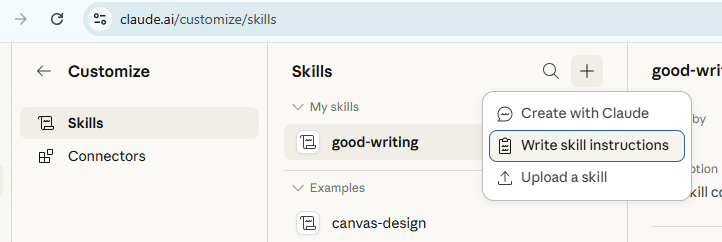
• Within the app, navigate to Customize > Skills and Create new skills
• Select add a new skill and Write skill instructions
• Copy and paste the copy from this file into the skill, making note of the name and description boxes. Feel free to tinker.
• Save your changes.
Note: The instructions in the linked file are Claude’s work, not mine. They came out of months of conversation, where Claude would analyze my style notes, and the file evolved from there. They read a little strangely because of that process. If I’d written them from scratch, they’d sound different. But looking at the file you can see what Claude responds to and how it works.
Claude will apply these instructions to every new conversation going forward. Existing conversations won’t pick up the change, so start a fresh chat to test it. If and when Claude struggles to apply the skill, call it out specifically in the prompt, such as, “Revise this for length using the good writing skill.”
The skill specifies constraints in a few categories and the instructions are plain text. As you go, you can also ask Claude to analyze previous conversations for suggested additions to the skill, which Claude will produce and implement within the chat. Each rule operates independently, so removing one doesn’t affect the others.
Claude processes custom instructions at the start of every conversation, before it generates any output. The instructions function as constraints on the model’s default behavior. The model doesn’t always follow every instruction perfectly and the results vary by task. You will still need to edit.
The dominant conversation is about whether LLMs can write well, but I suspect that’s the wrong frame. Human storytelling will probably always be more interesting than generated storytelling, because humans love quirks and novelty that can’t be produced artificially.
The more consequential change is that AI-generated text doesn’t just sit on the web waiting to be read, and instead feeds back into the system that produced it. It becomes training data, source material, and eventually, architecture. Remember: When an LLM generates text, it’s producing word sequences based on statistical patterns. The output is one plausible version to your prompt, not a definitive one — but it gets indexed, linked, and cited like any other writing. Nothing about its surface tells you it doesn’t carry the same authority.
Researchers call what follows “model collapse,” a feedback loop where models trained on AI-generated content lose touch with the range of human-produced data. The rare and specific details disappear first, then the middle narrows. Eventually what’s left is smooth, confident, increasingly generic text that sounds authoritative whether it’s accurate or not, which becomes the training data for the next round.
I’m thinking about it in terms of the shift from SEO to GEO. SEO preserved a connection between writing and human judgment. Someone wrote content, search engines indexed it, readers got a list of links and decided which to trust by comparing to their own experience and knowledge. This system was gameable through various sleights of hand, but it assumed a reader with agency. The creator’s job was to be easy to find and worth finding. Streaming video complicated this process but still worked with the same basic ideas. Meanwhile, GEO operates on a different premise. The goal isn’t to get found by a person, but to be found by an algorithm assembling a response the user may or may not independently verify.
Consider what happens to the same piece of writing in each system. In the SEO world, your article gets indexed, shows up in search results, someone clicks through, reads it, evaluates whether you or your institution is credible on the topic, maybe skeets it or sends it to a colleague. A human encountered your work, weighed it and decided it was useful, the algo responds and indexes accordingly.
In the old way, the reader moved through the web. AI yanks that experience into a single response from a single interface. We don’t fully understand how AI systems decide what to cite, which makes this power shift feel especially risky. Worse, different people will get different responses from LLMs, even using the same prompts and source materials. We don’t know why.
Fewer entry points to the web means fewer opportunities for diverse or unexpected sources to gain traction, which means the training data gets narrower, which means the outputs get more generic, which means the architecture narrows further, which means fewer perspectives represented in the output. For the reader, it accelerates context collapse in much the same way. Fewer inputs means fewer opportunities to stress test your ideas against new information.
So, what to do?
If generative AI grows as predicted, SEO and GEO will coexist for awhile, and working developers and communicators will need to understand both and how they layer. Strong SEO foundations give you a great head start in AI visibility too, so the fundamentals of good writing and web taxonomy still matter a lot.
But the production of knowledge, the keeping of data, and how it’s all indexed are subjects that are about to become very important, and very political. So I suspect that any fields that touch those topics will also become very important, and very political, very soon.
When I started building websites in the late ’90s, the line between writing and coding didn’t really exist. A person probably learned HTML because she had something to say and needed a place to put it. The internet was free and anonymous and it felt audacious to put your stuff online, like flinging a message in a bottle out to sea. The code was a container for the ideas that rendered them onscreen, and every post and page you published was both a piece of your thinking and a brick in something larger.
People forget that the early web was a writing community. Writers, or bloggers, built their own sites, maintained their own archives, linked to each other deliberately. A blogroll was both a reading list and a show of solidarity, a trackback was a way of saying, “I see you, I’m thinking with you.” The technical architecture - RSS feeds, permalinks, comment threads - existed to organize the writing and the writers’ thoughts, and to push their ideas forward on the open web.
This worked for a time. Communities of writers, most of them without institutional backing or media credentials, built new bodies of knowledge together through interacting as readers and writers, communicating across a foundation of code. The work didn’t stay online. It spilled into conference halls and state houses and newsrooms and policy discussions. As the body of communication built, it created something that accumulated over time. These people influenced mainstream journalism, shaped public conversations, launched careers and movements. In many ways, the national political conditions we face today are a reaction to that movement, and how it allowed regular people to influence the world through the democratization of mass communication.
Midway through the aughts, the brick and mortar publishers and venture capitalists started looking across the landscape, at all the writers creating fantastic content, largely for free, and sucked them into their content and editorial teams. Google Reader lost institutional and financial support as writers moved off the open web and onto publishing platforms, often backed by VC money, that measured the quality of your work by engagement. The addition of algorithmic feeds further broke down this structure – the algorithm doesn’t measure whether your work contributed to shared understanding, but whether it generated a click, a share. The code changed, and the writing changed with it.
The writers changed with it, too. The blogger became the influencer. Bloggers operated in a gift economy of ideas: you wrote to think, to argue, to contribute, and your standing in the wider community came from the quality of your work and contributions over time. Was it a meritocracy? No, but the conditions made it possible for a regular person to talk with experts as peers, which upended traditional power structures around authority and expertise (in both directions, good and bad). Meanwhile, influencers operate in a heavily capitalized attention economy where engagement converts to dollars. The audience is a market to press for money.
The gendered dimension of this shift matters as well. The early blogosphere was full of women writing sharp, rigorous work about politics, culture, parenthood, identity, and technology — work that was explicitly feminist and anti-racist and genuinely moved public conversations. This was the community I helped build (Feministe.us was my project, a community platform of writers and commenters whose coverage and discussion broadly fell under, but was certainly not limited to, the topic of feminism). When the monetized platforms absorbed that energy, the commercial model recast women’s online authority almost entirely in terms of consumer influence. What could we sell? And to whom? The framing around our work went from “this person has important ideas” to “this person can sell things to a niche market.” Meanwhile, men who’d built audiences through tech or political blogging were more likely to be absorbed into mainstream media as columnists and analysts, roles that kept their intellectual authority intact. The influencer label, with all its connotations of superficiality, landed disproportionately on women, and it stuck.
There’s a class piece here, too. The platform model offered something the early blogosphere mostly didn’t — a way to get paid. For women who’d been doing enormous amounts of unpaid intellectual labor building online communities, the question of monetization wasn’t shallow. The implications of information centralization and monetization were as present then as they are now with LLMs and AI. Some people figured out the social platforms and worked their way into viable digital careers. Platforms offered a lot of perks, but all of the perks had a backstop. Corporate interests introduced the problems of advertising, audience and sponsorship, which meant reorienting your individual practice around maximizing your commercial value over and above your intellectual contribution and community management skills. It often meant giving away some or all of your IP rights.
For most people, new system didn’t offer a viable way to get from “respected independent writer” to “respected, protected and compensated writer.” Many of us found ourselves in positions too precarious to take the leap into freelancing and social media, and some, like me, got regular jobs doing regular stuff. Some married money. And in the meantime, some folks figured out how to get into real journalism, which looks much different in 2026.
In our last session, I gave everyone the same task: ask your AI tool to summarize a single article in plain language. Every person got a factually accurate summary, but the style and depth of analysis varied widely from person to person. We tested this further by entering the same prompt multiple times. Each time, the output was slightly different. We copied and pasted everything into a shared document so we could compare side by side.
Later that day, I asked everyone to reopen the tool they’d used that morning and repeat the prompt that had worked best: summarize this article in plain language. The outputs shifted again. Some changed dramatically. One team member whose morning summary had been light and conversational received a much more formal, serious version in the afternoon.
I then asked Claude to compare the morning and afternoon versions of one summary. “In short, the morning version emphasizes practical implications and accessibility; the afternoon version prioritizes completeness and specificity. They complement each other well — someone reading both would get a fuller picture than either one alone provides.”
Why would Claude produce these differences despite the same source material and prompt?
I asked the source.
Even with the same prompt and source material, LLMs don't produce identical outputs each time. This is by design — there's a degree of randomness (called "temperature") in how the model selects words, which means each run produces a slightly different path through the text.
But the differences here go beyond random word choices. The morning version landed on a journalistic structure while the afternoon version landed on an academic one. That likely reflects what the paper calls sensitivity to framing and order effects — one of the cognitive biases it catalogs. Small, invisible differences in how the model’s internal processing unfolds at the start of generation can cascade into meaningfully different organizational choices. Once the morning version opened with a news-style framing, the rest followed that pattern. Once the afternoon version opened with a descriptive academic tone, it followed that thread instead.
This is actually a concrete example of the robustness issues the paper identifies. The underlying reasoning about the paper’s content is consistent across both summaries — neither gets the facts wrong. But the presentation varies in ways that weren’t requested, which means someone relying on just one version would get a subtly incomplete picture depending on which run they happened to see.
It’s a useful reminder that LLM outputs are one plausible version of a response, not the definitive one.
It’s important to understand how these tools work. What looks like an authoritative answer is really just one of many possible outputs the system could have generated. The text will sound plausible whether it’s accurate or not, and you may get different results each time you ask.
Researchers from Caltech and Stanford conducted the first comprehensive survey of how and why large language models (LLMs) — AI systems like ChatGPT or Claude — fail at reasoning tasks. Rather than focusing on what AI can do well, they cataloged and organized the ways it goes wrong.
Why it matters
LLMs are increasingly used in high-stakes settings, but their reasoning failures are often unpredictable and poorly understood. The researchers argue that systematically studying failures — like accident investigations in aviation — is essential for building more reliable AI.
The researchers created a framework with two dimensions:
• Type of reasoning: informal (intuitive, social), formal (logic, math), and embodied (physical, spatial)
• Type of failure: fundamental flaws built into the architecture; domain-specific weaknesses; and robustness problems (inconsistent performance when small details change)
Informal/intuitive reasoning
LLMs exhibit human-like cognitive biases — confirmation bias, anchoring, framing effects — but without human ability to recognize and correct for them. They also struggle with “theory of mind” (understanding what others believe or intend), and with applying consistent moral or ethical reasoning.
Formal/logical reasoning
LLMs often can’t reverse simple logical relationships (if they know “A is B,” they may not infer “B is A”). They struggle to chain multiple reasoning steps together. Basic counting and arithmetic fail in ways that seem surprising given their other capabilities.
Embodied/physical reasoning
LLMs have poor intuitions about the physical world — gravity, spatial relationships, object properties — because they’ve learned only from text, not from physical experience. This extends to visual AI systems as well.
Many failures trace back to how LLMs are trained: they predict the next word in a sequence rather than reasoning deliberately. This makes them good at pattern-matching but unreliable when tasks require genuine logical inference, especially under slight variations in how a question is phrased.
Researchers have proposed fixes including better training data, techniques that force step-by-step reasoning (like “chain-of-thought” prompting), connecting LLMs to external tools like calculators or physics simulators, and architectural changes. However, no single fix is comprehensive — many improvements in one area don’t transfer to others.
I have a confession. While experimenting with AI over the last year, I wondered what would happen if I crammed an unfinished novel draft, one I actually care about, into Claude. Claude is pitched as the LLM for writers, with Claude 3.7 Sonnet and 3 Opus widely regarded as the premier LLMs for writers, including creative writing, long-form content and human-like prose. Meanwhile, I majored in English and work in mass communications, so I’m trained to think about writing creatively, strategically and tactically. Writing and personal expression have been part of my daily life for most of my life. If this tool could in fact produce a quality story, someone like me should be able to make it happen. Instead, the experience left me confident that AI isn’t a good vehicle for creative, narrative writing.
Here’s what I found:
On the technical side, Claude struggled to maintain a narrative thread over time. The longer the chat, the more the bot drifted and eventually lost track of details and claims made about characters earlier in the plotline. It’s not a sustainable approach for narrative writers because continuity matters: outsource too much plotline to the bot and your characters lose relationship to one another.
LLMs like Claude work fine for writing support—they can function something like a synonym machine, helping writers work through technical questions of redundancy, register, length, and other semantic needs while drafting. But when you outsource world-building and meaning-making to an LLM, it becomes narratively confusing fast. Despite giving Claude extensive background on my primary characters and the world they live in, it would confidently declare that a character’s relationship to another was X, then claim the opposite on the next page. Dialogue was thin and expository. It preferred a sort of “maid and butler” style of dialogue where two characters artificially recap shared knowledge for the reader. Meanwhile Claude does not do feelings well, which is arguably the point of much narrative writing.
Ultimately my drafts were worse off than what I started with – less organized, more confusing, with so much narrative drift that almost nothing was usable, even as a first draft. A devil’s advocate might argue that my prompting wasn’t sophisticated enough to produce the results I wanted. Sure.
But then we have the second problem: Claude’s approach to storytelling isn’t narratively interesting. Fiction and narrative writers put tremendous energy into world-building and sensory experiences. The goal is to immerse the reader in a sensory experience so total that they can experience another world entirely – the original VR, if you will. A great writer even exploits your higher-level cognitive functions by reusing parts of the brain that evolved for action and perception, which is why a good story makes you think, feel, and wonder.
Claude does not feel or wonder. Claude collates.
A key part of this essay suggests that LLMs create meaning through triangulation – that by pinging other ideas and vocabulary, an LLM can get a human reader close, or close enough, to suffice in many cases of writing. In my experience, this is true enough in business writing, where tinkering with approach and register can become as important as precise verbiage.
But this misses the pleasure and the point of good storytelling, which is myriad but usually centers on the satisfaction of expanding your imagination and experience through narrative, by seeing your own messy, striving, failing, hopeful, and collective human experience reflected in another person’s expression. That kind of meaning-making doesn’t happen through triangulation. It happens through the labor of human thought, experience and skilled articulation. That’s art, babes.
This article gets into the mess of AI and creative writing, within the domain of the romance genre, which famously cranks out variations on romance themes at a rapid clip. It drills down into some of the debates about writing, authority and authorship in relationship to LLMs that are playing out across the publishing sector now. Remember: early research suggests that most writers who use LLMs as part of their workflow ultimately retain their sense of authorship in and around the tools, suggesting that even when writers adopt AI assistance, they still see themselves, not the tool, as the creative and accountable source. So based in my experience above, I suspect that if an AI approach to creative writing is successful, it’s because the author is linking her approach to emerging tech, not because the work is good, and that’s a difference worth distinction.
Something else I noticed in my experimentation with AI and creative writing: Claude prefers a mid-length, declarative sentence, while I prefer a lot of variety in my prose. Sentence variety is a primary consideration in any text-based communication approach. Write accordingly.
“Evidence from a study about workplace writers who use AI suggests that writers are outsourcing some of their research, editing, or drafting to AI, but that they retain responsibility for their writing.”
The move from a structuralist account in which capital is understood to structure social relations in relatively homologous ways to a view of hegemony in which power relations are subject to repetition, convergence, and rearticulation brought the question of temporality into the thinking of structure, and marked a shift from a form of Althusserian theory that takes structural totalities as theoretical objects to one in which the insights into the contingent possibility of structure inaugurate a renewed conception of hegemony as bound up with the contingent sites and strategies of the rearticulation of power.
This was my era in college, and I remember feeling challenged and overwhelmed as an undergrad trying to read theory for the first time. So today, I asked Claude.ai to put it in plain language, just to see what would happen. Here’s the after:
Scholars used to think that capitalism shaped society in consistent, predictable patterns. But newer thinking focuses on how power works—how it repeats, overlaps, and gets reshaped over time. This brought time into the picture and moved away from older theories that treated social structures as fixed. Instead, recognizing that structures can change opened up a new way of understanding power: it's tied to specific moments and strategies, and it's always being renegotiated.