Garbage Day asks what all the new embedded AI agents are for.
Garbage Day asks what all the new embedded AI agents are for.
I’ve spent the last few months annoyed with the incomplete retrospectives around writers and writing online and how we all got here. At work, I use a portfolio perspective to understand working groups, and used a couple of AI approaches to build out a highly contextual, and likely contested, interactive map charting some of the major players and influences around the feminist blog years, the major platforms, their cultural impacts and major publications. These are case studies and cohorts based on my personal angles mixed with authoritative resources, including a highly annotated bibliography.
Does this feel slimy? I concede it may. But it demonstrates the value of personal writing and thoughtful design in digital spaces despite its many gaps and flaws.
Enjoy and tinker. Feedback is welcome. I’ll have some notes on my approach and why many of these findings remain heavily qualified in the coming weeks.
Reading about yesterday’s Meta settlement, the global movement to get kids off tech, “chopped uncs,” and thinking about the dance between students and our local school system’s IT department during the COVID-19 shutdown, when my then-elementary schooler was unwittingly participating in a digital cold war:
In our community, the kids were in remote learning for a full year and a half, and the IT department chased them around their approved digital tools like a game of whack a mole, shutting down access to chat and collaboration. In the meantime, almost no socialization happened between students that wasn’t directly observed by teachers. By 2021, the kids were engaged in secret, digital note-passing, chatting within Google docs and PPT slide decks and Pinterest DMs to avoid teacher surveillance on their approved tools. Where there is a will to socialize, there is a way.
Business Insider provides an update on how teen social media bans are going in Australia, and it’s not great! After a few months, kids steadily got back online, nearing or matching pre-ban levels.
“We all know that you can get lied to online at any point. If you don’t get that this is an obvious lie, then you’re washed and you’re unc and you’re chopped.”
Garbage Day uses Jimothy to trace how virality works on the internet of 2026. Related: this story on how the algorithm has prevented us from producing a single “song of the summer.”
This is a pretty good Tiktok breaking down the historical, cultural and religious meanings invoked in the “computah” memes. An important rule of the internet: the best memes are intertextual.
Scheduled send as alibi? Nice try, Costanza.
Some media and ad-tech operations hire “clippers,” people who cut and distribute high volumes of short video across social platforms, to manufacture cultural relevance. The strategy in short: volume generates attention, and attention confers legitimacy.
More on user-generated content marketing and how it works. UGC is a powerful example of “social proof,” where people’s parasocial tendencies are leveraged to boost brand credibility and conversions. This is the consumer psychology behind celebrity and influencer sales and endorsements.
Watching the fallout: Fans discovered that the band Geese benefitted from a hefty marketing campaign. Folks are debating whether this makes Geese a “psy-op” or merely “sell-outs”, to use an old term of art. Meanwhile the marketing firm behind the push is getting a ton of attention in its own right.
Garbage Day on what makes something cool to Gen Z, and how this is impacted by the degradation of “pillars of coolness” in previous generations like culture rags and MTV. GD predicts that “cool” will be measured by lack of polish and “how many human beings left their house to experience it.”
This post and the accompanying graphs have been a trending topic on social all weekend, particularly on Twitter/X, which is negatively implicated in the findings. In short, social media looks weirder than ever.
Regarding dinergoth, a rebrand of an old trope: “Alt kids are the social fabric of the most economically depressed, culturally conservative corners of America and have been for a very long time.”
That was fast: Afroman cleared of charges. Also noticed that in an amicus brief, the ACLU argued that the deputies’ lawsuit was a classic SLAPP approach, referring to a type of lawsuit that seeks to discourage criticism of public officials by burdening individuals with lawsuits in retaliation for talking about state wrongdoing.
Rapper Afroman is going ultra viral this week as his “Lemon Pound Cake” trial plays out in the news. He captured the raid on security cameras in his home and used the footage in a series of songs, videos and merch. He ultimately did not face charges after the search, and argues (with evidence) that the police broke his door and stole $400, which provides the platform and substance for everything that followed. He argues the police shouldn’t have been there at all, and didn’t follow protocol when they were, and that as a citizen and artist he’s expressing his feelings about it in his preferred medium. Is this a winning legal strategy? Time will tell.
In the meantime he’s winning at public opinion. The trial is shaping up in the public view as a defamation vs. free speech trial, with the artist’s prolific work about this no-knock raid performed at his house, itself arguably unethical, held up as harassment by the officers who did the job. True crime, legal experts and court watcher accounts are going gangbusters providing cultural and legal analysis alongside video of court testimony. It helps that the court footage is a rich text — both hilarious and revealing.
Meanwhile: another first amendment case in and around rap lyrics is playing out now. A brief history of rap and the First Amendment.
Big internet controversy over dress codes in chain restaurants.
Forgive me, but I’d like to propose we call this a “sloppelganger.”
Do you have what it takes to be the next McDonald’s CEO? A quiz about this week’s funniest business story.
You might call this a taste test: Obsessed with the story about the McDonald’s CEO and how his LinkedIn-style videos selling the McD’s franchise have escaped containment, leading to one of the funnier CEO/product marketing dynamics in recent history. Burger King’s CEO swooped in, holding widely-marketed listening sessions with customers and to demonstrate his love for the Whopper in contrast with the deeply weird McD’s videos. Must read: Internet long-hauler Katie Notopoulos on how direct-to-public marketing works when the public is more familiar with the product than the org’s leaders.
My teenager thinks fast food is cool and subversive (cue the sound of one hundred moms groaning) and she and her friends regularly talk shop. They are Taco Bell fans and think burger stops are kind of gauche. Not gauche: Baja Blast.
In the meantime, the fast food sector is becoming a playground for AI approaches, causing a lot of nervous discussion on social media and in tech spaces.
Ryan Broderick is currently my fav reporter on the Internet culture beat, and on this podcast he’s talking about Epstein and why he was interested in putting his resources to developing the early internet (spoiler: for crimes).
Like Rickrolling on steroids: I didn’t even know P2P music file downloads were still a thing, but of course, and the scene had a big week recently when somebody trolled SoulSeek by generating a bunch of popular songs sung in Homer Simpson’s voice, then quietly polluted the platform by offering the AI generated Homer files up to other users. Someone then set up a digital radio station of all the Homer Simpson songs called D’oh Radio. Here’s more reporting from Gizmodo.
There is a long tradition of Simpsonifying things that go online, so this is the latest iteration. We observed Homer covers going viral on social in 2024 and 2025.
“Digital silence” is a new ethic emerging on the visual web, where travelers are no longer posting about their travels. Reading along, thinking of how I rarely post about family out of respect for their privacy, and recently took several road trips without a single post.
The last time I went truly viral was in April of 2020 in the height of the COVID shutdown. I posted a tweet and walked away from my phone. By the time I checked back, my notifications were out of control.
The next morning, I got a message from an old friend familiar with my handle. “I think I saw your account on Good Morning America?” Hilariously, there I was, and I couldn’t even claim responsibility for the meme.
I’ve spent most of my time on the internet as a pseudonymous account, using my first name only, or using a handful of handles (incl feministe, fauxrealtho, flotisserie, paired with punny names like “Petty White” and “Frieda People,” a convention from the Tumblr years). Even as a visible personality online, I was only known by my first name and URL and/or handle. In recent years I de- and reactivated some of my socials, so some of these breadcrumbs no longer exist, but I’ll do my best.
Pseudonymity allows writers to explore complex ideas in digital spaces while protecting their identity, location, and other identifying factors, while also maintaining a throughline of identity and storytelling.
There are a lot of trade offs in using a pseudonym, especially around how to claim credit for your work. But people use them because they give you the privacy to be honest, real, weird, authentic, and to escape the creep of modern social media presence into high stakes spaces like the workplace. This dynamic was kind of the impetus behind the era of “weird Twitter,” where people using pseudonymous social handles routinely threw out funny, absurdist one-liners to impress their friends and followers, while taking a turn at the social media slot machine. Not every post or joke lands in a way that converts to numbers, but some do, and it’s fun to try.
I’ve written a little previously about how the English program I was a part of used fiber arts to illustrate the fundamentals of technical writing, but one of their other methods of teaching the internet was through board games. Games, like the internet, and much like writing, provide rules and structure for communication and engagement, but everything that happens inside the container of game board and game play is a mystery until it emerges through human interaction. So goes the internet (and to some extent, so goes AI). Games and gaming were used as a method to think through what it means to create rules of play, then let a community rip through the model – and many of the thinking and skills involved around game design apply in social digital spaces, from chat rooms and Teams channels to the open seas of the WWW. The longer you’ve been playing the slot machine, the more you get a feel for the kind of thing that will get seen and read, and who among your readership will take your content to the next level.
Why does it matter? Because understanding what “works” to make ideas travel further online, the more you can tap into it. Big Tech is under fire right now for amplifying some of the worst impulses of the internet, by cranking engagement algorithms to exploit messages that produce outrage. Yes, big emotions create virality, but so do relatability and sharability.
So back to the meme: here’s how it went down.
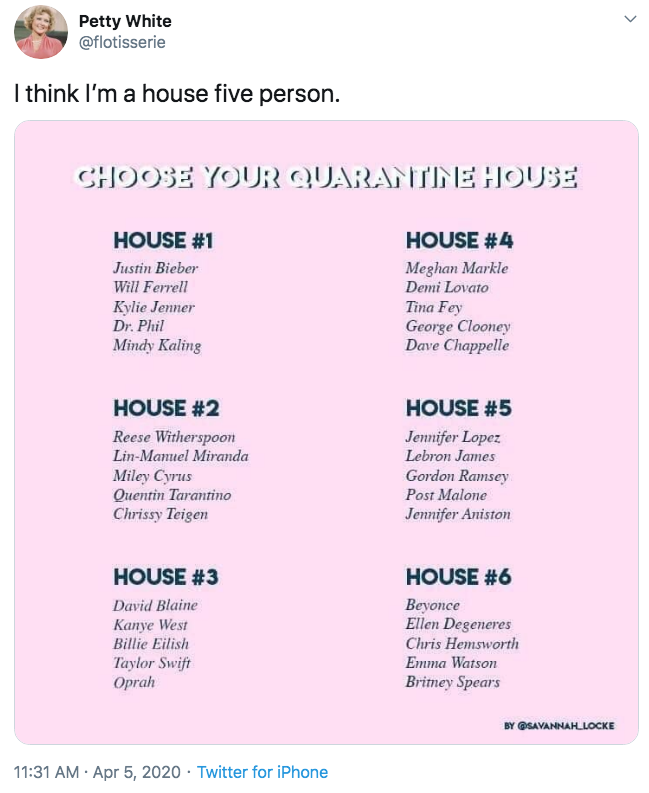
The meme was a list of six hypothetical celebrity households: pick one to quarantine in.
It had been circulating on Facebook, started by a Christian influencer named Savannah Locke. I encountered it deep in a Real Housewives fan group, and felt the pull of a good parlor game. In April 2020, everyone I knew was sitting at home, fretting about the COVID-19 pandemic looming over all of us, so I shared it with minimal ceremony, a couple of buddies with a slightly larger following hit retweet, and within two days the tweet was being cited by The Cut, Time, the Washington Post, ABC News, and others. Know Your Meme documented it for posterity. Several outlets named me as the originator, but trust, I was only trying to delight my friends with low grade Facebook content. I couldn’t find the original meme at the time – Locke appears to have had a name change that scrambled my search. But hey, as these things go, nobody earned a dime or promoted anything weird, so no harm, no foul. Business Insider managed to credit it correctly, so a special kudos to their editor.
The core game mechanism behind the meme is forced choice: constraints generate opinions and opinions generate activity. Each “house” also represents a personality type. House 3 is chaos, House 6 is aspirational, House 5 is the one where someone is definitely cooking and someone is definitely yelling about it. The choices are arbitrary, which invites curiosity about who grouped what and why. In short, this meme offered a light conversation starter at the right time, with low stakes, high personal reveal, and endlessly discussable combinations. It also drew from existing memes and games that are popular online, like “where you sitting” in the proverbial lunch room. This one became news because of the timing and gamability, not because I was particularly clever, but hey.
What does it feel like to go so viral? It’s hilarious, strangely affirming, and also a little crazy-making. It opens the door to a whole lot of wild people and ideas on the internet, not all of them flattering or welcome. Virality is sometimes paired with incredible harassment and requires “more condolences than congratulations.” But as far as this particular experience went – hilarious, whoops, and wow. It just felt like a Lebron James, Post Malone and Jennifer Aniston hang would be a good time.
French overlooks how smartphones and social media raised the stakes on debate and discussion, transforming campus discourse. Today’s students worry that one viral misstep (in countless directions) may define them forever.
France is taking the “not now, sweetie, mommy is cyberbullying the mayor” meme to new legal arenas.
“LOLgislation,” or how memes become policy, and posting becomes praxis.
For many years, “shitposting” has been a staple of internet culture in which individuals riff on the moment using nonsense and irony, derailing threads for fun. In today’s influencer-driven attention economy, however, shitposting as a practice is now a meaningful comms and engagement strategy.
Gap capitalized on the Sidney Sweeney “good genes” controversy by doing this collab with Katseye, the global pop group where each member is a different nationality. Each member of the pop group dances through in black and brown jeans.