Does this feel slimy? I concede it may. But it demonstrates the value of personal writing and thoughtful design in digital spaces despite its many gaps and flaws.
Enjoy and tinker. Feedback is welcome. I’ll have some notes on my approach and why many of these findings remain heavily qualified in the coming weeks.
When tech enthusiasts discuss federation today, they usually mean open protocols like ActivityPub or Mastodon. But in the 2000s, the feminist blogosphere was one of the earliest, most powerful examples of practical Web 2.0 federation, a decentralized, cross-site architectural network where open web standards powered a global ideas lab.
Instead of sitting inside a single corporate platform (like today’s X, Meta, or Substack), early blogs like Feministe, Reappropriate and Jezebel functioned as individual nodes in a federated ecosystem. Open protocols linked them, letting theory, critique and discussion travel seamlessly across independent servers, seeding some of the political conditions we face today.
1. Federated communication engine: CMS and protocol
Before quote-tweeting or tagging existed, the open web used Trackbacks and Pingbacks. If a post on Feministe analyzed an article about reproductive rights, a writer on Racialicious or Shakesville could respond on their own site. The underlying blogging software (Movable Type, WordPress) would automatically send an XML RPC “ping” back to Feministe.
Socially, this created architecture for ideas: a ping automatically listed the response essay in Feministe’s comment section or sidebar. Readers didn’t just consume one blogger’s singular and authoritative opinion; they could immediately follow the thread across five different independently hosted platforms. This created an inter-site conversation tree, allowing complex ideas to be cross-examined, refined, or challenged without any single person controlling the narrative.
2. Blogroll as federated curation and mutual discovery
Before algorithmic feeds dictated what readers saw, blogs relied on the Blogroll, a curated list of links in the site’s sidebar. Blogrolls formed a human-curated, decentralized routing layer. When a high-traffic node like Feministe added a smaller, independent blog (such as a disability rights blog like FWD or a smaller blog like Crunk Feminist Collective) to its blogroll, it directed server traffic directly to that independent domain.
Socially: This was a non-algorithmic way to expand the collective’s political consciousness. It allowed marginalized perspectives to build their own audiences and force mainstream feminist sites to engage with race, class, disability and queer theory. The blogroll mapped an intellectual community in real time – with strong caveats.
3. Open syndication protocols
The Architecture: Feeds ran on RSS (Really Simple Syndication), an open XML standard. Readers used independent RSS aggregators (like Google Reader or Bloglines) to subscribe directly to a site’s feed.
Socially: RSS meant no algorithm stood between the writer and the reader—no engagement bait, no rage-farming optimization, and no platform throttling links. Writers could publish 5,000-word, dense theoretical essays knowing their subscribers would receive the complete text in chronological order as designed. This structural stability gave writers the freedom to experiment with complex, “thick” personal narratives and political theory.
4. Real-time stress testing and spillover moderation
Because the blogosphere was a network of independent domains, each site maintained its own “house rules” and moderation policies. If a topic proved too controversial or toxic for one comment section, the conversation naturally federated outward. A reader who felt silenced or misunderstood in one blog’s comments could launch their own blog, write their response, and ping back into the original discussion.
Socially, this prevented any single author from monopolizing the narrative. It created a system of checks and balances where academic concepts (like intersectionality, rape culture, or microaggressions) were stress-tested across dozens of distinct, interconnected communities simultaneously.
Thinking about this architecture today
The feminist blogosphere proved that decentralized web protocols can generate deep, movement-building intellectual work. When platforms like Facebook, Twitter, and corporate media conglomerates centralized the internet in the 2010s, they broke those open connections. Conversations were locked behind platform walls, trackbacks were abandoned and RSS was marginalized, breaking, fencing and otherwise moderating independent community connections.
Rebuilding a modern “ideas lab” with modern federated protocols (like Webmentions, ActivityPub, RSS, and static site architecture) is simply picking up the technical blueprint OG feminist bloggers used to transform digital culture two decades ago.
A linklog is a dated list of outbound links, maybe a tag, and a note about why it’s worthwhile. But that little note does two things at once, and together they make for a better web.
First, it’s a way of organizing the web. The web doesn’t sort itself, so finding good information depends on someone curating and tracking interesting content, preferably on the open, free internet. It acts as a customizable bookmark library: newest at the top, tags to group items, and a line explaining why the link was worthwhile. This is similar to what del.icio.us did, where people grouped and tagged links, creating a rough filing system.
Second, it’s a social act. An outbound link points to someone else’s work, so a linklog is essentially a renewable engine for sending traffic to other people and places. It stays renewable because the content is easy to sort and remix: a URL’s relevance no longer depends on where an algorithm or activity feed happens to place it, so older links can keep resurfacing instead of scrolling out of reach. That’s the precise opposite of what big platforms design for audiences; platforms such as Twitter, Instagram and Facebook quietly bury posts with outbound links to keep your attention (and dollars) on their site and with their advertising customers, losing relevance after one interaction. A linklog explores the opposing dynamic: it willingly hands your audience and attention away while crediting your forebears, comrades, mentors and co-conspirators. It turns the rough digital filing system into a “folksonomy,” if you will.
Compare these dynamics to an algorithmic feed on a platform. An algo also sorts the flood of content, but computer magic does the sorting, and someone else monetizes your attention and relationships and hoards your data. “Engagement” for these companies is primarily a measure of how long you stay on their platform with their content. The goal is to keep you scrolling and the ad revenue rolling. But over here on the indie internet, our goal is to build human communities online and connect people to quality information, tools, ideas and processes.
In this sense, a linklog is an easy way to be an opinionated curator and a decent neighbor at once, by hosting and sharing with thoughtfulness and deliberation. Out here, my data is also likely being scraped, but I have far more control over what data is findable, shared, and shareable, and over what is investigable and degradable over time.
Posting a lot while I get through the inbox today. Among other stories, WordPress is offering free hosting to students, marketing WP as a way to change how people relate to their own writing. Does a self-hosted public blog make students think differently about audience than a school LMS post does?
I spent a little time with the blog last night and pulled together two new site features using Claude Cowork. The last time I experimented significantly with Claude like this was to use Claude chat to build the link log from scratch, walking it through my thinking in plain language, then copying and pasting its suggestions into the backend of the site and hitting publish. This time I used Cowork, the tool that runs in the browser, and it clicked through the screens itself, fully taking on the execution of tasks. I have some coding skills, but not the kind these changes required. If I were taking this on, I would need YouTube, Hugo for Dummies, and my own personal IT guy, and still probably couldn’t pull it together.
Last night I asked a few things of Claude:
I asked Claude Cowork to get into the backend of the micro.blog site and change my theme to link each line in the linklog back to my original post. The date field in the right column now links back to the original post for each link logged. No problem, easy request with easy execution. I made the request, confirmed the plan, and went about my business while Claude made the edits.
I also asked it to analyze my post content and suggest category tags for groups of content, then to label that content correctly in the backend. Claude reviewed about 500 posts and suggested I add a few new categories to my blog: AI in Practice, Books & Reading and Writing & Language. Then I set up some auto-filters to run at publish time to automatically categorize posts based on keywords moving forward.
Finally, I manually added the archive page, which lets you sort posts by category or year. This means I now have a functional archive here. Enjoy my anodyne thoughts, dear reader.
Adjacent to my day job, I’ve been toying with Claude Pro now for about a year; in my experience, it has improved significantly within the last six months. It’s not perfect: my requested edits were completed, but it also changed the CSS on the linklog so some of the text is too light to read, which I didn’t ask for and don’t want. But it has arguably extended my ability to execute on work that requires skills I don’t otherwise have (such as design and coding). What I do bring to the table is an expansive practical background in publishing and production, and all the language to describe it.
Winer on the purpose of web standards: “I find that most standards that come out of the standards bodies aren’t developed by implementors or with them in mind. They avoid trying to solve any specific problem, rather focusing on the elegance and flexibility of the format. This makes interop much less likely. I saw the differences several times as the web standards were growing up.”
Looking back at the feminist blogging era with the benefit of my current experience, I’d argue that what made Feministe different from our peer blogs was the commitment to convening the audience and sharing the platform without packaging it up for or selling to advertisers. That was largely my boundary – with as much market space as it commanded for the time, it was never monetized at scale, though individual contributors were free to use it as they wanted to build their audiences. We eventually committed to a small advertising carousel to cover hosting costs.
I recall someone balking at me for refusing to broadly monetize when I spoke at Blogher in 2005, but it was a hard line, for better or worse.
I heard a good talk on “slow brain” activities this week and have been thinking about that alongside indie web practices. I’m not alone: how to leave your feed and go exploring again.
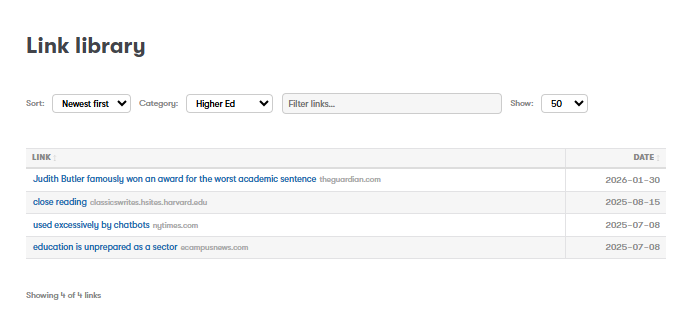
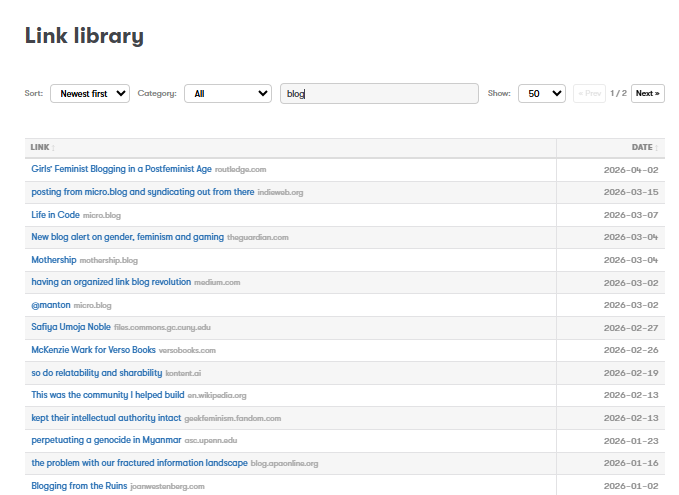
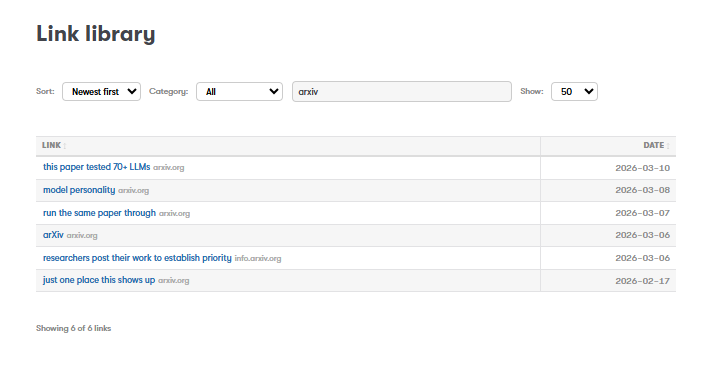
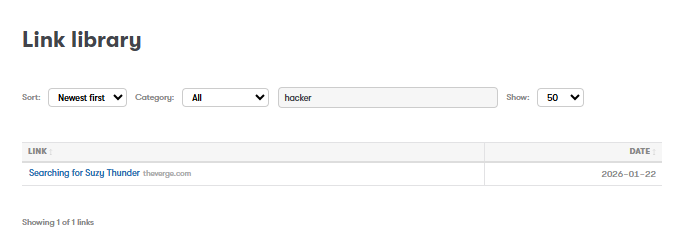
Testing a new feature I created using a mix of open source code and Claude, hoping I didn’t break my own site. I pulled together a dynamic link library using a Hugo partial and some shortcode that automatically catalogs all of my outbound links into sortable lists.
Turned on a couple of micro.blog site features: if you’re reading this feed on a social site (Mastodon, Bsky, Threads), I’m posting from micro.blog and syndicating out from there. Replies from federated social sites (Bsky, Mastodon) are now syndicated on my site as comments under my blog posts.
Pulling everything she’s ever posted back to her own website: Lisa Charlotte Muth flips POSSE to PESOS, “Publish Elsewhere, Syndicate (to your) Own Site.”
Excited about Inkwell, a contemporary treatment of the classic RSS reader.
Telling the gods: I would love a micro.blog plugin that provides an easy way to bulk-manage post categories. If there is one, lmk.
Some content notes: while I haven’t quite figured out how much I want to broadcast this space, I have put a couple of feedback mechanisms into place, including an email loop as well as turning on comments for those logged into micro.blog, Bluesky and Mastodon. If you’re reading along, say hello.
I’ve been spending more time in tech spaces online and getting good information from folks like @manton, creator of Micro.blog. Like this reflection on how to think about AI now that vibe coding works. Something I’m thinking about: there’s an emerging tension between those who see value in being able to immediately prototype an idea and the people downstream who have to manage the outputs/code over time. The ability to proof every idea sounds like a superpower until you’re the one driving and maintaining the results.