Both books were published on March 10, and both authors are talented, with impressive bylines, with significant followings baked in. Incidentally, they come from the same cohort we loosely refer to as “feminist blogging,” though both would probably bristle at the description. And both use autoethnographic methods to leverage their personal lives to tell bigger stories about social, cultural and economic dynamics (a common method among feminists, where the personal is often made explicitly political). Lemieux goes further by including a series of essays by other Black single mothers at the end of her book, expanding the frame from memoir into something more collective, a full bloom.
West’s book has gone ultra viral over the last few weeks while Lemieux’s has found significantly less footing. West’s work is being spectacularized in real time, while Lemieux’s support has been mostly grassroots, respectful (thankfully), and largely limited to Black media outlets and NPR. This reproduces one of the oldest patterns in feminist media: a white woman’s confessional work circulates as universal or spectacular (West is being treated like a spectacle currently, which is great for sales and visibility but comes with negative trade-offs), while a Black woman doing rigorous, arguably more structurally ambitious work gets categorized as niche, an outlier. That this is happening within the very audience that would generally name and critique this dynamic in any other context makes it worth sitting with.
While I respect both authors and their bodies of work, I am looking forward to Lemieux’s book because I know firsthand how difficult it is to get a publisher and an audience for serious, foundational work like this. I suspect it will prove relevant long after the viral moment is over.
A note on Ezra Klein: I’ve been looking across the NYT’s breathless reporting on the AI industry and seeing very few women represented across the commentary. Klein’s tech coverage tends to center a fairly narrow circuit of sources: founders, researchers, and policy thinkers who are overwhelmingly male and concentrated in a few institutions, and generally assert the inevitability of disruptive AI as a matter of course. Meanwhile, Anthropic and others are anticipating that career ladders where women are concentrated will be impacted, some claiming professional women’s jobs will dry up or disappear entirely.
I looked over his podcast guests for the last year and noticed that among his tech-focused guests, almost all white, almost all men, almost none of them are women. A rough count of eight podcasts (nine if you stretch) with accompanying commentary only produced two women, both economists. Klein’s brand is the guy who does the reading, the big ideas guy. So it’s worth asking what he’s reading and whose ideas he considers big. While he probably wouldn’t disagree with Gebru or Crawford or Noble on the substance, his current body of commentary is pulled toward the perspectives of people who have the most to gain from the technology’s expansion and the least exposure to its costs.
McKenzie Wark for Verso Books on Donna Haraway, in 2015: “Creating any kind of knowledge and power in and against something as pervasive and effective as the world built by postwar techno-science is a difficult task. It may seem easier simply to vacate the field, to try to turn back the clock, or appeal to something outside of it. But this would be to remain stuck in the stage of romantic refusal. Just as Marx fused the romantic fiction that another world was possible with a resolve to understand from the inside the powers of capital itself, so too Haraway begins what can only be a collaborative project for a new international. One not just of laboring men, but of all the stuttering cyborgs stuck in reified relations not of their making.”
My life is work right now, so I’ve been training my reading and writing habits in that direction in the hope it will be additive. So when a friend who works in tech suggested I pick up some Ellen Ullman, I snapped it up. Ullman was a programmer who wrote about her experience as a woman in tech in the 1990s, a diligent personal accounting of the early days of Silicon Valley that foreshadows so much of what people are worried about today. Through her first person account of life as a programmer, she consistently reminds the reader that computers are made of boxes and wires, with choices made by mortals (often imbued with dreams of immortality) written on chips and tape, and are limited to only know what we tell them. The Y2K essay was an especially welcome reminder in the era of “singularity” — we’ve been here before.
The last time I went truly viral was in April of 2020 in the height of the COVID shutdown. I posted a tweet and walked away from my phone. By the time I checked back, my notifications were out of control.
The next morning, I got a message from an old friend familiar with my handle. “I think I saw your account on Good Morning America?” Hilariously, there I was, and I couldn’t even claim responsibility for the meme.
I’ve spent most of my time on the internet as a pseudonymous account, using my first name only, or using a handful of handles (incl feministe, fauxrealtho, flotisserie, paired with punny names like “Petty White” and “Frieda People,” a convention from the Tumblr years). Even as a visible personality online, I was only known by my first name and URL and/or handle. In recent years I de- and reactivated some of my socials, so some of these breadcrumbs no longer exist, but I’ll do my best.
Pseudonymity allows writers to explore complex ideas in digital spaces while protecting their identity, location, and other identifying factors, while also maintaining a throughline of identity and storytelling.
There are a lot of trade offs in using a pseudonym, especially around how to claim credit for your work. But people use them because they give you the privacy to be honest, real, weird, authentic, and to escape the creep of modern social media presence into high stakes spaces like the workplace. This dynamic was kind of the impetus behind the era of “weird Twitter,” where people using pseudonymous social handles routinely threw out funny, absurdist one-liners to impress their friends and followers, while taking a turn at the social media slot machine. Not every post or joke lands in a way that converts to numbers, but some do, and it’s fun to try.
I’ve written a little previously about how the English program I was a part of used fiber arts to illustrate the fundamentals of technical writing, but one of their other methods of teaching the internet was through board games. Games, like the internet, and much like writing, provide rules and structure for communication and engagement, but everything that happens inside the container of game board and game play is a mystery until it emerges through human interaction. So goes the internet (and to some extent, so goes AI). Games and gaming were used as a method to think through what it means to create rules of play, then let a community rip through the model – and many of the thinking and skills involved around game design apply in social digital spaces, from chat rooms and Teams channels to the open seas of the WWW. The longer you’ve been playing the slot machine, the more you get a feel for the kind of thing that will get seen and read, and who among your readership will take your content to the next level.
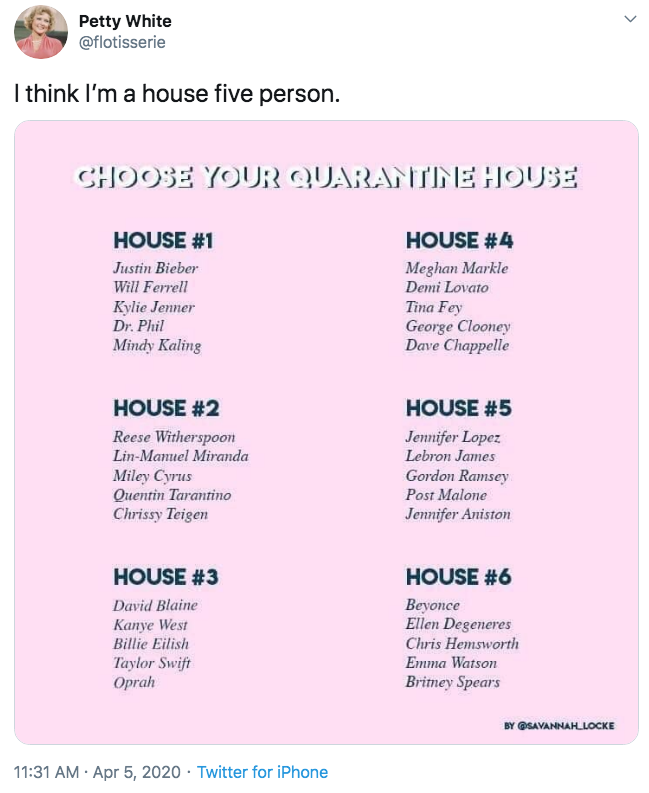
The meme was a list of six hypothetical celebrity households: pick one to quarantine in.
It had been circulating on Facebook, started by a Christian influencer named Savannah Locke. I encountered it deep in a Real Housewives fan group, and felt the pull of a good parlor game. In April 2020, everyone I knew was sitting at home, fretting about the COVID-19 pandemic looming over all of us, so I shared it with minimal ceremony, a couple of buddies with a slightly larger following hit retweet, and within two days the tweet was being cited by The Cut, Time, the Washington Post, ABC News, and others. Know Your Meme documented it for posterity. Several outlets named me as the originator, but trust, I was only trying to delight my friends with low grade Facebook content. I couldn’t find the original meme at the time – Locke appears to have had a name change that scrambled my search. But hey, as these things go, nobody earned a dime or promoted anything weird, so no harm, no foul. Business Insider managed to credit it correctly, so a special kudos to their editor.
The core game mechanism behind the meme is forced choice: constraints generate opinions and opinions generate activity. Each “house” also represents a personality type. House 3 is chaos, House 6 is aspirational, House 5 is the one where someone is definitely cooking and someone is definitely yelling about it. The choices are arbitrary, which invites curiosity about who grouped what and why. In short, this meme offered a light conversation starter at the right time, with low stakes, high personal reveal, and endlessly discussable combinations. It also drew from existing memes and games that are popular online, like “where you sitting” in the proverbial lunch room. This one became news because of the timing and gamability, not because I was particularly clever, but hey.
What does it feel like to go so viral? It’s hilarious, strangely affirming, and also a little crazy-making. It opens the door to a whole lot of wild people and ideas on the internet, not all of them flattering or welcome. Virality is sometimes paired with incredible harassment and requires “more condolences than congratulations.” But as far as this particular experience went – hilarious, whoops, and wow. It just felt like a Lebron James, Post Malone and Jennifer Aniston hang would be a good time.
When I started building websites in the late ’90s, the line between writing and coding didn’t really exist. A person probably learned HTML because she had something to say and needed a place to put it. The internet was free and anonymous and it felt audacious to put your stuff online, like flinging a message in a bottle out to sea. The code was a container for the ideas that rendered them onscreen, and every post and page you published was both a piece of your thinking and a brick in something larger.
People forget that the early web was a writing community. Writers, or bloggers, built their own sites, maintained their own archives, linked to each other deliberately. A blogroll was both a reading list and a show of solidarity, a trackback was a way of saying, “I see you, I’m thinking with you.” The technical architecture - RSS feeds, permalinks, comment threads - existed to organize the writing and the writers’ thoughts, and to push their ideas forward on the open web.
This worked for a time. Communities of writers, most of them without institutional backing or media credentials, built new bodies of knowledge together through interacting as readers and writers, communicating across a foundation of code. The work didn’t stay online. It spilled into conference halls and state houses and newsrooms and policy discussions. As the body of communication built, it created something that accumulated over time. These people influenced mainstream journalism, shaped public conversations, launched careers and movements. In many ways, the national political conditions we face today are a reaction to that movement, and how it allowed regular people to influence the world through the democratization of mass communication.
Midway through the aughts, the brick and mortar publishers and venture capitalists started looking across the landscape, at all the writers creating fantastic content, largely for free, and sucked them into their content and editorial teams. Google Reader lost institutional and financial support as writers moved off the open web and onto publishing platforms, often backed by VC money, that measured the quality of your work by engagement. The addition of algorithmic feeds further broke down this structure – the algorithm doesn’t measure whether your work contributed to shared understanding, but whether it generated a click, a share. The code changed, and the writing changed with it.
The writers changed with it, too. The blogger became the influencer. Bloggers operated in a gift economy of ideas: you wrote to think, to argue, to contribute, and your standing in the wider community came from the quality of your work and contributions over time. Was it a meritocracy? No, but the conditions made it possible for a regular person to talk with experts as peers, which upended traditional power structures around authority and expertise (in both directions, good and bad). Meanwhile, influencers operate in a heavily capitalized attention economy where engagement converts to dollars. The audience is a market to press for money.
The gendered dimension of this shift matters as well. The early blogosphere was full of women writing sharp, rigorous work about politics, culture, parenthood, identity, and technology — work that was explicitly feminist and anti-racist and genuinely moved public conversations. This was the community I helped build (Feministe.us was my project, a community platform of writers and commenters whose coverage and discussion broadly fell under, but was certainly not limited to, the topic of feminism). When the monetized platforms absorbed that energy, the commercial model recast women’s online authority almost entirely in terms of consumer influence. What could we sell? And to whom? The framing around our work went from “this person has important ideas” to “this person can sell things to a niche market.” Meanwhile, men who’d built audiences through tech or political blogging were more likely to be absorbed into mainstream media as columnists and analysts, roles that kept their intellectual authority intact. The influencer label, with all its connotations of superficiality, landed disproportionately on women, and it stuck.
There’s a class piece here, too. The platform model offered something the early blogosphere mostly didn’t — a way to get paid. For women who’d been doing enormous amounts of unpaid intellectual labor building online communities, the question of monetization wasn’t shallow. The implications of information centralization and monetization were as present then as they are now with LLMs and AI. Some people figured out the social platforms and worked their way into viable digital careers. Platforms offered a lot of perks, but all of the perks had a backstop. Corporate interests introduced the problems of advertising, audience and sponsorship, which meant reorienting your individual practice around maximizing your commercial value over and above your intellectual contribution and community management skills. It often meant giving away some or all of your IP rights.
For most people, new system didn’t offer a viable way to get from “respected independent writer” to “respected, protected and compensated writer.” Many of us found ourselves in positions too precarious to take the leap into freelancing and social media, and some, like me, got regular jobs doing regular stuff. Some married money. And in the meantime, some folks figured out how to get into real journalism, which looks much different in 2026.
It feels like there’s something to take forward from the experience.
Searching for Suzy Thunder: In the ’80s, Susan Headley ran with the best of them—phone phreakers, social engineers, and the most notorious computer hackers of the era. Then she disappeared.
I suspect these three trends are connected: Women reportedly use AI at significantly lower rates than men—25 percent lower on average—in part because they’re more concerned about ethics, including privacy, consent and intellectual property. At the same time, countries with more positive social media experiences tend to be more open to AI, while Americans’ distrust is shaped by years of watching tech platforms erode trust. Meanwhile, one of the largest social platforms has turned its AI chatbot into a harassment tool—generating roughly one nonconsensual sexualized deepfake image per minute, disproportionately targeting women and girls.
While I’m cleaning up the cruft around my social presence, I’m finding more references to the heyday of blogging that explain how people organized online (Web 1.0) before the era of platforms (Web 2.0). One is this interview with Jill Filipovic, my one-time co-blogger and comrade at Feministe, with the folks at LGM who interviewed me on the subject a few years ago. Jill and I differed (and still do) on the meat of many issues, but have a lot of our thinking in common about how to handle disagreement and advance our ideas in common (and risky!) spaces. She’s welcome in my foxhole anytime.
I appreciate this oral history project by LGM because the articulation of our processes then (before automation) provides a lot of instruction about how to organize and think about communication outside of increasingly toxic and irresponsible social platforms today. One idea that is relevant today is around pluralism. In our case, we practiced pluralism on subjects and perspectives within a defined domain, “feminism.” In practice, making it work before true automation meant we lived with a lot of decision points around moderating a raucous community. Back then, we had our CMS and set up a list of community expectations, iterating as we went, then let the community rip. Collectively, this approach created a robust and vibrant interactive community of peers and moved our interests forward as a cohort. Between her interview, where she talks through the decision points we faced, and mine, where I talk more about the tools and their limitations, there is a lot for people who want to organize people digitally while thinking outside of the algorithm.
There are certain pieces of writing I return to when thinking about our relationship with technology. Donna Haraway’s “A Cyborg Manifesto,” published in 1985, is one of them. Despite being forty years old, it continues to offer insights into how we understand technology’s role in our lives.
Haraway used the cyborg, a hybrid of machine and organism, as a metaphor for understanding identity in an increasingly technological and scientific world. Her central argument was this: because the traditional boundaries we’ve relied on are breaking down with the rise of STEM, computers and factory automation, a tenuous new order is emerging, blurring the lines between human and machine, physical and digital, natural and artificial, gender and biology, moral and immoral. The world order was undergoing a remodel, the guys were designing the game board for the next era, and she worried that refusal meant catastrophic and strategic losses to research, creating the cyborg metaphor to challenge her cohort to consider her angle. Many women in academia resisted the political push for STEM, concerned about the impact on the humanities. This was critical stuff in the mid-1980s, especially in a global (and academic) context of collective civil rights struggle across very different coalitions, amid the science and all of its implications. She wrote it as a salvo appealing to fellow academic feminists not to be so skeptical of new and emerging computer technology that they lose on emerging opportunities. To her, the implication of these new technologies meant new political landscapes and platforms for discussion and iteration.
Haraway challenged the either/or categories that dominate these debates: online versus offline, human versus machine, authentic versus artificial, even good and bad. Instead, she proposed we’re already living in a world of hybrids and overlaps and contingencies and compromises, where identity and experience are shaped by our relationships with technology and science and capitalism rather than existing separately from it. Whether you wear glasses, take daily medicine, strum a guitar, drive a car, or regularly log into a device for work or leisure, our lives are heavily augmented by layers of tech already. Your cyborg self is already here. We are already deeply technical creatures, living in concert with machines.
Haraway invites us to dabble in the Matrix, to take off your trench coat and stay awhile, to see what it feels like in the moral relativism and ambiguity. Within this web of complexity lies a lot of opportunity.
Tl;dr: the cyborg metaphor is a permission structure and a thought exercise: Instead of asking if or whether to accept tech, she asks you to consider something more pragmatic, how your cyborg self might use and shape technology to assert your particular existence, politics and interests across the network. This is an if/then that is simultaneously empowering, cynical, dystopian, ironic and futurist, but allows us to set aside some limiting binaries and narratives when thinking about the specter of new technology.
Last week I joined an old friend on a road trip through Wisconsin. We saw a folk show, stayed at a vintage motel, and camped in the crook of Green Bay.
In our early years, we were both shit-kicking dirtbags, rebels, people who thumbed our noses at convention and were told (and fully believed) we wouldn’t amount to much. Today, we’re regular middle-aged ladies secure in our work, home and ambition, figuring out what the rest of our lives will look like. In that way, this trip was a fun reset: a reminder of where I’ve been and where I’m going.
I’m grateful to be surrounded by so many incredible women.
A clever look at feminist theory through celebrity case studies. My favorite chapters were on humor, leadership and nudity.
The relevance of these authors, imo, is about women’s buying power in the ex-evangelical and ex-Mormon movement. But I think it’s pretty difficult to think publicly about ideas like liberation or, say, bodily autonomy when you aren’t regularly entertaining trans politics or questioning carceral politics.
I’ve been waiting for this one because it’s a story I know well. It is an impeccably reported book covering how young women navigated a compromised, stigmatized, coercive landscape around unplanned pregnancies in the late 20th century. Sisson is a comprehensive writer whose reporting is deeply empathetic, based on her personal experience as an activist and academic working in reproductive justice alongside extensive research. She discusses the history of the adoption movement at length, connecting it to other institutional family separation movements, and considers it alongside the choice to abort unplanned pregnancies and against the decision to parent anyway, often in a deeply compromised social and political climate.
My deep appreciation to her for telling these stories and telling them well.
Currently reading: Relinquished by Gretchen Sisson 📚
This is the kind of book that connects the dots on some big ideas, primarily how traditional gender roles intersect with capitalism to produce the economy, and in turn, how these systems, tensions and behaviors then reproduce inequality. It’s also, at the root, about how ideas form reality. By reframing some of the feminist classics - and the Marxist ones, too - the writers recast some of our old stories about how the world works, and set up a framework for future scholarship across a number of disciplines.
This is an intensely academic and dialectical book by some of the best thinkers who work at the intersection of Marxism and feminism, and worthwhile for anyone thinking about how work, labor, gender, sex, and culture press on the individual and the collective alike.
If this feels too heavy but you like the subject, check out the editor’s later book, “Feminism for the 99%.” It’s similar in form to bell hooks’ classic “Feminism is for Everybody” but with a clear collectivist and activist call to action.
The latest You’re Wrong About podcast about the pro-life movement is an excellent primer for anyone who knows a little but doesn’t feel like an expert. Covers the history of the movement, where they came from ideologically, how they organize and why it’s effective. yourewrongabout.com
After a stint as an English major and as a writer myself, I got into a habit of reading dozens of articles a day instead of longer form writing: books. I spent a lot of energy in 2023 getting back to books. Thanks to a great book club (you know who you are) and making space to settle in with a great book in a cozy spot, here are my favs from 2023:
I’ve followed Potts’ career since she was a student blogger turned journalist in the aughts, so seeing her publish this book was a little personally gratifying, too. Potts brings her reporting background to this memoir about coming of age in Arkansas, one of the poorest, reddest states, with lengthy explorations of the economic and social policies that create conditions in which women struggle to thrive. She compares her childhood against a friend who didn’t get out of dodge, and explores what makes the difference in areas where people get left behind.
I really enjoyed this read for so many reasons, and was pleased that Potts’ voice is empathetic, smart and searching despite the challenging material. A mix of memoir and sociology. Very recommended.
In the roaring twenties, my home state of Indiana was a hotbed of racist activity. The KKK rose to their peak power with something like one in three adult Hoosiers counting themselves among their ranks, by leveraging evangelical churches, law enforcement, and local politicians to curry influence and power. This is ultimately a story about a deathbed testimony that broke the spell, when the telling of the Grand Dragon’s secrets, cruelties and perversions finally brought a public reckoning with the Klan.
📚 Barbara Kingsolver, “Demon Copperhead”
Like Dickens did with “Copperfield,” Kingsolver does with “Copperhead.” This novel explores how institutional poverty harms children, set in an American South that, frankly, felt familiar coming from the lower Midwest. It lives up to the hype and was vindicating and familiar. I listened to this audiobook on a long road trip and the narrator nailed it.
(I forgot how much I love Kingsolver. I finished this and turned around and reread “Poisonwood Bible” - about the hubris of American missionaries in Congo - on a camping trip. It holds up.)
Yanno, I didn’t think this would be on my list either, but here we are. Come for the juicy tell-all, stay for the damning details on how Britney’s abusive father, codependent mother and opportunist sister ensnared one of the world’s biggest stars into an abusive conservatorship and stole her time, money and autonomy. Consider at length why we ask young starlets to run through these gauntlets in exchange for our attention. It’s neither the complete portrait of the artist nor the feminist manifesto I wish it was, but I came away from it with more empathy and respect for her and what horrors she’s weathered right under our noses. It’s giving “Yellow Wallpaper,” but pop. Free Britney.
📚 Patrick Radden Keefe, “Empire of Pain: The Secret History of the Sackler Dynasty”
This is a giant tome of a book that nevertheless provides a riveting and thorough history of who knew what when and why it matters. It’s also a study of impunity among the super-rich, and how their money and influence reaches into the public commons. It turns out a lot of modern fiction deals with addiction, opioids in particular, so this became a foundational book for a lot of other reads on this year’s list.
If you don’t want to read the book, but want to know more about the Sacklers and their terrible, coercive global influence, don’t miss the documentary “All the Beauty and the Bloodshed,” which follows artist, activist and addict Nan Goldin as she fights against and grieves for all that opioids have taken from her, and from us. It’s a beautiful testament to art, community and the disenfranchised - and currently streaming on MAX.
I’m building my list for 2024, so let me know what you recommend!
Come for the juicy tell-all, stay for the damning details on how Britney’s abusive father, codependent mother and opportunist sister ensnared one of the world’s biggest stars into an abusive conservatorship, and consider at length why we ask young starlets to run through these gauntlets in exchange for our attention. It’s neither the complete portrait of the artist nor the feminist manifesto I wish it was, but I came away from it with more empathy and respect for her and what horrors she’s weathered.