This new report from Anthropic is depressing at best, as it tries to measure which employment sectors carry the most exposure around AI expansion into the economy. In short, the tech is likely to impact two groups the hardest: educated professional women, and young workers for whom the career ladder will never materialize. In a right-side-up world, this would change the political dynamics of any policy response considerably. In this one, I don’t know.
Anthropic’s positioning here is curious, very god tricky. They are claiming the mantle of responsibility and transparency while predicting an inevitable end nobody wants, that they’re also selling as a service.
I still think much of the forecasting is oversold – the tech performs well in optimized environments, and last mile issues are a perennial concern in any engineering venture because the practical world is non-optimal. Time will tell, and there are big incentives in play. But the hunger and animus around the forecast feel bad.
I have pretty strong feelings against the use of AI around military operations, based on my hands-on experience with the tools. When the tech’s creators say the tech isn’t ripe for warfare, that’s strong feedback. And I agree, with the risks and implications around trust, marketing and hallucinations, it’s not even really ripe for the consumer marketplace, much less drone warfare. Whether or not artificial intelligence tech should be used for war is, of course, at the root of Haraway’s thesis, which we like to noodle with around these parts.
It’s an old idea, and one I’ve been drawing from while I tinker with Claude, which is purportedly the best in the game. The “god trick” is baked right into the AI interface: one input, one output, an authoritative-seeming answer, offered without named perspectives behind it, trained on text produced overwhelmingly by a narrow demographic who has historically had access to both literacy and publishing, by programmers and new media drawing from the same well. Smushed together, it gives the impression that consensus exists where there are in fact many, many loose ends.
I increasingly find it annoying that even “good” AI outputs seem fixed on phrases like “key,” “core,” “exist,” “actually,” “never,” and possibly the worst sentence structure of all time, “it’s not X, it’s Y” — and I’ve begun to recognize how LLMs work like autocorrect for phrases and ideas, drawing from ranked search sources first before fanning out to more obscure sources, trying to determine and assert what’s important to me, a user known by demographics and data. It feels like a big linguistics machine, which is pretty cool in some regards, but also aggressively semantic. The math doesn’t always work to connect me to what I want to find because I am situated in my individual context in ways LLMs are not able to understand, with my memory, in my body, with my unique experiences, which shape and translate meaning for me as I interact with the world (and the web).
And so for you, in your body and memory and experience. An LLM can approximate the outputs of an experience without having access to the experience itself. Sometimes this is useful, sometimes it’s reckless.
McKenzie Wark for Verso Books on Donna Haraway, in 2015: “Creating any kind of knowledge and power in and against something as pervasive and effective as the world built by postwar techno-science is a difficult task. It may seem easier simply to vacate the field, to try to turn back the clock, or appeal to something outside of it. But this would be to remain stuck in the stage of romantic refusal. Just as Marx fused the romantic fiction that another world was possible with a resolve to understand from the inside the powers of capital itself, so too Haraway begins what can only be a collaborative project for a new international. One not just of laboring men, but of all the stuttering cyborgs stuck in reified relations not of their making.”
I’ve been spending more time in tech spaces online and getting good information from folks like @manton, creator of Micro.blog. Like this reflection on how to think about AI now that vibe coding works. Something I’m thinking about: there’s an emerging tension between those who see value in being able to immediately prototype an idea and the people downstream who have to manage the outputs/code over time. The ability to proof every idea sounds like a superpower until you’re the one driving and maintaining the results.
The last time I went truly viral was in April of 2020 in the height of the COVID shutdown. I posted a tweet and walked away from my phone. By the time I checked back, my notifications were out of control.
The next morning, I got a message from an old friend familiar with my handle. “I think I saw your account on Good Morning America?” Hilariously, there I was, and I couldn’t even claim responsibility for the meme.
I’ve spent most of my time on the internet as a pseudonymous account, using my first name only, or using a handful of handles (incl feministe, fauxrealtho, flotisserie, paired with punny names like “Petty White” and “Frieda People,” a convention from the Tumblr years). Even as a visible personality online, I was only known by my first name and URL and/or handle. In recent years I de- and reactivated some of my socials, so some of these breadcrumbs no longer exist, but I’ll do my best.
Pseudonymity allows writers to explore complex ideas in digital spaces while protecting their identity, location, and other identifying factors, while also maintaining a throughline of identity and storytelling.
There are a lot of trade offs in using a pseudonym, especially around how to claim credit for your work. But people use them because they give you the privacy to be honest, real, weird, authentic, and to escape the creep of modern social media presence into high stakes spaces like the workplace. This dynamic was kind of the impetus behind the era of “weird Twitter,” where people using pseudonymous social handles routinely threw out funny, absurdist one-liners to impress their friends and followers, while taking a turn at the social media slot machine. Not every post or joke lands in a way that converts to numbers, but some do, and it’s fun to try.
I’ve written a little previously about how the English program I was a part of used fiber arts to illustrate the fundamentals of technical writing, but one of their other methods of teaching the internet was through board games. Games, like the internet, and much like writing, provide rules and structure for communication and engagement, but everything that happens inside the container of game board and game play is a mystery until it emerges through human interaction. So goes the internet (and to some extent, so goes AI). Games and gaming were used as a method to think through what it means to create rules of play, then let a community rip through the model – and many of the thinking and skills involved around game design apply in social digital spaces, from chat rooms and Teams channels to the open seas of the WWW. The longer you’ve been playing the slot machine, the more you get a feel for the kind of thing that will get seen and read, and who among your readership will take your content to the next level.
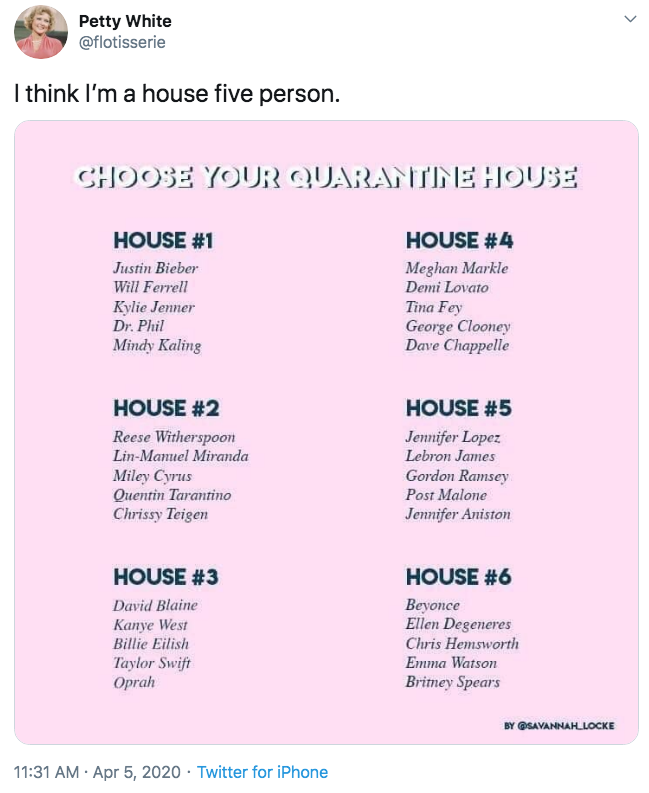
The meme was a list of six hypothetical celebrity households: pick one to quarantine in.
It had been circulating on Facebook, started by a Christian influencer named Savannah Locke. I encountered it deep in a Real Housewives fan group, and felt the pull of a good parlor game. In April 2020, everyone I knew was sitting at home, fretting about the COVID-19 pandemic looming over all of us, so I shared it with minimal ceremony, a couple of buddies with a slightly larger following hit retweet, and within two days the tweet was being cited by The Cut, Time, the Washington Post, CBS, and others. Know Your Meme documented it for posterity. Several outlets named me as the originator, but trust, I was only trying to delight my friends with low grade Facebook content. I couldn’t find the original meme at the time – Locke appears to have had a name change that scrambled my search. But hey, as these things go, nobody earned a dime or promoted anything weird, so no harm, no foul. Business Insider managed to credit it correctly, so a special kudos to their editor.
The core game mechanism behind the meme is forced choice: constraints generate opinions and opinions generate activity. Each “house” also represents a personality type. House 3 is chaos, House 6 is aspirational, House 5 is the one where someone is definitely cooking and someone is definitely yelling about it. The choices are arbitrary, which invites curiosity about who grouped what and why. In short, this meme offered a light conversation starter at the right time, with low stakes, high personal reveal, and endlessly discussable combinations. It also drew from existing memes and games that are popular online, like “where you sitting” in the proverbial lunch room. This one became news because of the timing and gamability, not because I was particularly clever, but hey.
What does it feel like to go so viral? It’s hilarious, strangely affirming, and also a little crazy-making. It opens the door to a whole lot of wild people and ideas on the internet, not all of them flattering or welcome. Virality is sometimes paired with incredible harassment and requires “more condolences than congratulations.” But as far as this particular experience went – hilarious, whoops, and wow. It just felt like a Lebron James, Post Malone and Jennifer Aniston hang would be a good time.
I agree on one angle, that as a cohort, abstaining entirely from new tech is a bad approach.
Haraway (obvs) suggests we stick with the trouble, that sometimes our very presence in the room is what’s required to trouble existing narratives, and that it’s important that share what we learn back to our people at home, whatever that means in our context.
For me: I spend a lot of time at work translating technical ideas and projects in an institutional voice, but on nights and weekends, I’m explaining the ins and outs of the internet to my working class friends and family. Increasingly, I’m asked to explain LLMs and AI and how it relates to their needs around business, the news, entertainment, and as a legal aid.
The “cyborg’s mark” is a metaphor for writing, our duty to translate, and the inevitability of translation through experience. Perhaps staying with the trouble allows us to articulate our experiences in and around the science in ways that both advance our interests and that keep our communities safer. For those of us who straddle multiple worlds, translation is a responsibility.
Widespread AI adoption reopens some basic questions in business: who your audience is, what work can reasonably be automated, what absolutely requires human oversight, and how the service and information environment actually holds together when we shuffle these circumstances around. All this, with many social and environmental risks and a side of existential doom.
I suspect the predictions of economic and social doom are overblown by a lot – in life as in business, generalisms are easy and specifics are hard. Last mile issues remain a reality of nearly any technical or software implementation, and differentiation is in many ways the art of business. There are serious incentives to promising a smooth, profitable near-future, especially around emerging markets, so I feel pretty comfortable forecasting that the era we currently live in is valuation masquerading as value. Instead, I think we should worry more about how the tech changes our relationship to information and to each other.
The dominant conversation is about whether LLMs can write well, but I suspect that’s the wrong frame. Human storytelling will probably always be more interesting than generated storytelling, because humans love quirks and novelty that can’t be produced artificially.
The more consequential change is that AI-generated text doesn’t just sit on the web waiting to be read, and instead feeds back into the system that produced it. It becomes training data, source material, and eventually, architecture. Remember: When an LLM generates text, it’s producing word sequences based on statistical patterns. The output is one plausible version to your prompt, not a definitive one — but it gets indexed, linked, and cited like any other writing. Nothing about its surface tells you it doesn’t carry the same authority.
Researchers call what follows “model collapse,” a feedback loop where models trained on AI-generated content lose touch with the range of human-produced data. The rare and specific details disappear first, then the middle narrows. Eventually what’s left is smooth, confident, increasingly generic text that sounds authoritative whether it’s accurate or not, which becomes the training data for the next round.
I’m thinking about it in terms of the shift from SEO to GEO. SEO preserved a connection between writing and human judgment. Someone wrote content, search engines indexed it, readers got a list of links and decided which to trust by comparing to their own experience and knowledge. This system was gameable through various sleights of hand, but it assumed a reader with agency. The creator’s job was to be easy to find and worth finding. Streaming video complicated this process but still worked with the same basic ideas. Meanwhile, GEO operates on a different premise. The goal isn’t to get found by a person, but to be found by an algorithm assembling a response the user may or may not independently verify.
Consider what happens to the same piece of writing in each system. In the SEO world, your article gets indexed, shows up in search results, someone clicks through, reads it, evaluates whether you or your institution is credible on the topic, maybe skeets it or sends it to a colleague. A human encountered your work, weighed it and decided it was useful, the algo responds and indexes accordingly.
In the old way, the reader moved through the web. AI yanks that experience into a single response from a single interface. We don’t fully understand how AI systems decide what to cite, which makes this power shift feel especially risky. Worse, different people will get different responses from LLMs, even using the same prompts and source materials. We don’t know why.
Fewer entry points to the web means fewer opportunities for diverse or unexpected sources to gain traction, which means the training data gets narrower, which means the outputs get more generic, which means the architecture narrows further, which means fewer perspectives represented in the output. For the reader, it accelerates context collapse in much the same way. Fewer inputs means fewer opportunities to stress test your ideas against new information.
So, what to do?
If generative AI grows as predicted, SEO and GEO will coexist for awhile, and working developers and communicators will need to understand both and how they layer. Strong SEO foundations give you a great head start in AI visibility too, so the fundamentals of good writing and web taxonomy still matter a lot.
But the production of knowledge, the keeping of data, and how it’s all indexed are subjects that are about to become very important, and very political. So I suspect that any fields that touch those topics will also become very important, and very political, very soon.
When I started building websites in the late ’90s, the line between writing and coding didn’t really exist. A person probably learned HTML because she had something to say and needed a place to put it. The internet was free and anonymous and it felt audacious to put your stuff online, like flinging a message in a bottle out to sea. The code was a container for the ideas that rendered them onscreen, and every post and page you published was both a piece of your thinking and a brick in something larger.
People forget that the early web was a writing community. Writers, or bloggers, built their own sites, maintained their own archives, linked to each other deliberately. A blogroll was both a reading list and a show of solidarity, a trackback was a way of saying, “I see you, I’m thinking with you.” The technical architecture - RSS feeds, permalinks, comment threads - existed to organize the writing and the writers’ thoughts, and to push their ideas forward on the open web.
This worked for a time. Communities of writers, most of them without institutional backing or media credentials, built new bodies of knowledge together through interacting as readers and writers, communicating across a foundation of code. The work didn’t stay online. It spilled into conference halls and state houses and newsrooms and policy discussions. As the body of communication built, it created something that accumulated over time. These people influenced mainstream journalism, shaped public conversations, launched careers and movements. In many ways, the national political conditions we face today are a reaction to that movement, and how it allowed regular people to influence the world through the democratization of mass communication.
Midway through the aughts, the brick and mortar publishers and venture capitalists started looking across the landscape, at all the writers creating fantastic content, largely for free, and sucked them into their content and editorial teams. Google Reader lost institutional and financial support as writers moved off the open web and onto publishing platforms, often backed by VC money, that measured the quality of your work by engagement. The addition of algorithmic feeds further broke down this structure – the algorithm doesn’t measure whether your work contributed to shared understanding, but whether it generated a click, a share. The code changed, and the writing changed with it.
The writers changed with it, too. The blogger became the influencer. Bloggers operated in a gift economy of ideas: you wrote to think, to argue, to contribute, and your standing in the wider community came from the quality of your work and contributions over time. Was it a meritocracy? No, but the conditions made it possible for a regular person to talk with experts as peers, which upended traditional power structures around authority and expertise (in both directions, good and bad). Meanwhile, influencers operate in a heavily capitalized attention economy where engagement converts to dollars. The audience is a market to press for money.
The gendered dimension of this shift matters as well. The early blogosphere was full of women writing sharp, rigorous work about politics, culture, parenthood, identity, and technology — work that was explicitly feminist and anti-racist and genuinely moved public conversations. This was the community I helped build (Feministe.us was my project, a community platform of writers and commenters whose coverage and discussion broadly fell under, but was certainly not limited to, the topic of feminism). When the monetized platforms absorbed that energy, the commercial model recast women’s online authority almost entirely in terms of consumer influence. What could we sell? And to whom? The framing around our work went from “this person has important ideas” to “this person can sell things to a niche market.” Meanwhile, men who’d built audiences through tech or political blogging were more likely to be absorbed into mainstream media as columnists and analysts, roles that kept their intellectual authority intact. The influencer label, with all its connotations of superficiality, landed disproportionately on women, and it stuck.
There’s a class piece here, too. The platform model offered something the early blogosphere mostly didn’t — a way to get paid. For women who’d been doing enormous amounts of unpaid intellectual labor building online communities, the question of monetization wasn’t shallow. The implications of information centralization and monetization were as present then as they are now with LLMs and AI. Some people figured out the social platforms and worked their way into viable digital careers. Platforms offered a lot of perks, but all of the perks had a backstop. Corporate interests introduced the problems of advertising, audience and sponsorship, which meant reorienting your individual practice around maximizing your commercial value over and above your intellectual contribution and community management skills. It often meant giving away some or all of your IP rights.
For most people, new system didn’t offer a viable way to get from “respected independent writer” to “respected, protected and compensated writer.” Many of us found ourselves in positions too precarious to take the leap into freelancing and social media, and some, like me, got regular jobs doing regular stuff. Some married money. And in the meantime, some folks figured out how to get into real journalism, which looks much different in 2026.
Great storytelling helps people understand themselves and their world. We let some of that depth go on the Internet with the onslaught of digital marketing and all of its implications, and today the internet feels less useful and less trustworthy than it once did.
It feels like there’s something to take forward from the experience.
My undergrad experience in college really shaped my approach to the internet. I was an English Education major at the time, in the early 00s, when the internet was around but mostly the wheelhouse of scholars and nerds. I was a nerd, learning code as a vehicle for writing, primarily to amuse myself and my friends.
The English department was an embattled unit within a school within a college of a STEM-centric university whose administration was perennially annoyed by the Humanities and their writing requirements. One of the English department’s survival tactics was to grow their approach to technical writing, getting deep into the question of how technology changes, shapes and shifts reading, writing and literacy. Thus they organized loosely around an emerging field called “digital rhetoric.”
For a time this was the top rhetoric and composition program in the field, populated by scholars from scrappy programs. My closest mentor, an English PhD from Wayne State in Detroit, studied race and gender representation in video games and how programmers (particularly Black and trans programmers) write themselves into existence through code, design and other aesthetic and storytelling choices. Outsiders had a really hard time understanding how this work belonged in an English department, but ultimately, she was focused on the question of authorship and how the author is projected throughout her work, a classic literary debate. She treated video games as texts and gamers as an audience, an approach that foretold many things about our current political era.
In this space, “digital” doesn’t just mean content on a screen. The concept is more complex, including social, cultural and rhetorical dimensions, in addition to shifts through time. Digital “texts” and practices exist on a continuum with print and other media, rather than in isolation, transforming how persuasion and communication work, both separately and together.
I took all these lessons and ran with them. This is where my approach to the internet is situated, and there are a few truisms that I learned from that time and era that further position my writing and approach.
Writing is code, code is writing
Writing and code are fundamentally the same thing in digital contexts. Both are systems of symbols that create meaning and action through semantic rules. The line between “content” and “container” blurs in digital spaces. A blog post is the copy on the page – and it’s also the metadata, the responsive design that adapts to different screens, the accessibility markup that makes it readable by screen readers. Each of these elements is written (coded) and each carries rhetorical weight and communicates something to the audience, intended or not. If you understand these relationships, you understand how the internet works as a social and information system.
This convergence of digital and material amplifies the concept of intertextuality, the idea that all texts reference, respond to and build upon other texts. In the classroom, intertextuality often focuses on plays and novels, and explores how authors speak and refer to one another’s work over time. In music, this is the study of sampling and referencing and why.
In digital environments, intertextuality becomes literal and functional. Code libraries reference other code libraries. Websites link to and embed other websites. APIs allow different platforms to communicate and share data. A single digital text might pull content from multiple sources simultaneously – a Twitter embed, a YouTube video, a Google Map – creating a networked document that exists across multiple platforms and authors. Virality builds rhetorical velocity through layers of meaning being added by individual users in real time, creating new texts and contexts through iteration and sharing.
Writing makes reality
A lot of students of this era took up knitting. It was trendy, yes, but the professors also taught knitting as an applied example of technical writing, and how writing produces a material reality.
Knitting patterns are technical writing in its purest form. A pattern is a set of instructions that must be precise, unambiguous, and reproducible, the same goals as any technical document. Pattern writers use specialized notation (K2tog, SSK, yo) that functions like code, compressing complex physical actions into standardized symbols that individuals interpret using sticks and string. The pattern must account for different skill levels, anticipate common errors, and provide enough context for the knitter to understand not just what to do, but why.
Good instructions and an able translator may result in a wearable delight: a sweater, a scarf, a cozy and colorful pair of socks. When a pattern fails the result is the same as failed technical documentation: confusion, wasted time and an unusable product. Piles of string. Dumb, useless sticks. It is an incredibly strong reminder that technical writing isn’t confined to manuals and protocols. It exists anywhere complex processes need to be communicated clearly and consistently so others can replicate results – including in your granny’s yarn basket.
So that’s how I learned to knit. Digital rhetors link physical practices to digital ones to illustrate highly conceptual ideas about writing and social networks. And one reason why digital spaces like Ravelry deserve recognition as thoughtful, functional social platforms is that this link between conceptual and material is made explicit in the digital knitting community. Designed for information sharing among a particular audience, decisions about information architecture and community management reasonably cascade from the mission, so Ravelry has remained a reasonably healthy community experience for most users despite its massive size and sprawling discussion. It remains an example of positive social dynamics online, unlike its behemoth competitors.
Always returning to Haraway
Many thinkers and texts built out this field of thought, but Cyborg Manifesto sits at the forefront for me. Writing during the Reagan era, with the populace freaking out about the rise of biotechnology and personal computing all around her, Haraway entered debates about whether women should enter male-dominated, militaristic fields like engineering and computer science, bringing an overtly feminist lens to questions of technology and power.
One major takeaway from Haraway’s work is the importance of rejecting binary thinking around technology and science. This approach aligns with other humanist and feminist perspectives that foundationally believe technology is by, about, and for the human experience, thus providing new and novel sites for political struggle. This gave people frustrated by tech a permission structure for interacting with technology rather than avoiding or abstaining from it entirely.
If these questions of knowledge and power remain central to technology, we want the people making those decisions to share our values and interests, and to be in the room when decisions are made. This argument is ripe for various challenges, which is why it was such a provocative starting point for cyberpunks and cyberfeminists alike.
Sharing is caring
This was an open source culture that meant sharing not just finished products, but the breadcrumbs and other attempts at learning along the way. It requires the safety that supports a yes/and culture, where people can collaborate with transparency, in spite of, or in consideration of, the ugly stuff and the many unknowns.
We let public and private live alongside each other without rigid boundaries about professionalism and polish. Your serious professional work could sit next to a meme, which could sit next to a picture of your cat, and none of it diminished the other.
This was an intentional acknowledgment that people are multifaceted, and that the digital spaces we inhabit should reflect that complexity. Putting the personal and the real alongside the artificiality of digital communications builds a relationship between the viewer and creator in ways that carefully curated, brand-managed presences just can’t (also: yawn).
Vulnerability, humor, expertise, horror, scholarship, and joy coexist, as in real life.
Tiktok is not much better or worse than other major social platforms, I say. The primary arguments against TikTok, including data collection, algorithmic manipulation, potential foreign government access, addiction and influence on public opinion, apply with equal or greater force to American platforms. Meta has faced billions in fines for allowing privacy violations, enabled documented election interference, and its algorithms have been linked to mental health harms and the amplification of extremist content globally, including perpetuating a genocide in Myanmar. Google and other domestic platforms vacuum up vastly more user data with fewer restrictions.
The distinguishing factor isn’t the behavior but the ownership: TikTok’s parent company ByteDance is subject to Chinese law and intelligence relationships, while Meta and Google are subject to U.S. law and intelligence relationships. That’s a legitimate policy distinction, but rarely articulated honestly. Instead, the debate has been framed around purportedly unacceptable harms that American tech companies perpetrate routinely, creating a kind of security theater that lets domestic platforms escape equivalent scrutiny while positioning a foreign competitor for a forced sale or ban.
“In short, decades of research have demonstrated that our political beliefs and behavior are thoroughly motivated and mediated by our social identities: i.e., the many cross-cutting social groupings we feel affinity with. And as long as we do not account for this profound and pervasive dependence, our attempts to address the epistemic failures threatening contemporary democracies will inevitably fall short. More than any particular institutional, technological, or educational reform, promoting a healthier democracy requires reshaping the social identity landscape that ultimately anchors other democratic pathologies.”
As always, this drives me back to Haraway’s cyborg, a useful metaphor for thinking about our political, environmental and social tangle and how it butts up against emerging tech and science. (In Haraway’s context, it was the rise of STEM as a driving force in academia at the dawn of the computer age.) Bagg’s argument lands in familiar territory for anyone who’s wrestled with the cyborg metaphor. Both reject the assumption that better information alone will save us from ourselves, whether from context collapse or the dualisms (binaries, heh) that structure how we think about technology, nature, humanity and politics.
Bagg arrives at something parallel from political science: We trust information that affirms the groups we belong to. (Business and marketing, for what it’s worth, tell us the same thing from a slightly different angle: you’re most likely to convert on a recommendation from a trusted friend. The next best thing in our current media landscape: a trusted influencer you identify with, which is why TikTok increasingly feels like QVC.) The problem isn’t that people lack access to truth, it’s that they’ve lost affinity with the experts, institutions and collaborative practices that produce expertise.
Both perspectives point toward the same conclusion: you have to recognize shared affinities through the slow work of creating conditions where people want to trust each other across differences.
Blogging from the Ruins is an essay getting a ton of attention in the fediverse this week, making a strong case for intentionally building non-algorithmic intellectual communities on the open web.
Winer’s original script is pretty slick, and includes a list of all my feeds with titles, URLs, and categories; click-to-expand functionality to see the 5 most recent posts from each feed; clickable post titles that open articles in new tabs; sort options (by title or by update); and automatic updates when I change my FeedLand subscriptions.
The official documentation method didn’t initially work because Hugo (the blogging software behind micro.blog) was wrapping client-side templates around the script. The toolkit requires server-side dependencies that don’t exist on static sites like micro.blog, and we hit a cascade of missing JavaScript dependencies (jsonStringify, servercall, etc.). Each fix revealed another dependency, leading to some “sunk cost” frustrations for me. I kept trying because I wanted to see if Claude could pull it together. Through trial and error, I got to a point where the OPML file was rendered correctly without server dependencies or complex external libraries.
Time invested: ~3 hours (including wrong turns)
Time it should take: 10 minutes
AI extended my code reach beyond my practical skillset by quite a lot. I now have a dynamic and dedicated place to read and share news feeds as I wish. Though even when generative AI works and works well, I have significant concerns about the intellectual property implications of AI, and this project brought those tensions into sharp focus. The AI could only help me because it was trained on documentation and intellectual work from the open source community, contributions made freely in the spirit of knowledge sharing, not to train commercial AI systems. I tapped into their expertise by paying Anthropic $15 a month. While I’m grateful for the accessibility this provides to non-developers like me, I recognize there’s an unresolved ethical question about whether this use respects the intent and labor of the original creators. The feat is incredible; the foundation it’s built on deserves careful consideration.
After the exercise was complete, I asked Claude how I could have improved my prompting to make this process easier, and in short, Claude said I could have been a web developer. But since I’m not, here’s what it recommended:
✅ When the process isn’t working, question the process mid-stream. Most people either give up or keep following bad advice deeper into rabbit holes. Stop and question the LLM’s process and ask for alternatives to force a reset.
✅ Push for usability. Keep bringing the conversation back to what you actually need the end result to do, not what’s technically impressive or “correct.” In my case, this meant repeatedly asking “can I click through to the articles?” rather than getting lost in discussions about CORS proxies or JavaScript syntax. Focus on outcomes, not implementation details.
✅ Ask for complete solutions. Instead of trying to mentally patch together incremental changes across multiple responses, ask the LLM to provide fresh, complete code each time. This prevents copy-paste errors and ensures you’re always working with a coherent, tested solution. There’s more than one way to crack an egg, but you want the whole egg regardless.
After all that, I got it to work but can’t figure out how to make it show up in my header menu, with or without Claude. TBD.
Just speaking this into the universe, but it would be exceedingly cool if someone pulled together a micro.blog plugin for Feedland blogrolls and page feeds.
Solarpunk is happening in sub-Saharan Africa, a movement to bring electricity to places that are impacted by “last mile” challenges in grid engineering and politics.
More on rhetorical velocity and the art of the remix. As Lawrence Lessig says, “Remix is how we as humans live and everyone within our society engages in this act of creativity.”
While I’m cleaning up the cruft around my social presence, I’m finding more references to the heyday of blogging that explain how people organized online (Web 1.0) before the era of platforms (Web 2.0). One is this interview with Jill Filipovic, my one-time co-blogger and comrade at Feministe, with the folks at LGM who interviewed me on the subject a few years ago. Jill and I differed (and still do) on the meat of many issues, but have a lot of our thinking in common about how to handle disagreement and advance our ideas in common (and risky!) spaces. She’s welcome in my foxhole anytime.
I appreciate this oral history project by LGM because the articulation of our processes then (before automation) provides a lot of instruction about how to organize and think about communication outside of increasingly toxic and irresponsible social platforms today. One idea that is relative today is around pluralism. In our case, we practiced pluralism on subjects and perspectives within a defined domain, “feminism.” In practice, making it work before true automation meant we lived with a lot of decision points around moderating a raucous community. Bask then, we had our CMS and set up a list of community expectations, iterating as we went, then let the community rip. Collectively, this approach created a robust and vibrant interactive community of peers and moved our interests forward as a cohort. Between her interview, where she talks through the decision points we faced, and mine, where I talk more about the tools and their limitations, there is a lot for people who want to organize people digitally while thinking outside of the algorithm.
I met a friend for dinner, we had a time, and as she left she mentioned her long-time book club and how much everyone hated their latest read. What was it? I asked. She said, “Have you heard of ‘The Heart in Winter’?” 😭