Good and bad uses of AI on a website, from Sumy Designs.
Good and bad uses of AI on a website, from Sumy Designs.
LLMs have a default house writing style with identifiable patterns: sentence fragments for emphasis, “not X, but Y” constructions, lots of hard contrast, atmospheric openings, heavy use of em dashes, and heavy use of marketing language. This reflects the semantic construction of an LLM. Custom instructions can override these defaults. A custom skill is a set of instructions within your account that modify how the model generates text. When you paste instructions into your profile settings, Claude reads them at the start of every conversation and adjusts its output accordingly.
I began using Claude daily for light writing tasks about six months ago, and over that time I started cataloging the patterns I was consistently editing out, including the terrible “not X, but Y” construction that showed up in nearly every response, and persistent em dashes used as all-purpose connectors when other punctuation is more appropriate.
I went through several iterations of bullying Claude into submission, narrowing the scope each time, before arriving at this version, which focuses specifically on writing mechanics and hard prohibitions.
You’ll need a paid Claude plan (Pro, Max, Team, or Enterprise). Free-tier accounts don’t have access to custom skills.
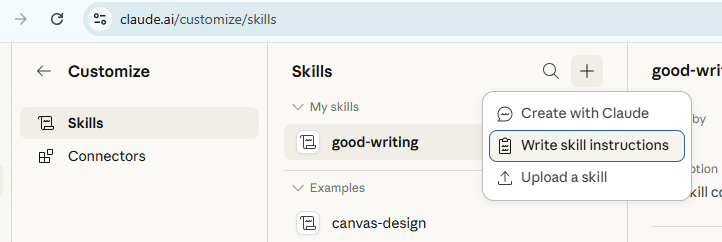
• Within the app, navigate to Customize > Skills and Create new skills
• Select add a new skill and Write skill instructions
• Copy and paste the copy from this file into the skill, making note of the name and description boxes. Feel free to tinker.
• Save your changes.
Note: The instructions in the linked file are Claude’s work, not mine. They came out of months of conversation, where Claude would analyze my style notes, and the file evolved from there. They read a little strangely because of that process. If I’d written them from scratch, they’d sound different. But looking at the file you can see what Claude responds to and how it works.
Claude will apply these instructions to every new conversation going forward. Existing conversations won’t pick up the change, so start a fresh chat to test it. If and when Claude struggles to apply the skill, call it out specifically in the prompt, such as, “Revise this for length using the good writing skill.”
The skill specifies constraints in a few categories and the instructions are plain text. As you go, you can also ask Claude to analyze previous conversations for suggested additions to the skill, which Claude will produce and implement within the chat. Each rule operates independently, so removing one doesn’t affect the others.
Claude processes custom instructions at the start of every conversation, before it generates any output. The instructions function as constraints on the model’s default behavior. The model doesn’t always follow every instruction perfectly and the results vary by task. You will still need to edit.
This new report from Anthropic is depressing at best, as it tries to measure which employment sectors carry the most exposure around AI expansion into the economy. In short, the tech is likely to impact two groups the hardest: educated professional women, and young workers for whom the career ladder will never materialize. In a right-side-up world, this would change the political dynamics of any policy response considerably. In this one, I don’t know.
Anthropic’s positioning here is curious, very god tricky. They are claiming the mantle of responsibility and transparency while predicting an inevitable end nobody wants, that they’re also selling as a service.
I still think much of the forecasting is oversold – the tech performs well in optimized environments, and last mile issues are a perennial concern in any engineering venture because the practical world is non-optimal. Time will tell, and there are big incentives in play. But the hunger and animus around the forecast feel bad.
WaPo on the many issues of LLM house writing styles. I have much to add. Here are some notes on applying a writing skill to override house style on Claude.
Apparently one thing LLMs excel at is deanonymization at scale. The original promise of pseudonymity online was social and normative, over and above any question of technical depth: decent people don’t try to unmask you, because why. What strikes me today is how what used to be unacceptably antisocial behavior online is now both automated and unremarkable.
Over the last couple of weeks, I asked a couple of chatbots what could be known about me from this pseudonymous site, where I am more intentional about what I choose to reveal and conceal. It pulled the obvious but also drew conclusions based on a few geographic points I’d made in context that were both revealing and correct. I also noticed that it only drew from the top two pages of information - anything beyond page two of posts wasn’t part of the compute. Archives are for humans?
People assume that there is some computer magic on the backend where the LLMs connect all your account logins behind the scenes, but no, in fact it does all this through inference, by linking your digital trail, your friends, your breadcrumbs of likes and hearts and follows, and obvs your posts, into a picture of who you are, practically and demographically.
Second wavers in tech and engineering talked a lot about the “god trick” of presenting knowledge and information, particularly around math and science, in a way that suggests its objectivity is eternal, immortal, unknowable. Work by Safiya Umoja Noble and others extended this lens to Internet search and architecture, finding that the search algorithm was never neutral, instead it was a series of business decisions wearing neutrality like a costume, creating a customer service experience. LLMs take that same trick and compress it further.
It’s an old idea, and one I’ve been drawing from while I tinker with Claude, which is purportedly the best in the game. The “god trick” is baked right into the AI interface: one input, one output, an authoritative-seeming answer, offered without named perspectives behind it, trained on text produced overwhelmingly by a narrow demographic who has historically had access to both literacy and publishing, by programmers and new media drawing from the same well. Smushed together, it gives the impression that consensus exists where there are in fact many, many loose ends.
I increasingly find it annoying that even “good” AI outputs seem fixed on phrases like “key,” “core,” “exist,” “actually,” “never,” and possibly the worst sentence structure of all time, “it’s not X, it’s Y” — and I’ve begun to recognize how LLMs work like autocorrect for and idea, drawing from ranked search sources first before fanning out to more obscure sources, trying to determine and assert what’s important to me, a user known by demographics and data. It feels like a big linguistics machine, which is pretty cool in some regards, but also aggressive. The math doesn’t always work to connect me to what I want to find because I am situated in my individual context in ways LLMs are not able to understand, with my memory, in my body, with my unique experiences, which shape and translate meaning for me as I interact with the world (and the web).
And so for you, in your body and memory and experience. An LLM can approximate the outputs of an experience without having access to the experience itself. Sometimes this is useful, sometimes it’s reckless.
Overall the dynamic reminds me of the famous scene from Good Will Hunting: Claude is a smart kid, and he’s never been outta Boston.
I’ve been running a series of informal experiments with my team to understand how we should advise people on using AI tools like ChatGPT, Claude and Gemini around our work.
In our last session, I gave everyone the same task: ask your AI tool to summarize a single article in plain language. Every person got a factually accurate summary, but the style and depth of analysis varied widely from person to person. We tested this further by entering the same prompt multiple times. Each time, the output was slightly different. We copied and pasted everything into a shared document so we could compare side by side.
Later that day, I asked everyone to reopen the tool they’d used that morning and repeat the prompt that had worked best: summarize this article in plain language. The outputs shifted again. Some changed dramatically. One team member whose morning summary had been light and conversational received a much more formal, serious version in the afternoon.
I then asked Claude to compare the morning and afternoon versions of one summary. “In short, the morning version emphasizes practical implications and accessibility; the afternoon version prioritizes completeness and specificity. They complement each other well — someone reading both would get a fuller picture than either one alone provides.”
Why would Claude produce these differences despite the same source material and prompt?
I asked the source.
Even with the same prompt and source material, LLMs don't produce identical outputs each time. This is by design — there's a degree of randomness (called "temperature") in how the model selects words, which means each run produces a slightly different path through the text.But the differences here go beyond random word choices. The morning version landed on a journalistic structure while the afternoon version landed on an academic one. That likely reflects what the paper calls sensitivity to framing and order effects — one of the cognitive biases it catalogs. Small, invisible differences in how the model’s internal processing unfolds at the start of generation can cascade into meaningfully different organizational choices. Once the morning version opened with a news-style framing, the rest followed that pattern. Once the afternoon version opened with a descriptive academic tone, it followed that thread instead.
This is actually a concrete example of the robustness issues the paper identifies. The underlying reasoning about the paper’s content is consistent across both summaries — neither gets the facts wrong. But the presentation varies in ways that weren’t requested, which means someone relying on just one version would get a subtly incomplete picture depending on which run they happened to see.
It’s a useful reminder that LLM outputs are one plausible version of a response, not the definitive one.
It’s important to understand how these tools work. What looks like an authoritative answer is really just one of many possible outputs the system could have generated. The text will sound plausible whether it’s accurate or not, and you may get different results each time you ask.
I asked Claude.ai for a plain language summary of this buzzy new research paper. Claude offers the following:
Researchers from Caltech and Stanford conducted the first comprehensive survey of how and why large language models (LLMs) — AI systems like ChatGPT or Claude — fail at reasoning tasks. Rather than focusing on what AI can do well, they cataloged and organized the ways it goes wrong.Why it matters
LLMs are increasingly used in high-stakes settings, but their reasoning failures are often unpredictable and poorly understood. The researchers argue that systematically studying failures — like accident investigations in aviation — is essential for building more reliable AI.The researchers created a framework with two dimensions:
• Type of reasoning: informal (intuitive, social), formal (logic, math), and embodied (physical, spatial)
• Type of failure: fundamental flaws built into the architecture; domain-specific weaknesses; and robustness problems (inconsistent performance when small details change)Informal/intuitive reasoning
LLMs exhibit human-like cognitive biases — confirmation bias, anchoring, framing effects — but without human ability to recognize and correct for them. They also struggle with “theory of mind” (understanding what others believe or intend), and with applying consistent moral or ethical reasoning.Formal/logical reasoning
LLMs often can’t reverse simple logical relationships (if they know “A is B,” they may not infer “B is A”). They struggle to chain multiple reasoning steps together. Basic counting and arithmetic fail in ways that seem surprising given their other capabilities.Embodied/physical reasoning
LLMs have poor intuitions about the physical world — gravity, spatial relationships, object properties — because they’ve learned only from text, not from physical experience. This extends to visual AI systems as well.Many failures trace back to how LLMs are trained: they predict the next word in a sequence rather than reasoning deliberately. This makes them good at pattern-matching but unreliable when tasks require genuine logical inference, especially under slight variations in how a question is phrased.
Researchers have proposed fixes including better training data, techniques that force step-by-step reasoning (like “chain-of-thought” prompting), connecting LLMs to external tools like calculators or physics simulators, and architectural changes. However, no single fix is comprehensive — many improvements in one area don’t transfer to others.
I have a confession. While experimenting with AI over the last year, I wondered what would happen if I crammed an unfinished novel draft, one I actually care about, into Claude. Claude is pitched as the LLM for writers, with Claude 3.7 Sonnet and 3 Opus widely regarded as the premier LLMs for writers, including creative writing, long-form content and human-like prose. Meanwhile, I majored in English and work in mass communications, so I’m trained to think about writing creatively, strategically and tactically. Writing and personal expression have been part of my daily life for most of my life. If this tool could in fact produce a quality story, someone like me should be able to make it happen. Instead, the experience left me confident that AI isn’t a good vehicle for creative, narrative writing.
Here’s what I found:
On the technical side, Claude struggled to maintain a narrative thread over time. The longer the chat, the more the bot drifted and eventually lost track of details and claims made about characters earlier in the plotline. It’s not a sustainable approach for narrative writers because continuity matters: outsource too much plotline to the bot and your characters lose relationship to one another.
LLMs like Claude work fine for writing support—they can function something like a synonym machine, helping writers work through technical questions of redundancy, register, length, and other semantic needs while drafting. But when you outsource world-building and meaning-making to an LLM, it becomes narratively confusing fast. Despite giving Claude extensive background on my primary characters and the world they live in, it would confidently declare that a character’s relationship to another was X, then claim the opposite on the next page. Dialogue was thin and expository. It preferred a sort of “maid and butler” style of dialogue where two characters artificially recap shared knowledge for the reader. Meanwhile Claude does not do feelings well, which is arguably the point of much narrative writing.
Ultimately my drafts were worse off than what I started with – less organized, more confusing, with so much narrative drift that almost nothing was usable, even as a first draft. A devil’s advocate might argue that my prompting wasn’t sophisticated enough to produce the results I wanted. Sure.
But then we have the second problem: Claude’s approach to storytelling isn’t narratively interesting. Fiction and narrative writers put tremendous energy into world-building and sensory experiences. The goal is to immerse the reader in a sensory experience so total that they can experience another world entirely – the original VR, if you will. A great writer even exploits your higher-level cognitive functions by reusing parts of the brain that evolved for action and perception, which is why a good story makes you think, feel, and wonder.
Claude does not feel or wonder. Claude collates.
A key part of this essay suggests that LLMs create meaning through triangulation – that by pinging other ideas and vocabulary, an LLM can get a human reader close, or close enough, to suffice in many cases of writing. In my experience, this is true enough in business writing, where tinkering with approach and register can become as important as precise verbiage.
But this misses the pleasure and the point of good storytelling, which is myriad but usually centers on the satisfaction of expanding your imagination and experience through narrative, by seeing your own messy, striving, failing, hopeful, and collective human experience reflected in another person’s expression. That kind of meaning-making doesn’t happen through triangulation. It happens through the labor of human thought, experience and skilled articulation. That’s art, babes.
This article gets into the mess of AI and creative writing, within the domain of the romance genre, which famously cranks out variations on romance themes at a rapid clip. It drills down into some of the debates about writing, authority and authorship in relationship to LLMs that are playing out across the publishing sector now. Remember: early research suggests that most writers who use LLMs as part of their workflow ultimately retain their sense of authorship in and around the tools, suggesting that even when writers adopt AI assistance, they still see themselves, not the tool, as the creative and accountable source. So based in my experience above, I suspect that if an AI approach to creative writing is successful, it’s because the author is linking her approach to emerging tech, not because the work is good, and that’s a difference worth distinction.
Something else I noticed in my experimentation with AI and creative writing: Claude prefers a mid-length, declarative sentence, while I prefer a lot of variety in my prose. Sentence variety is a primary consideration in any text-based communication approach. Write accordingly.
In 1999, academic and theorist Judith Butler famously won an award for the worst academic sentence, raising good questions about how we read difficult texts, who gets to access academic ideas, and the role of academic and plain language in and around the academy:
The move from a structuralist account in which capital is understood to structure social relations in relatively homologous ways to a view of hegemony in which power relations are subject to repetition, convergence, and rearticulation brought the question of temporality into the thinking of structure, and marked a shift from a form of Althusserian theory that takes structural totalities as theoretical objects to one in which the insights into the contingent possibility of structure inaugurate a renewed conception of hegemony as bound up with the contingent sites and strategies of the rearticulation of power.
This was my era in college, and I remember feeling challenged and overwhelmed as an undergrad trying to read theory for the first time. So today, I asked Claude.ai to put it in plain language, just to see what would happen. Here’s the after:
Scholars used to think that capitalism shaped society in consistent, predictable patterns. But newer thinking focuses on how power works—how it repeats, overlaps, and gets reshaped over time. This brought time into the picture and moved away from older theories that treated social structures as fixed. Instead, recognizing that structures can change opened up a new way of understanding power: it's tied to specific moments and strategies, and it's always being renegotiated.
I just completed my first attempt at coding using AI, in this case having Claude assist me with putting together a simple client-side OPML parser using Dave Winer’s Feedland service.
Winer’s original script is pretty slick, and includes a list of all my feeds with titles, URLs, and categories; click-to-expand functionality to see the 5 most recent posts from each feed; clickable post titles that open articles in new tabs; sort options (by title or by update); and automatic updates when I change my FeedLand subscriptions.
You can check it out here: Feeds
The official documentation method didn’t initially work because Hugo (the blogging software behind micro.blog) was wrapping client-side templates around the script. The toolkit requires server-side dependencies that don’t exist on static sites like micro.blog, and we hit a cascade of missing JavaScript dependencies (jsonStringify, servercall, etc.). Each fix revealed another dependency, leading to some “sunk cost” frustrations for me. I kept trying because I wanted to see if Claude could pull it together. Through trial and error, I got to a point where the OPML file was rendered correctly without server dependencies or complex external libraries.
Time invested: ~3 hours (including wrong turns)
Time it should take: 10 minutes
AI extended my code reach beyond my practical skillset by quite a lot. I now have a dynamic and dedicated place to read and share news feeds as I wish. Though even when generative AI works and works well, I have significant concerns about the intellectual property implications of AI, and this project brought those tensions into sharp focus. The AI could only help me because it was trained on documentation and intellectual work from the open source community, contributions made freely in the spirit of knowledge sharing, not to train commercial AI systems. I tapped into their expertise by paying Anthropic $15 a month. While I’m grateful for the accessibility this provides to non-developers like me, I recognize there’s an unresolved ethical question about whether this use respects the intent and labor of the original creators. The feat is incredible; the foundation it’s built on deserves careful consideration.
After the exercise was complete, I asked Claude how I could have improved my prompting to make this process easier, and in short, Claude said I could have been a web developer. But since I’m not, here’s what it recommended:
✅ When the process isn’t working, question the process mid-stream. Most people either give up or keep following bad advice deeper into rabbit holes. Stop and question the LLM’s process and ask for alternatives to force a reset.
✅ Push for usability. Keep bringing the conversation back to what you actually need the end result to do, not what’s technically impressive or “correct.” In my case, this meant repeatedly asking “can I click through to the articles?” rather than getting lost in discussions about CORS proxies or JavaScript syntax. Focus on outcomes, not implementation details.
✅ Ask for complete solutions. Instead of trying to mentally patch together incremental changes across multiple responses, ask the LLM to provide fresh, complete code each time. This prevents copy-paste errors and ensures you’re always working with a coherent, tested solution. There’s more than one way to crack an egg, but you want the whole egg regardless.
After all that, I got it to work but can’t figure out how to make it show up in my header menu, with or without Claude. TBD.
Human in the loop (HITL): HITL means that humans are involved at some point in the AI workflow to ensure accuracy, safety, accountability or ethical decision-making. HITL inserts human insight into the “loop,” the continuous cycle of interaction and feedback between AI systems and humans.
I graduated from college right before the 2008 recession and bounced through some unpromising temp jobs until an opportunity emerged for a permanent position. Sometimes you just need to get in where you fit in, and so I did. That’s how I came to work for a regional cable company that used federal money to expand the new national broadband network, extending out to the rural communities dotting central Indiana.
It was a front row seat to the national broadband expansion efforts of the early 2000s. Our business ran right across the state, spanning the 80 or so miles from Attica to Kokomo, which included several small cities with large manufacturers, two public research universities, and several community and liberal arts colleges. The strip of broadband fiber at the core of our service followed existing highways and electrical lines that split the corn and soybean fields from town to town, feathering out to more rural areas from there.
I worked a variety of roles there that put me face-to-face with a classic technical problem: the last mile. On many occasions, someone would come in looking pensive, and explain that the fiber had been extended all the way from town to their hamlet, and yet there was no plan to connect their property to the pole. Over time the pattern was clear: while the network was expanded, the cost of running a physical line to each individual property was too expensive and specific at scale. These customers often left without a path forward despite all their efforts and ours.
The “last mile problem” refers to the logistical challenges and high costs associated with the final leg of delivering goods or services to the end customer. It’s often the most difficult and expensive part of the supply chain, despite being a relatively short distance. The pattern shows up everywhere: public transit can get commuters most of the way most of the time, but that final leg of the journey remains specific and individual and problematic. E-commerce companies promise drone delivery solutions, scooter and bike-share apps claim to solve urban mobility gaps, but these technological optimizations remain persistently stubborn at scale, running up against the messy realities of sidewalks, intersections, and actual human behavior.
Tl;dr: I’ve been turning over this suspicion that AI automation will hit a classic “last mile problem,” especially in the public sector.
AI systems, particularly LLMs, are like those systems—they work incredibly well in their intended domain, processing and manipulating information. But because they’re fundamentally an information-only approach, that creates their own last mile problem when we try to implement them in physical and context-specific environments. Public institutions are uniquely specific — they are often the originators and producers of knowledge and the keepers of original policy, tasked with making the rubber hit the road. Additionally, the need for comprehensive data protection required by public workers and institutions fundamentally hamstring potential applications.
Actually implementing recommendations is where you hit the last mile. This is the work of public administration.
Imagine an AI application trained on every facilities management manual ever written and tuned to synthesize best practices for HVAC optimization. It can analyze years of energy usage data and recommend precise temperature adjustments for different zones of a building, but can’t feel that the third floor is always stuffy, or know that the facilities manager retired last year and took decades of institutional knowledge with him. Building A’s HVAC system was installed in 1987 and has a manual keypad. Building B’s system interfaces with the campus-wide monitoring system, but unreliably, and investigation is slated for later, someday, when resources allow. Professor Smith has taught in Room 204 for 25 years and will blow up your spot before moving to a different classroom for maintenance. Your engineers who manage these spaces are balancing human teams, who have time off and training and other priorities they manage in life. So, you need staff who understand the quirks of each area, the history of each system, the politics of which departments will accept changes and which will flood your inbox with complaints. You need someone who knows that the third floor always runs hot because of a design flaw from 1974, and that the solution isn’t more precise control but a $50,000 renovation that’s been deferred for a decade because a glittering new project across campus takes priority.
Imagine this tangle of questions and contingencies times infinity on every university campus in existence. Universities are like cities—they’ve been built and rebuilt over decades or centuries, with layers of systems and fiefdoms that weren’t designed to work together. AI recommendations assume a level of standardization that simply doesn’t exist. Every AI implementation in higher ed requires navigating multiple constituencies with different priorities and power structures. It’s like trying to redesign traffic patterns in a neighborhood where the residents, business owners, commuters, and city planners all have veto power and conflicting interests.
So. When looking at efficiency efforts spinning up across the education sector, I’m feeling pensive, trying to understand how exactly the house gets connected to the pole.
The promise of new tech in higher ed needs to more deeply consider the translation costs: the human labor, institutional knowledge, knowledge documentation and local adaptation required to bridge between the usefulness of tech and specific realities of public university work. Public employees want modernization and don’t want to fall behind. We want systems that work. We are also balancing a great deal of change and pressure as a sector, with fewer material resources than ever. We need less marketing and more right-sizing in the claims around AI against the political and tech realities of public administration.
This disconnect between technological promise and implementation reality becomes even more critical as higher education faces increased political scrutiny. When tech vendors promise that AI will solve efficiency problems or reduce administrative costs, institutions are under immense pressure to deliver measurable results quickly. But the translation costs we experience don’t disappear just because the political pressure to modernize increases.
The institutions that thread this needle will be the ones that accurately assess these translation costs upfront and set expectations accordingly—not the ones that assume the technology will magically bridge the gap between digital and physical, abstract and specific.
by Lauren Bruce
As communications professionals in higher education, we work for institutions built on the pursuit of knowledge and innovation, yet many of us feel uncertain about how to thoughtfully integrate one of the most significant technological advances of our time: artificial intelligence.
Over the past year, my team has wrestled with questions that didn’t exist in our profession just a few years ago. Should we use AI to draft articles and email copy? How do we disclose AI-generated content, or do we? When does AI assistance cross the line from helpful tool to ethical concern?
These aren’t abstract questions any longer. Over the last year, I had to overcome AI resistance of my own to develop practical, hands-on approaches to AI use that align with our institutional values while acknowledging the realities of modern communications work (more on that below). What I’ve learned is that the answers aren’t found in blanket policies or rules, but in applying our existing professional ethics to these new tools. Here is where I am today on the journey from AI praxis to practice.
Mission first
The foundation of responsible AI use in our field starts with a principle we already know: everything we do should advance our institution’s educational mission. Higher education exists to create, share, and preserve knowledge while fostering critical thinking and diverse perspectives, in service of students, faculty, researchers, workers and the world.
The bulk of our work comes from conversations with colleagues, understanding of our campus dynamics and processes, and professional judgment about what our community needs to hear. This inevitably means more work upfront, but it maintains the authenticity and institutional knowledge that our audience deserves, regardless of whether AI tools are part of the process.
Transparency without paranoia
Do I need to mention AI every time I use it? The answer isn’t simple, but I’ve found a helpful framework: consider whether your audience would feel misled if they knew how AI was involved in creating the content.
When I use AI to polish grammar and shape format, that feels similar to using spell-check – it’s helpful but not something that changes the fundamental nature of the content we wish to communicate. But when AI helps generate the main structure for a story about campus policy changes, that’s a different ball game. The audience expects those priorities and framing decisions to come from human judgment about what matters to our community.
Internally, we differentiate between the two by defining whether or not you are “automating” processes using AI, or “augmenting” processes using AI. Full disclosure, my area of experience is in augmentation, not automation. That said.
I’ve started recommending simple disclosures when AI plays a substantial role in content creation. A line like “This article was developed with AI assistance” maintains trust while allowing us to thoughtfully benefit from these tools. It’s not about being defensive, it’s about being transparent with the people we serve, especially as the tech and attitudes around it evolve over time. Additional qualifications can be included here, such as how the information was shaped and shared by AI or not (privacy implications abound).
Here, it’s important to remember to only use your university-approved tools, because university enterprise AI tools are modified to meet campus rules and requirements related to data handling.
The accuracy imperative
Perhaps nowhere are the stakes higher than with accuracy. In higher education communications, we’re not just sharing information—we’re stewarding public trust in our institutions and, by extension, in higher education itself. In addition, much of the information we are communicating is original, in that it’s new information that cannot be generated using the limitless soup of generative AI.
Every piece of AI-generated content requires human verification, especially anything involving numbers, research findings, or claims about institutional achievements. This means checking sources, confirming statistics, and ensuring that quotes are accurate and properly sourced. It’s more work, but the alternative—publishing incorrect information—could undermine years of relationship-building with community stakeholders and partners.
The promise of speed and efficiency that comes with generative AI must be balanced with the work of close reading, the skill and practice of carefully analyzing a passage’s language, content, structure, and patterns in order to understand what a passage means, what it suggests, and how it connects to our larger body of work. I firmly believe that close reading, learned in the Humanities and Social Sciences, will become increasingly important to understand, shape and steer AI output, especially with regard to public communication best practices.
Inclusion as a practice
AI bias isn’t an abstract concern—it shows up in subtle but significant ways in the work. I’ve noticed that AI tools often default to formal, academic language that might exclude first-generation college students, or suggest examples and metaphors that assume certain cultural backgrounds, for example.
This has made me more intentional about prompt engineering—the way I request AI assistance. I build digital accessibility and plain language best practices into my prompts, in alignment with institutional best practices. One tip is to draft the original using my chosen, intentional language, then ask for revisions using as much of the original verbiage as possible. The difference in output is significant and it allows me to focus on higher-order communication strategy while demonstrating both accuracy and inclusive values in our output.
Privacy and the long view
Working at a public university means balancing transparency with appropriate privacy protections. We work within strict guidelines about what information can be included in AI prompts, particularly around student data, personnel information, and strategic planning discussions. Again, it’s important to only use your university-approved tools, because university enterprise AI tools are modified to meet campus rules and requirements related to data handling.
The challenge is that AI tools work best with context, but providing that context can sometimes mean sharing information inappropriately. I’ve learned to be creative about how I frame requests to AI tools—giving enough context for useful output while protecting sensitive information about individuals and institutional operations.
I focus AI prompts on publicly available information rather than including details from internal planning discussions or individual faculty concerns. It requires more thoughtful preparation, but it ensures we’re protecting appropriate confidentiality.
Speed vs. strategy
The efficiency of AI is seductive, especially when facing tight deadlines and endless communication requests. But I’ve learned that speed can’t come at the expense of quality or authenticity.
Authentic institutional voice and authority doesn’t emerge from algorithms—it requires the deliberate application of human judgment to ensure our plans and communications reflect our campus culture, embody our values, and resonate with our specific audiences. The strategic thinking we bring—our ability to read context, navigate relationships, and understand the subtle dynamics of higher education communication—cannot be automated.
Consider my own practice: I frequently engage AI as a collaborative thinking tool, particularly for structural planning and format development. However, AI’s default tendency toward comprehensive, multi-layered approaches often produces unnecessarily complex frameworks for university communication realities. This is where professional judgement becomes critical. Strong strategic foundations and institutional knowledge allow us to right-size AI’s expansive suggestions into focused, contextually appropriate communication plans that actually serve our goals and communities.
Looking ahead
What I’ve learned over this past year is that responsible AI use isn’t about following a rigid set of rules. It’s about applying the professional ethics we already have to new technological capabilities. The core principles that guide good communications work—accuracy, transparency, service to mission, respect for audience—remain the same.
What’s different is that we now have tools that can enhance our ability to live up to those principles, if we use them thoughtfully. AI can help us communicate more clearly, research more efficiently, and reach broader audiences. But only if we maintain our professional judgment about when, how, and why to use these tools.
As our field continues to evolve, I’m convinced that the communications professionals who thrive will be those who can harness the power of AI while maintaining the human insight, ethical judgment, and institutional knowledge that define excellence in our profession. The technology will keep changing, but our commitment to serving our institutions and communities through ethical, effective communication remains constant. That’s the foundation we build on, whether we’re writing with pen and paper, collaborating in a digital document, or prompting the most sophisticated AI tool on campus.
*This post reflects my ongoing learning about AI ethics in communications practice and was generated using the assistance of AI (Claude, Gemini). Cross-posted on LinkedIn.