Developing a new pet theory that you could theoretically crank AI outputs toward your vision by having an organized link blog revolution.
Newsletter
The Guardian has a long-running series where readers answer one another’s questions, which gives a pretty good point-in-time survey of how people of a certain demographic are feeling on a given subject. This week’s question is on AI futures: “what would happen to the world if computer said yes?”
Reading about a new “slow” RSS app called Current.
Some analysis on Anthropic and the Pentagon. Per @manton, it feels a little bit like the company isn’t fully on board with the product they produce. I find it interesting that the feds appear to be toying with the idea of nationalizing AI companies alongside other nationalization efforts.
A pal sent along this exceedingly cool article on an art space on the south side of Madison, WI, that marries quilting and memory care.
Like Rickrolling on steroids: I didn’t even know P2P music file downloads were still a thing, but of course, and the scene had a big week recently when somebody trolled SoulSeek by generating a bunch of popular songs sung in Homer Simpson’s voice, then quietly polluted the platform by offering the AI generated Homer files up to other users. Someone then set up a digital radio station of all the Homer Simpson songs called D’oh Radio. Here’s more reporting from Gizmodo.
There is a long tradition of Simpsonifying things that go online, so this is the latest iteration. We observed Homer covers going viral on social in 2024 and 2025.
A new report shows that “just 100 users were responsible for almost 70 per cent of online conspiracy posts from influential accounts they examined in Canada.” Relatedly, a White House staffer is reportedly behind a massive Trump account on Twitter. This practice is a common information strategy by bad actors called astroturfing.
A guy put his life savings up against DOGE and won big on the new, anarchic betting markets online. This line hooked me: “Crucially, he’s been around long enough to see promises collide into reality and to know basic federal-budget math.”
Second wavers in tech and engineering talked a lot about the “god trick” of presenting knowledge and information, particularly around math and science, in a way that suggests its objectivity is eternal, immortal, unknowable. Work by Safiya Umoja Noble and others extended this lens to Internet search and architecture, finding that the search algorithm was never neutral, instead it was a series of business decisions wearing neutrality like a costume, creating a customer service experience. LLMs take that same trick and compress it further.
It’s an old idea, and one I’ve been drawing from while I tinker with Claude, which is purportedly the best in the game. The “god trick” is baked right into the AI interface: one input, one output, an authoritative-seeming answer, offered without named perspectives behind it, trained on text produced overwhelmingly by a narrow demographic who has historically had access to both literacy and publishing, by programmers and new media drawing from the same well. Smushed together, it gives the impression that consensus exists where there are in fact many, many loose ends.
I increasingly find it annoying that even “good” AI outputs seem fixed on phrases like “key,” “core,” “exist,” “actually,” “never,” and possibly the worst sentence structure of all time, “it’s not X, it’s Y” — and I’ve begun to recognize how LLMs work like autocorrect for phrases and ideas, drawing from ranked search sources first before fanning out to more obscure sources, trying to determine and assert what’s important to me, a user known by demographics and data. It feels like a big linguistics machine, which is pretty cool in some regards, but also aggressively semantic. The math doesn’t always work to connect me to what I want to find because I am situated in my individual context in ways LLMs are not able to understand, with my memory, in my body, with my unique experiences, which shape and translate meaning for me as I interact with the world (and the web).
And so for you, in your body and memory and experience. An LLM can approximate the outputs of an experience without having access to the experience itself. Sometimes this is useful, sometimes it’s reckless.
Overall the dynamic reminds me of the famous scene from Good Will Hunting: Claude is a smart kid, and he’s never been outta Boston.
An open letter from employees of Google and OpenAI in support of Anthropic, against the DoD: notdivided.org
Looking at this new book by Michael Berube (mensch and legend) on what science fiction can tell us about our contemporary crises. Berube and I used to play Words With Friends together and I assure you he’s a killer.
Where are the women? A brief history of women in the computer sciences.
McKenzie Wark for Verso Books on Donna Haraway, in 2015: “Creating any kind of knowledge and power in and against something as pervasive and effective as the world built by postwar techno-science is a difficult task. It may seem easier simply to vacate the field, to try to turn back the clock, or appeal to something outside of it. But this would be to remain stuck in the stage of romantic refusal. Just as Marx fused the romantic fiction that another world was possible with a resolve to understand from the inside the powers of capital itself, so too Haraway begins what can only be a collaborative project for a new international. One not just of laboring men, but of all the stuttering cyborgs stuck in reified relations not of their making.”
New research shows that social media advertising suppresses voting in targeted communities, and is the first to quantify the effect of this kind of microtargeting on voter turnout.
Sharing Digital Animal, a new, curated playlist of songs about all the angst and joys of living with modern technology.
Wednesday, February 25, 2026 →
I’ve been spending more time in tech spaces online and getting good information from folks like @manton, creator of Micro.blog. Like this reflection on how to think about AI now that vibe coding works. Something I’m thinking about: there’s an emerging tension between those who see value in being able to immediately prototype an idea and the people downstream who have to manage the outputs/code over time. The ability to proof every idea sounds like a superpower until you’re the one driving and maintaining the results.
Wednesday, February 25, 2026 →
Making the rounds on Twitter today, an AI programmer pulled together a dashboard comparing how LLMs respond when given a series of nonsense prompts. There is a notable difference in quality even between Claude’s Opus and Sonnet, in my experience. The lesser GPTs will take a wobbly claim as truth and run with it.
Some additional discussion of LLM models, including open weight and “staggered openness,” where orgs “release previous versions of proprietary models once a successor is launched, providing limited insight into the architecture while restricting access to the most current innovations.”
“Open source,” “open weight,” and “proprietary” describe different relationships between LLM model producers and users, governing what you see, modify and control. Comparing them isn’t necessarily about “best,” but whether you’re optimizing for transparency, compliance or performance. Massive investment in proprietary models means the best-resourced research teams, the largest training runs, and the most sophisticated safety work tend to happen behind closed doors.
A new report from Pew on how teens view and use AI says that more than half of teens turn to chatbots for help with school, and some are turning to AI for emotional support and companionship.
“A brief history on writing, a forgotten technology: how the challenges we face in today’s digital age can be traced back to one of the most significant yet underrated innovations of all time.”
“Digital silence” is a new ethic emerging on the visual web, where travelers are no longer posting about their travels. Reading along, thinking of how I rarely post about family out of respect for their privacy, and recently took several road trips without a single post.
My life is work right now, so I’ve been training my reading and writing habits in that direction in the hope it will be additive. So when a friend who works in tech suggested I pick up some Ellen Ullman, I snapped it up. Ullman was a programmer who wrote about her experience as a woman in tech in the 1990s, a diligent personal accounting of the early days of Silicon Valley that foreshadows so much of what people are worried about today. Through her first person account of life as a programmer, she consistently reminds the reader that computers are made of boxes and wires, with choices made by mortals (often imbued with dreams of immortality) written on chips and tape, and are limited to only know what we tell them. The Y2K essay was an especially welcome reminder in the era of “singularity” — we’ve been here before.
My friend Dave Bangert has been a Midwestern reporter for thirty years, and began his own newsletter project after layoffs and mergers emptied his local newsroom. Now his 8000 subscriber project is a major influence in a Big Ten town that otherwise has a weak media market. In this podcast he talks about how it all works, what we lose as legacy media dries up, and what it means when your readers know exactly who you are, and you run into them in the produce aisle.
As a true blue Hoosier, here’s my hot take on the Chicago Bears moving to Hammond: no dunking on NWI.
I’m seeing a lot of disgust for Indiana in related Bears commentary that troubles me, especially the comments about NWI as a place of blight, beyond consideration or repair, obscuring the stakes behind a regional geography of race and class. Meanwhile, I am glad that people from Chicago suburbs have found occasion to think about their neighbors in Hammond and Gary. There is life outside of Schaumburg.
Indiana’s history as a state is thick with race and class problems, perhaps best captured in the old phrase calling it the “middle finger of the South thrust into the North.” That middle finger reaches right up and touches Chicagoland. Indiana’s policy approach to this dynamic is predictably toxic, having cleaved communities like Hammond and Gary from state investments and statehouse power. Indy loves business and it loves a chance to razz Chicago. Guess why.
“The Region” in Northwest Indiana is practically and functionally the south side of Chicago. You can drive from Gary through East Chicago and Whiting straight into Pullman and Bronzeville, without much marking a state line other than some signage and an iconic White Castle. But everything on the Indiana side of the line is governed from a statehouse that rarely considers them at all until there’s a chance to further demean and isolate them. Like so, with Indiana’s current plans for redistricting that further disenfranchise Gary residents.
Does it serve to remind us that Gary was founded as a company town by the world’s first billion dollar corporation? I think so (and great article btw). The town was the subject of serious curiosity and consternation during the early days of industrialization, especially when comparing the claims of the owners and capitalists to the realities of the workers. Poet Carl Sandburg famously wrote the poem “The Mayor of Gary” to illustrate the casual venality that the ownership class felt toward the steelworkers. This dynamic is still very much alive in the minds of the people in surrounding communities, who are perpetually worried about a “Chicago influence.”
This is why we train a jaundiced eye on characterizing working class communities like they’re beyond consideration or redemption. The world isn’t a Costco. People live among the brownfields. I spent a lot of time in this area in my twenties – all my friends in The Region were somehow connected to US Steel, even still. Feel however you feel about the Bears deal, but we don’t do Gary slander in this house.
Yanking this back to the question of writing: if you want to catch an interesting news source from the area, Capital B’s Gary outlet does some amazing reporting and opinion.
The last time I went truly viral was in April of 2020 in the height of the COVID shutdown. I posted a tweet and walked away from my phone. By the time I checked back, my notifications were out of control.
The next morning, I got a message from an old friend familiar with my handle. “I think I saw your account on Good Morning America?” Hilariously, there I was, and I couldn’t even claim responsibility for the meme.
I’ve spent most of my time on the internet as a pseudonymous account, using my first name only, or using a handful of handles (incl feministe, fauxrealtho, flotisserie, paired with punny names like “Petty White” and “Frieda People,” a convention from the Tumblr years). Even as a visible personality online, I was only known by my first name and URL and/or handle. In recent years I de- and reactivated some of my socials, so some of these breadcrumbs no longer exist, but I’ll do my best.
Pseudonymity allows writers to explore complex ideas in digital spaces while protecting their identity, location, and other identifying factors, while also maintaining a throughline of identity and storytelling.
There are a lot of trade offs in using a pseudonym, especially around how to claim credit for your work. But people use them because they give you the privacy to be honest, real, weird, authentic, and to escape the creep of modern social media presence into high stakes spaces like the workplace. This dynamic was kind of the impetus behind the era of “weird Twitter,” where people using pseudonymous social handles routinely threw out funny, absurdist one-liners to impress their friends and followers, while taking a turn at the social media slot machine. Not every post or joke lands in a way that converts to numbers, but some do, and it’s fun to try.
I’ve written a little previously about how the English program I was a part of used fiber arts to illustrate the fundamentals of technical writing, but one of their other methods of teaching the internet was through board games. Games, like the internet, and much like writing, provide rules and structure for communication and engagement, but everything that happens inside the container of game board and game play is a mystery until it emerges through human interaction. So goes the internet (and to some extent, so goes AI). Games and gaming were used as a method to think through what it means to create rules of play, then let a community rip through the model – and many of the thinking and skills involved around game design apply in social digital spaces, from chat rooms and Teams channels to the open seas of the WWW. The longer you’ve been playing the slot machine, the more you get a feel for the kind of thing that will get seen and read, and who among your readership will take your content to the next level.
Why does it matter? Because understanding what “works” to make ideas travel further online, the more you can tap into it. Big Tech is under fire right now for amplifying some of the worst impulses of the internet, by cranking engagement algorithms to exploit messages that produce outrage. Yes, big emotions create virality, but so do relatability and sharability.
So back to the meme: here’s how it went down.
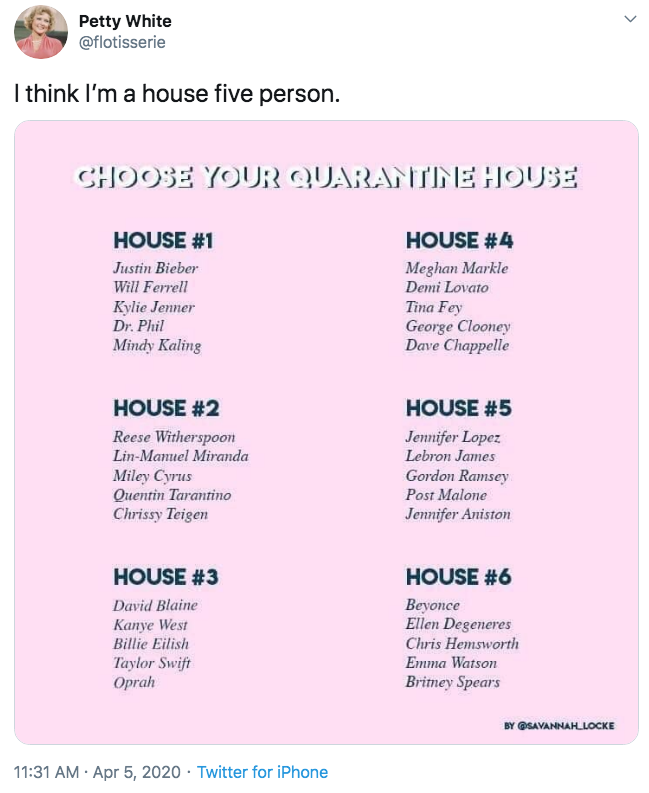
The meme was a list of six hypothetical celebrity households: pick one to quarantine in.
It had been circulating on Facebook, started by a Christian influencer named Savannah Locke. I encountered it deep in a Real Housewives fan group, and felt the pull of a good parlor game. In April 2020, everyone I knew was sitting at home, fretting about the COVID-19 pandemic looming over all of us, so I shared it with minimal ceremony, a couple of buddies with a slightly larger following hit retweet, and within two days the tweet was being cited by The Cut, Time, the Washington Post, CBS, and others. Know Your Meme documented it for posterity. Several outlets named me as the originator, but trust, I was only trying to delight my friends with low grade Facebook content. I couldn’t find the original meme at the time – Locke appears to have had a name change that scrambled my search. But hey, as these things go, nobody earned a dime or promoted anything weird, so no harm, no foul. Business Insider managed to credit it correctly, so a special kudos to their editor.
The core game mechanism behind the meme is forced choice: constraints generate opinions and opinions generate activity. Each “house” also represents a personality type. House 3 is chaos, House 6 is aspirational, House 5 is the one where someone is definitely cooking and someone is definitely yelling about it. The choices are arbitrary, which invites curiosity about who grouped what and why. In short, this meme offered a light conversation starter at the right time, with low stakes, high personal reveal, and endlessly discussable combinations. It also drew from existing memes and games that are popular online, like “where you sitting” in the proverbial lunch room. This one became news because of the timing and gamability, not because I was particularly clever, but hey.
What does it feel like to go so viral? It’s hilarious, strangely affirming, and also a little crazy-making. It opens the door to a whole lot of wild people and ideas on the internet, not all of them flattering or welcome. Virality is sometimes paired with incredible harassment and requires “more condolences than congratulations.” But as far as this particular experience went – hilarious, whoops, and wow. It just felt like a Lebron James, Post Malone and Jennifer Aniston hang would be a good time.
In an Internet of things (IOT), what happens when the companies behind the service model cease to be?
What to do when the biggest platforms for readers are kind of evil?
Wednesday, February 18, 2026 →
Making the rounds on social today: New study suggests that while 70% of financial firms use AI today, 80% report no impact on employment or productivity.