A friend of the blog shared the Embroidered Computer, a programmable 8-bit computer created by using a combination of magnetic and glass beads, gold wire, and traditional gold embroidery techniques to fix material elements to cotton cloth. When complete, it has the processing capacity of a 1950s mainframe computer without the modern silicon microchip. Something about this reminds me of Ellen Ullman’s observation that computers are made of boxes and wires, written on chips and tape. (via)
Art and Craft
The knitting community is one of the great deliberative communities of the internet, and as they’ll happily tell you, knitting and fiber arts are closely tied to industrial and computing history. It’s really hard to pull one over on knitters online, because they have a deep and different relationship to the technical side of their hobby and all of the political and tech history behind it, and especially how it relates to computer engineering. I was thinking about that dynamic while reading about the latest fracas around YouTuber Hank Green, who is taking time away from public life after being called out by his audience, when his AI use was perceived as being in contradiction with his public persona. If you want to go down the rabbit hole on this, here’s a good video summary.
Ultimately viewers are reacting negatively to Green’s admission of using AI to quickly aggregate research to drive his content creation, suggesting that he lost his own creative discretion amid a growing demand for online content. But in the meantime, his technical inaccuracies were paired with completely avoidable gender bias alongside the AI use, which drew additional scrutiny from technical experts. It wasn’t his first go-round with the knitting community, it turns out. Was the bias Green’s or facilitated by his use of the tools? Debate ensues.
Clothing technology: tracing a history of pockets from ancient coin purses to tie-on pouches to today.
I’m seeing grunge icons L7 in concert with Amyl and the Sniffers this summer and have been reading a lot about the ’90s indie rock era in the meantime. One frame I keep encountering positions grunge as regional punk musicians navigating a global, corporate pop mainstream – awkward, crass and vulgar, but in the big leagues all the same. Reading the Auf der Maur bio reminded me that a lot of the punk scene was steeped in ideas about social roles and archetypes and oriented around upending them – or at least giving them a healthy challenge. This subculture was also populated by poets and artists in the classical sense. The retro polish around ’90s pop culture has flattened that texture, but it was genuinely a thing.
The era also introduced the woman rock star, introducing women who wrote and performed with full creative authority, not just as muses, groupies or singers. The reception from fans and critics was mixed, and the discourse around Courtney Love in particular was gross and volatile. Most of the positions she was vilified for read as entirely unremarkable today. I was a teenager during all of this, too young to meaningfully participate, but the aesthetic dominated my early adolescence. At the time I loved Tori Amos and PJ Harvey like kids now love Chappell Roan. What I forgot over time is how literary the era was, and how romantic, both in the literary sense and in relation to the New Romantics of the 1980’s. Big culture lessons for a starry-eyed teenager.
L7’s music is not that deep – it’s metal for meatheads, by design – but their politics and presence were. While poking around, I found that L7 was one of four bands featured in the 1995 documentary film Not Bad For a Girl, which was co-produced by Love and Kurt Cobain. The film focused on several all-female indie punk bands and won Best Documentary at the New York Underground Film Festival in 1996. I’ve never heard of it before now. It got middling reviews from critics then, and it’s not available streaming in full in English, unless you’re viewing it here at this dubious Google Drive link – which I will do and report back.
Maris Kreizman on AI pressures building in the publishing industry, particularly how it impacts writers and editors: “It’s not an ideal environment for productivity, let alone for making art.”
I’m following a guy in TX who is using AI to write and illustrate children’s books whole cloth, then self-publishes using Amazon, and getting recognition in his region as a laudable children’s author. The books are categorically not good. It’s like people are rewarding his content strategy.
Taste the Music is a new audio series exploring why artists are driven to create. The first episode features storytelling and songwriting by friend of the blog Whitney Mann, where she chronicles her experience getting “the yips” onstage, and how she worked through it and picked up her guitar again.
An observation on feminist writing and Jezebel: Throughout history, a lot of time and energy has been spent mediating how and whether certain kinds of people talk to one another. The feminist blogosphere, for all its faults, was the first time lateral, public, unmediated conversation happened among women at scale. Many kinds of women were there that had no space at other tables. And it was very messy, and very revealing, because it was the first time that happened at scale for all to see.
Some thoughts:
- When I started in 2001, the most viewed website about feminism on the internet was a solo blog by a man in Portland.
- I just pulled Mindy Seu’s “Cyberfeminism Index” off my shelf, a veritable tome, and the feminist sites don’t even make the table of contents. Which is not an indictment of the book, but an example of how ephemeral all this is online.
- You can see this on Twitter in the live debate about what Jezebel was and wasn’t, a conversation happening mostly through collective remembering. Jezebel joined the pack of blogs at some point, and they were big dogs, but they weren’t responsible for the creation or steering of the digital movement. They were a glossy, spendy repackaging of the organic thing, backed by real investors. It’s wild to see the entirety of the movement attributed to Jezebel by young Twitter, given that most of the indies kept Jezebel at arms’ length until much later. They were pretty widely considered a corporate interloper in a grassroots arena, though in hindsight that wasn’t right either.
- The first time the indie bloggers gave Jezebel their day was when they published the untouched photographs of Faith Hill on the cover of Redbook, a women’s magazine. The Redbook post tore the veil off the beauty industry in real time. Until then, the idea that “celebrities are photoshopped” and “photos are retouched” was almost an urban myth, which is easy to forget given the ubiquity of filters and AI now. Then, you heard about it but couldn’t confirm it for yourself unless you had firsthand experience. Retouching was a discrete industry practice, digital tools were still expensive and clunky, and all of it was surrounded by a lot of tradecraft and secrecy. The mystery of celebrity image management exploded with an animated gif on a public-facing post, and it was rad.
This post is mostly an excuse to talk about my latest playlist: Digital Animal. This one consists of about 200 songs across genres, all reflecting on our human relationship to science and technology, futurism, digital culture and the internet.
When I’m chewing over a big idea, I like to compile resources in and around that idea to help support my thinking. Embracing my angst about artificial intelligence, I started compiling songs that reach back to the early 20th century, tapping into prior generations’ anxieties about telephones, television and early networking technology, adding more contemporary concerns as I went. The playlist runs from David Bowie and Blue Öyster Cult and Kraftwerk to Zapp and Radiohead, then forward into modern takes on social media, cell phones, and the internet from Missy Elliott, Gillian Welch and Charli XCX.
I like a playlist because it’s convenient, and because songs are one place where meaning and feeling are created simultaneously, and because it’s easy to spot salient patterns across disparate sources. Scholars in interdisciplinary studies have long argued that you cannot fully understand a thing without understanding what it feels like to live with it, and that cultural analysis may get you there faster than surveys will anyway. Meanwhile most writing about technology separates feelings from form and function. Art and music compress all three, and have the potential to surface ideas that professional and institutional language can’t. Art and culture frequently peg an issue down before emerging best practices are formalized in business and academia.
For anyone working in technology communications, that lag between culture and practice has practical consequences. The language we use to describe technical systems shapes what people can think and do about those systems. An institutional frame — efficiency, access, innovation, value — consistently misses important dynamics that people living inside those systems are experiencing as users and as people. Art keeps the human subject inside the frame, functioning as both anecdote and data.
Plus, it’s fun and we should collectively think about art as much as possible. So, treat every song like a portal.
What does it mean to be both digital and animal? Some observations:
- Grief and sadness sit next to fun and ecstasy. Many of the older songs see computers as friend and companion, treating tech with a kind of tender curiosity, a toy that makes you happy as much as a medium for expressing longing and desire. These nevertheless tend to be layered with a sense of loneliness, a minor key, a dynamic that bears out through user research.
- Between the era of telephones and the digital web, there are a charming number of songs about beepers, beeping and pagers. I’m hopelessly devoted to Missy’s “Beep Me 911” right now.
- Recent songs are concerned about understanding identity and the self under the pressure of social media. Songs talking about social media persistently trawl the gap between your real identity and your public identity and personal brand, and how this dynamic can hollow out your relationships and quality of life. Songwriters like Jazmine Sullivan consistently refer to tech as a place of escapism, like retreating into the creation of a new Tinder profile while avoiding reflection on your last relationship. Comparison is the product, and sometimes it stinks.
- Lots of songs from peak elder Millennial/Gen X songwriters are about watching the old analog world being swallowed by the new. The older the songs, the more aware they are of the machine across the room, and the more they lean into allegory. The contemporary songs don’t worry about the boundary between human and machine much at all, likely reflecting the high level of technical integration (and acceptance) we live with right now.
Is fretting about our relationship to tech and industry part of the human condition? Or is there something specific to tech that accelerates these anxieties and impulses?
A few favs:
- I’m enjoying almost everything from the band Automatic. One of the band members is the daughter of the drummer from Bauhaus, and their work is heavily influenced by 80s era synth pop and new wave. I have several of their songs represented on the list, and particularly like “Black Box” off their 2025 album.
- Erykah Badu’s “Cel U Lar Device,” which positions the phone as an instrument of interpersonal surveillance, has been on rotation in my house for (cough) years. It is also a reinterpretation of Drake’s hit “Hotline Bling,” itself forever memorialized as a popular meme format.
- The Talking Heads’ 1988 “(Nothing but) Flowers” imagines a sunny life after the fall of industrial civilization. For the doomer take on this theme, check out Nina Simone’s cover of “22nd Century.”
- Sophie’s “Faceshopping” is about the negative pressures of cultivating a public persona and brand, and tips a hat to our relatively new ability to use science and technology to curate a physical appearance that matches your internal (and digital) one.
- Nobody talks about Ladytron anymore.
I’m watching the feminist writer scene go hard on some recent books: Jamilah Lemieux’s Black. Single. Mother. and Lindy West’s Adult Braces.
Both books were published on March 10, and both authors are talented, with impressive bylines, with significant followings baked in. Incidentally, they come from the same cohort we loosely refer to as “feminist blogging,” though both would probably bristle at the description. And both use autoethnographic methods to leverage their personal lives to tell bigger stories about social, cultural and economic dynamics (a common method among feminists, where the personal is often made explicitly political). Lemieux goes further by including a series of essays by other Black single mothers at the end of her book, expanding the frame from memoir into something more collective, a full bloom.
West’s book has gone ultra viral over the last few weeks while Lemieux’s has found significantly less footing. West’s work is being spectacularized in real time, while Lemieux’s support has been mostly grassroots, respectful (thankfully), and largely limited to Black media outlets and NPR. This reproduces one of the oldest patterns in feminist media: a white woman’s confessional work circulates as universal or spectacular (West is being treated like a spectacle currently, which is great for sales and visibility but comes with negative trade-offs), while a Black woman doing rigorous, arguably more structurally ambitious work gets categorized as niche, an outlier. That this is happening within the very audience that would generally name and critique this dynamic in any other context makes it worth sitting with.
While I respect both authors and their bodies of work, I am looking forward to Lemieux’s book because I know firsthand how difficult it is to get a publisher and an audience for serious, foundational work like this. I suspect it will prove relevant long after the viral moment is over.
Rapper Afroman is going ultra viral this week as his “Lemon Pound Cake” trial plays out in the news. He captured the raid on security cameras in his home and used the footage in a series of songs, videos and merch. He ultimately did not face charges after the search, and argues (with evidence) that the police broke his door and stole $400, which provides the platform and substance for everything that followed. He argues the police shouldn’t have been there at all, and didn’t follow protocol when they were, and that as a citizen and artist he’s expressing his feelings about it in his preferred medium. Is this a winning legal strategy? Time will tell.
In the meantime he’s winning at public opinion. The trial is shaping up in the public view as a defamation vs. free speech trial, with the artist’s prolific work about this no-knock raid performed at his house, itself arguably unethical, held up as harassment by the officers who did the job. True crime, legal experts and court watcher accounts are going gangbusters providing cultural and legal analysis alongside video of court testimony. It helps that the court footage is a rich text — both hilarious and revealing.
Meanwhile: another first amendment case in and around rap lyrics is playing out now. A brief history of rap and the First Amendment.
Ruling: AI art is not copyrightable.
A pal sent along this exceedingly cool article on an art space on the south side of Madison, WI, that marries quilting and memory care.
The last time I went truly viral was in April of 2020 in the height of the COVID shutdown. I posted a tweet and walked away from my phone. By the time I checked back, my notifications were out of control.
The next morning, I got a message from an old friend familiar with my handle. “I think I saw your account on Good Morning America?” Hilariously, there I was, and I couldn’t even claim responsibility for the meme.
I’ve spent most of my time on the internet as a pseudonymous account, using my first name only, or using a handful of handles (incl feministe, fauxrealtho, flotisserie, paired with punny names like “Petty White” and “Frieda People,” a convention from the Tumblr years). Even as a visible personality online, I was only known by my first name and URL and/or handle. In recent years I de- and reactivated some of my socials, so some of these breadcrumbs no longer exist, but I’ll do my best.
Pseudonymity allows writers to explore complex ideas in digital spaces while protecting their identity, location, and other identifying factors, while also maintaining a throughline of identity and storytelling.
There are a lot of trade offs in using a pseudonym, especially around how to claim credit for your work. But people use them because they give you the privacy to be honest, real, weird, authentic, and to escape the creep of modern social media presence into high stakes spaces like the workplace. This dynamic was kind of the impetus behind the era of “weird Twitter,” where people using pseudonymous social handles routinely threw out funny, absurdist one-liners to impress their friends and followers, while taking a turn at the social media slot machine. Not every post or joke lands in a way that converts to numbers, but some do, and it’s fun to try.
I’ve written a little previously about how the English program I was a part of used fiber arts to illustrate the fundamentals of technical writing, but one of their other methods of teaching the internet was through board games. Games, like the internet, and much like writing, provide rules and structure for communication and engagement, but everything that happens inside the container of game board and game play is a mystery until it emerges through human interaction. So goes the internet (and to some extent, so goes AI). Games and gaming were used as a method to think through what it means to create rules of play, then let a community rip through the model – and many of the thinking and skills involved around game design apply in social digital spaces, from chat rooms and Teams channels to the open seas of the WWW. The longer you’ve been playing the slot machine, the more you get a feel for the kind of thing that will get seen and read, and who among your readership will take your content to the next level.
Why does it matter? Because understanding what “works” to make ideas travel further online, the more you can tap into it. Big Tech is under fire right now for amplifying some of the worst impulses of the internet, by cranking engagement algorithms to exploit messages that produce outrage. Yes, big emotions create virality, but so do relatability and sharability.
So back to the meme: here’s how it went down.
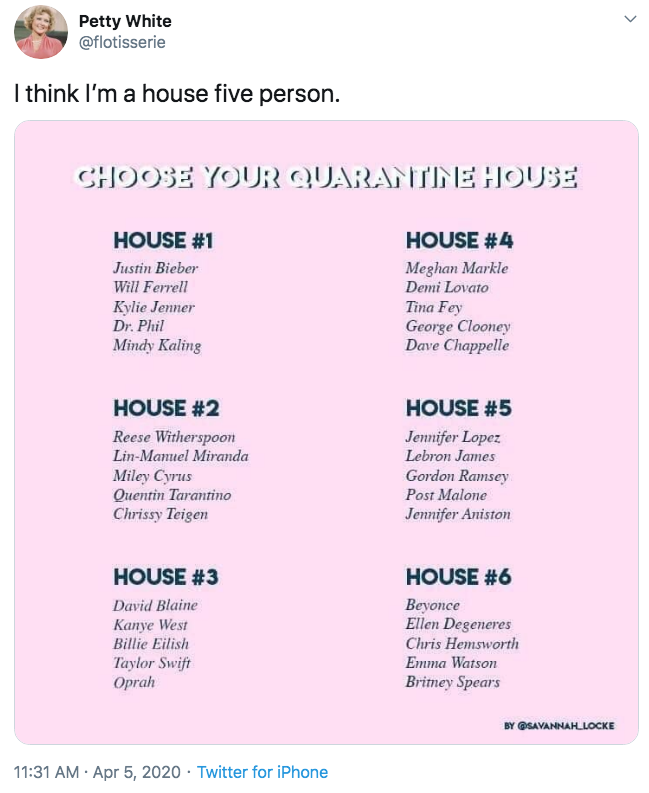
The meme was a list of six hypothetical celebrity households: pick one to quarantine in.
It had been circulating on Facebook, started by a Christian influencer named Savannah Locke. I encountered it deep in a Real Housewives fan group, and felt the pull of a good parlor game. In April 2020, everyone I knew was sitting at home, fretting about the COVID-19 pandemic looming over all of us, so I shared it with minimal ceremony, a couple of buddies with a slightly larger following hit retweet, and within two days the tweet was being cited by The Cut, Time, the Washington Post, CBS, and others. Know Your Meme documented it for posterity. Several outlets named me as the originator, but trust, I was only trying to delight my friends with low grade Facebook content. I couldn’t find the original meme at the time – Locke appears to have had a name change that scrambled my search. But hey, as these things go, nobody earned a dime or promoted anything weird, so no harm, no foul. Business Insider managed to credit it correctly, so a special kudos to their editor.
The core game mechanism behind the meme is forced choice: constraints generate opinions and opinions generate activity. Each “house” also represents a personality type. House 3 is chaos, House 6 is aspirational, House 5 is the one where someone is definitely cooking and someone is definitely yelling about it. The choices are arbitrary, which invites curiosity about who grouped what and why. In short, this meme offered a light conversation starter at the right time, with low stakes, high personal reveal, and endlessly discussable combinations. It also drew from existing memes and games that are popular online, like “where you sitting” in the proverbial lunch room. This one became news because of the timing and gamability, not because I was particularly clever, but hey.
What does it feel like to go so viral? It’s hilarious, strangely affirming, and also a little crazy-making. It opens the door to a whole lot of wild people and ideas on the internet, not all of them flattering or welcome. Virality is sometimes paired with incredible harassment and requires “more condolences than congratulations.” But as far as this particular experience went – hilarious, whoops, and wow. It just felt like a Lebron James, Post Malone and Jennifer Aniston hang would be a good time.
⚡ AI's last mile problem in higher ed
Sunday, August 17, 2025
I graduated from college right before the 2008 recession and bounced through some unpromising temp jobs until an opportunity emerged for a permanent position. Sometimes you just need to get in where you fit in, and so I did. That’s how I came to work for a regional cable company that used federal money to expand the new national broadband network, extending out to the rural communities dotting central Indiana.
It was a front row seat to the national broadband expansion efforts of the early 2000s. Our business ran right across the state, spanning the 80 or so miles from Attica to Kokomo, which included several small cities with large manufacturers, two public research universities, and several community and liberal arts colleges. The strip of broadband fiber at the core of our service followed existing highways and electrical lines that split the corn and soybean fields from town to town, feathering out to more rural areas from there.
I worked a variety of roles there that put me face-to-face with a classic technical problem: the last mile. On many occasions, someone would come in looking pensive, and explain that the fiber had been extended all the way from town to their hamlet, and yet there was no plan to connect their property to the pole. Over time the pattern was clear: while the network was expanded, the cost of running a physical line to each individual property was too expensive and specific at scale. These customers often left without a path forward despite all their efforts and ours.
The “last mile problem” refers to the logistical challenges and high costs associated with the final leg of delivering goods or services to the end customer. It’s often the most difficult and expensive part of the supply chain, despite being a relatively short distance. The pattern shows up everywhere: public transit can get commuters most of the way most of the time, but that final leg of the journey remains specific and individual and problematic. E-commerce companies promise drone delivery solutions, scooter and bike-share apps claim to solve urban mobility gaps, but these technological optimizations remain persistently stubborn at scale, running up against the messy realities of sidewalks, intersections, and actual human behavior.
Tl;dr: I’ve been turning over this suspicion that AI automation will hit a classic “last mile problem,” especially in the public sector.
AI systems, particularly LLMs, are like those systems—they work incredibly well in their intended domain, processing and manipulating information. But because they’re fundamentally an information-only approach, that creates their own last mile problem when we try to implement them in physical and context-specific environments. Public institutions are uniquely specific — they are often the originators and producers of knowledge and the keepers of original policy, tasked with making the rubber hit the road. Additionally, the need for comprehensive data protection required by public workers and institutions fundamentally hamstring potential applications.
Actually implementing recommendations is where you hit the last mile. This is the work of public administration.
Imagine an AI application trained on every facilities management manual ever written and tuned to synthesize best practices for HVAC optimization. It can analyze years of energy usage data and recommend precise temperature adjustments for different zones of a building, but can’t feel that the third floor is always stuffy, or know that the facilities manager retired last year and took decades of institutional knowledge with him. Building A’s HVAC system was installed in 1987 and has a manual keypad. Building B’s system interfaces with the campus-wide monitoring system, but unreliably, and investigation is slated for later, someday, when resources allow. Professor Smith has taught in Room 204 for 25 years and will blow up your spot before moving to a different classroom for maintenance. Your engineers who manage these spaces are balancing human teams, who have time off and training and other priorities they manage in life. So, you need staff who understand the quirks of each area, the history of each system, the politics of which departments will accept changes and which will flood your inbox with complaints. You need someone who knows that the third floor always runs hot because of a design flaw from 1974, and that the solution isn’t more precise control but a $50,000 renovation that’s been deferred for a decade because a glittering new project across campus takes priority.
Imagine this tangle of questions and contingencies times infinity on every university campus in existence. Universities are like cities—they’ve been built and rebuilt over decades or centuries, with layers of systems and fiefdoms that weren’t designed to work together. AI recommendations assume a level of standardization that simply doesn’t exist. Every AI implementation in higher ed requires navigating multiple constituencies with different priorities and power structures. It’s like trying to redesign traffic patterns in a neighborhood where the residents, business owners, commuters, and city planners all have veto power and conflicting interests.
So. When looking at efficiency efforts spinning up across the education sector, I’m feeling pensive, trying to understand how exactly the house gets connected to the pole.
The promise of new tech in higher ed needs to more deeply consider the translation costs: the human labor, institutional knowledge, knowledge documentation and local adaptation required to bridge between the usefulness of tech and specific realities of public university work. Public employees want modernization and don’t want to fall behind. We want systems that work. We are also balancing a great deal of change and pressure as a sector, with fewer material resources than ever. We need less marketing and more right-sizing in the claims around AI against the political and tech realities of public administration.
This disconnect between technological promise and implementation reality becomes even more critical as higher education faces increased political scrutiny. When tech vendors promise that AI will solve efficiency problems or reduce administrative costs, institutions are under immense pressure to deliver measurable results quickly. But the translation costs we experience don’t disappear just because the political pressure to modernize increases.
The institutions that thread this needle will be the ones that accurately assess these translation costs upfront and set expectations accordingly—not the ones that assume the technology will magically bridge the gap between digital and physical, abstract and specific.
🧶 Wonky Star quilt
Monday, November 11, 2024
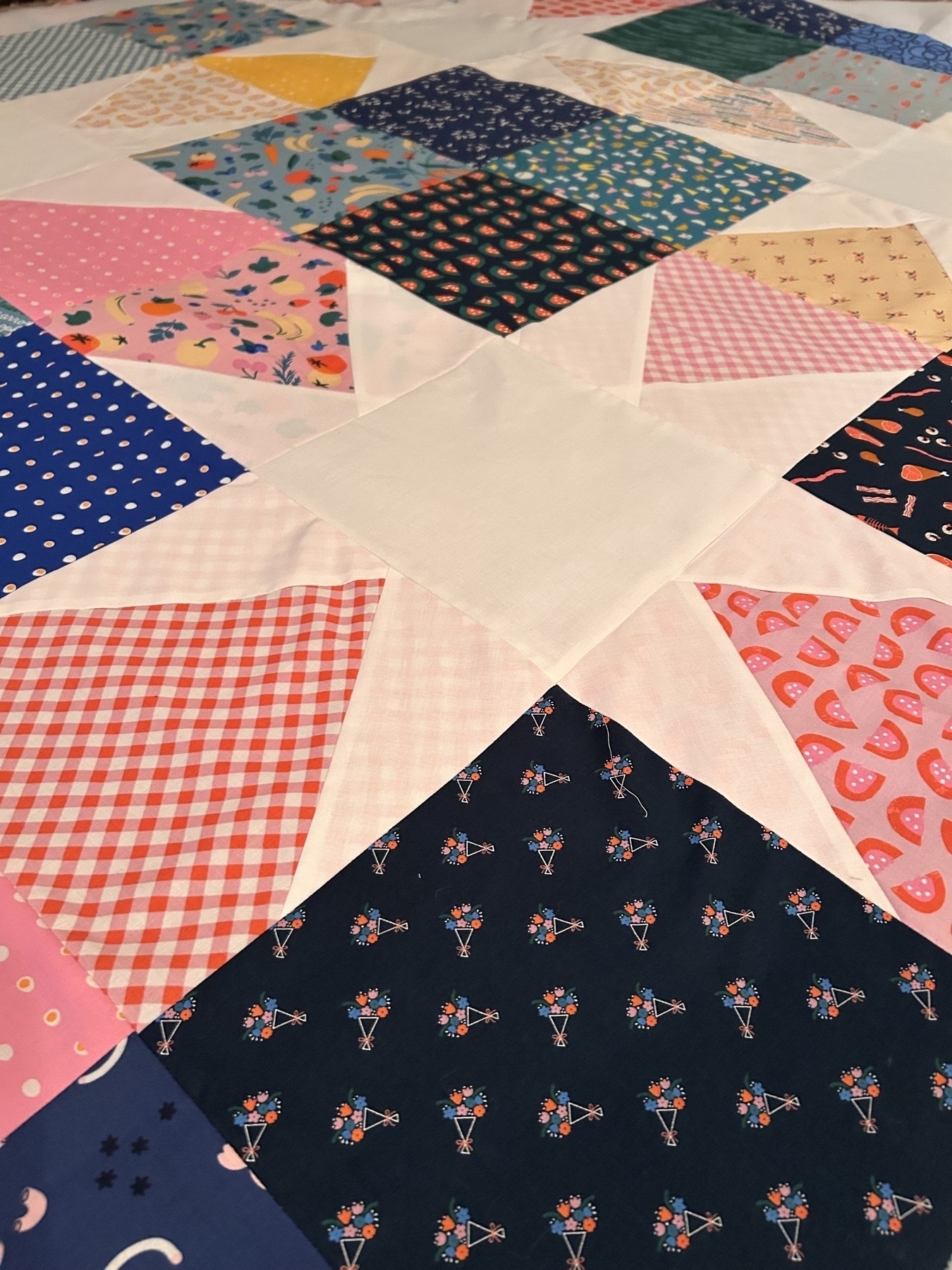
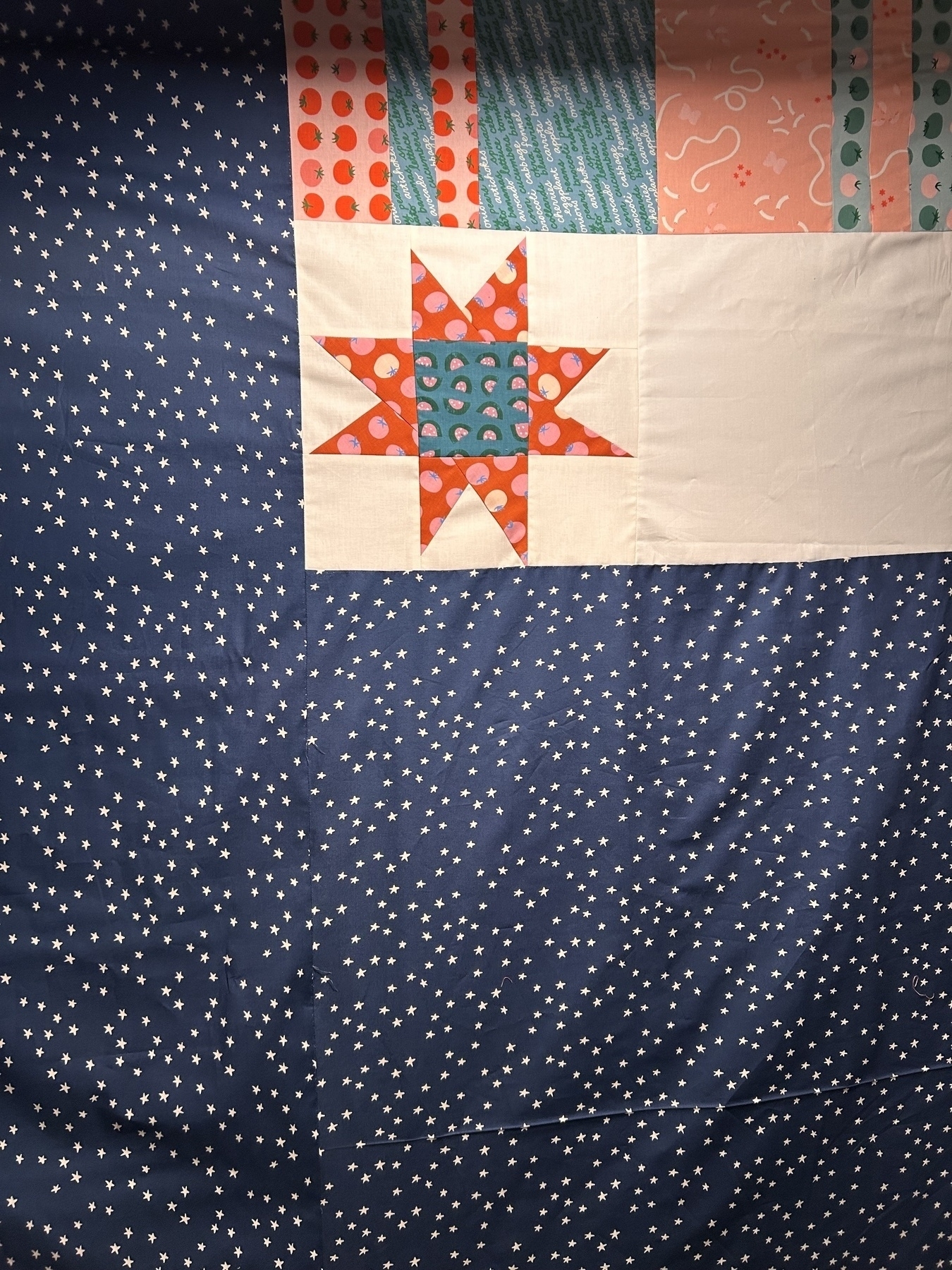
Posting about my latest quilt for posterity. This is a “wonky star” quilt using 10” precuts, measuring about 60 X 70”. I completed the sides last night and will hand quilt all of it with a mix of big stitch quilting.
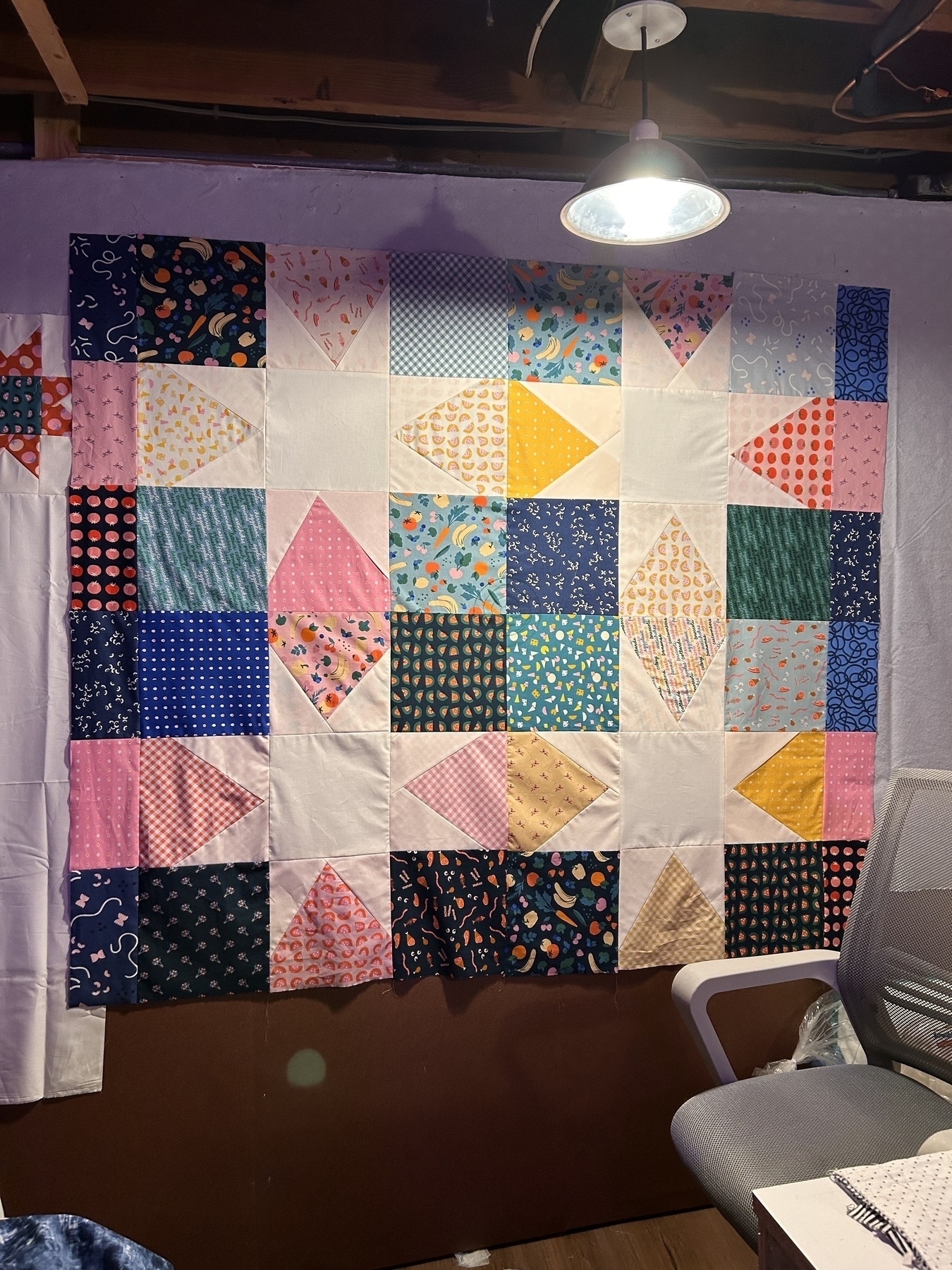
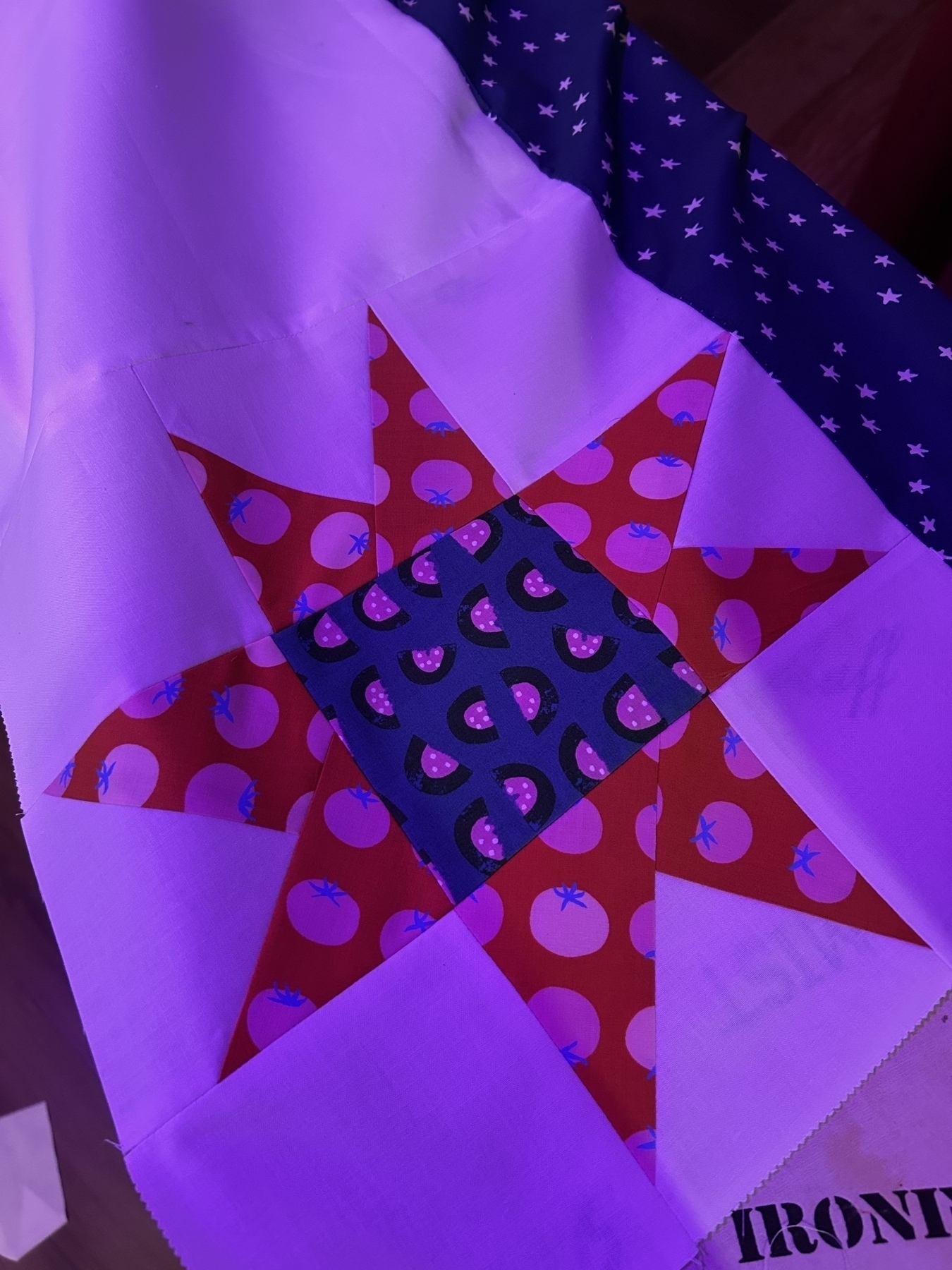
Also in arts and crafts: On the revival of blacksmithing in Kentucky.
🧶 Craft Work: On a Joann's bankruptcy and the struggling retail craft market
Wednesday, March 6, 2024
The internet says Joann fabrics is going to declare bankruptcy, putting a huge market of individual crafters without access to in-person retail craft spaces into a tailspin. It’s likely they will ask their creditors to restructure their debt, making them able to keep some stores open. The whole market relies heavily on in-person shopping (it’s a textural and sensory shopping experience, which is the point!) and hasn’t pivoted well to e-commerce.
This is one of my favorite pet subjects. Globally, the arts and crafts market overwhelmingly caters to women and children and it’s HUGE, commanding a very dedicated and loyal customer base. And still, it struggles.
Despite an influx of crafters during the shutdown, retail craft stores have struggled to strike a balance between sustainable e-commerce and in-person retail strategies. Other issues: For months after the pandemic, the Joann’s in my neighborhood struggled to keep the place stocked and staffed, exacerbated by skyrocketing shipping costs and shifts in the retail worker market after the shutdowns. Kids went back to school, cooling the market for arts and crafts activities on which to spend their time. And with lagging incomes and cost of living increases eating into people’s spending money, customers just don’t have the bandwidth they may be used to.
In my experience, customers don’t love shopping at a Michaels or a Joann’s, but they appreciate the ability to get what they need, mostly on demand, and to do so in-person where you can handle the materials before you buy them. Fiber arts people, for example, put a lot of importance on the weight, texture and color of their tools and materials - and for good reason! Pleasant tools make for a pleasant experience - and for pleasant outcomes. Indie retailers corner this market by keeping inventory low, building relationships with customers, creating affinity using social media marketing and by nurturing community with digital learning and forums. Crafters from around the world can share tricks, tools, patterns and finished items with like-minded people. The large-scale retailers can’t compete with that and haven’t really tried.
It’s unclear what’s next, but I’m thinking of all the people who live in places that can’t sustain a standalone fabric or yarn store. Rural makers can sometimes find tools and materials in resale markets like Facebook Marketplace, and sometimes you can find decent stuff at the local flea, or at specialty shop, such as a small machine repair shop that works on sewing machines. A lot of those folks won’t have a store to go to, and will have to travel to shop in person or resort to online retailers that don’t meet their needs.
Halloween quilt, finally
Thursday, February 22, 2024
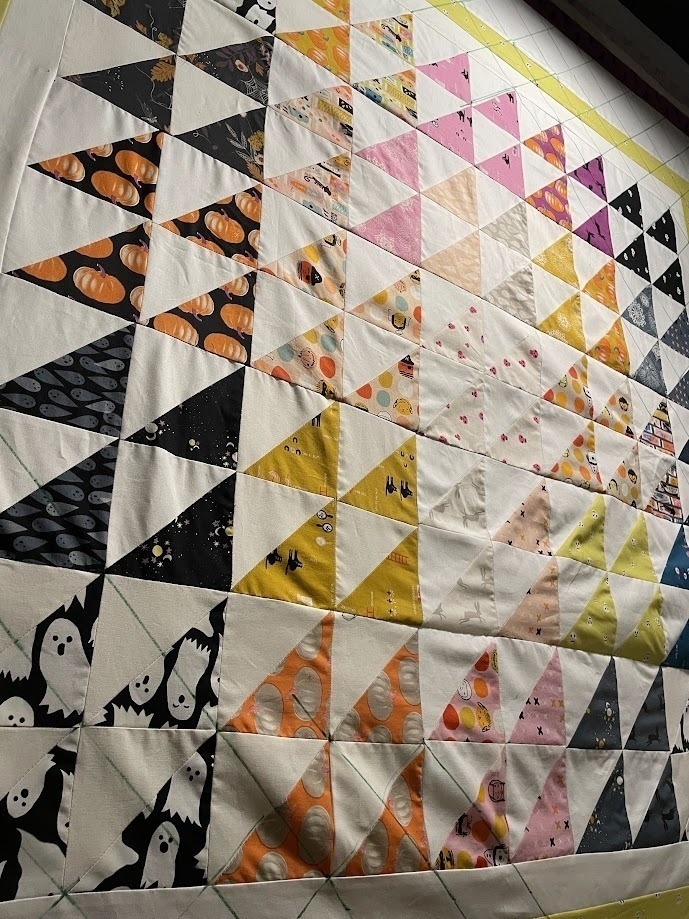
I finished my latest quilt on my birthday, a Halloween quilt made from precuts (no pattern) that I started in 2021? 2022? I don’t know how old it is. It’s been languishing.
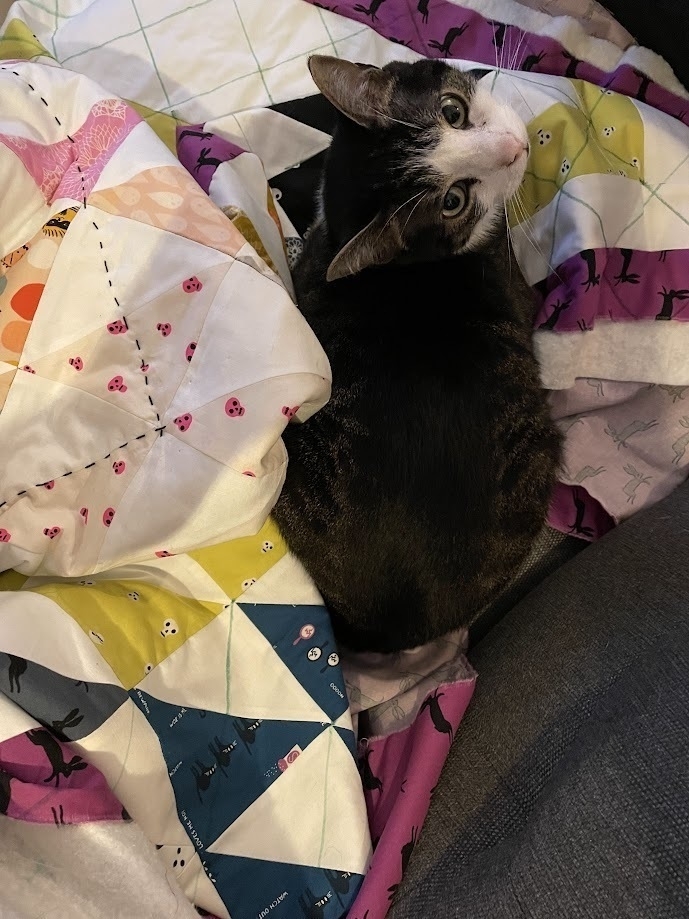
I don’t love shoving a huge quilt through my lil sewing machine, so I still hand quilt these puppies using 6-strand embroidery floss. It’s hard on my hands but gives the final quilt so much texture and weight.
These photos are of the quilt fresh out of the washing machine. Super crinkly and cat-approved.
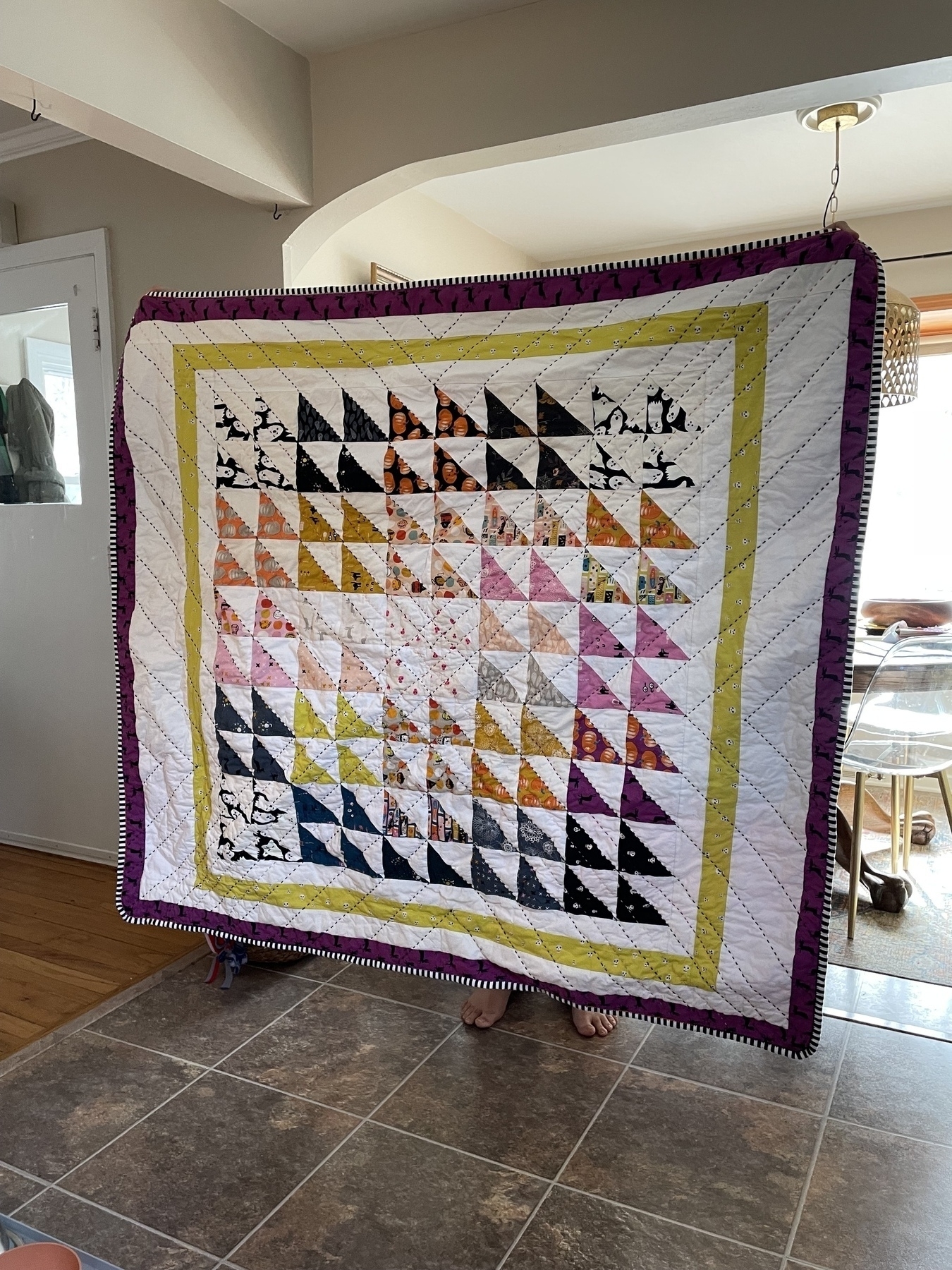
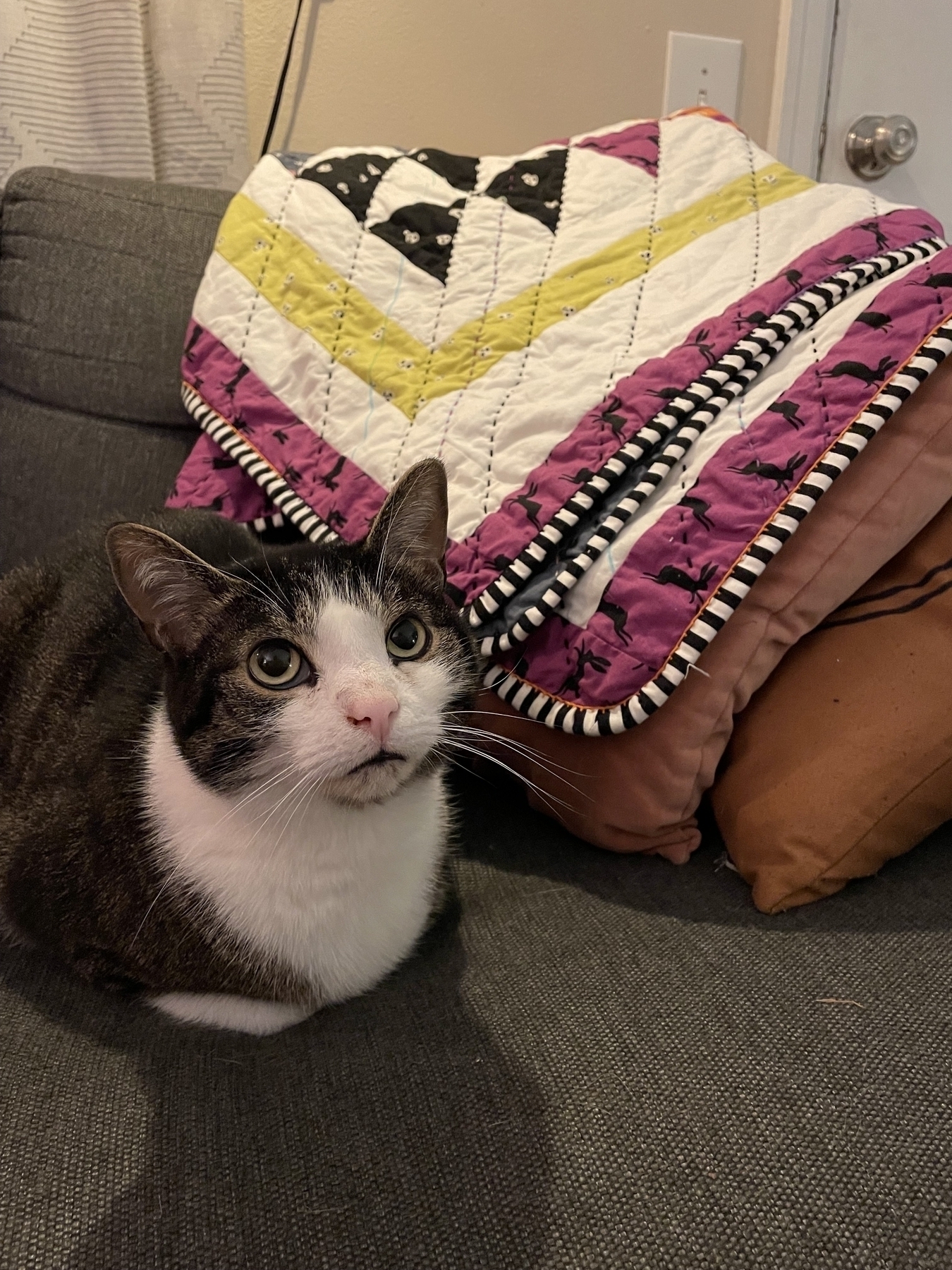
V proud of myself because, despite going to the quilt store yesterday and getting everything BUT what I went there for, I found enough batting scraps to put together a quilt sandwich and began hand quilting it last night. She’s going to be cute.
Looming projects
Thursday, November 23, 2023
I was invited to submit to the pop culture fiber craft show at Gallery 1988 again this year. Last year I sold a large Kris Jenner meme quilt. I was delighted to be included and nervous about how my work would be received, and was chuffed to be one of the first artists whose work sold.
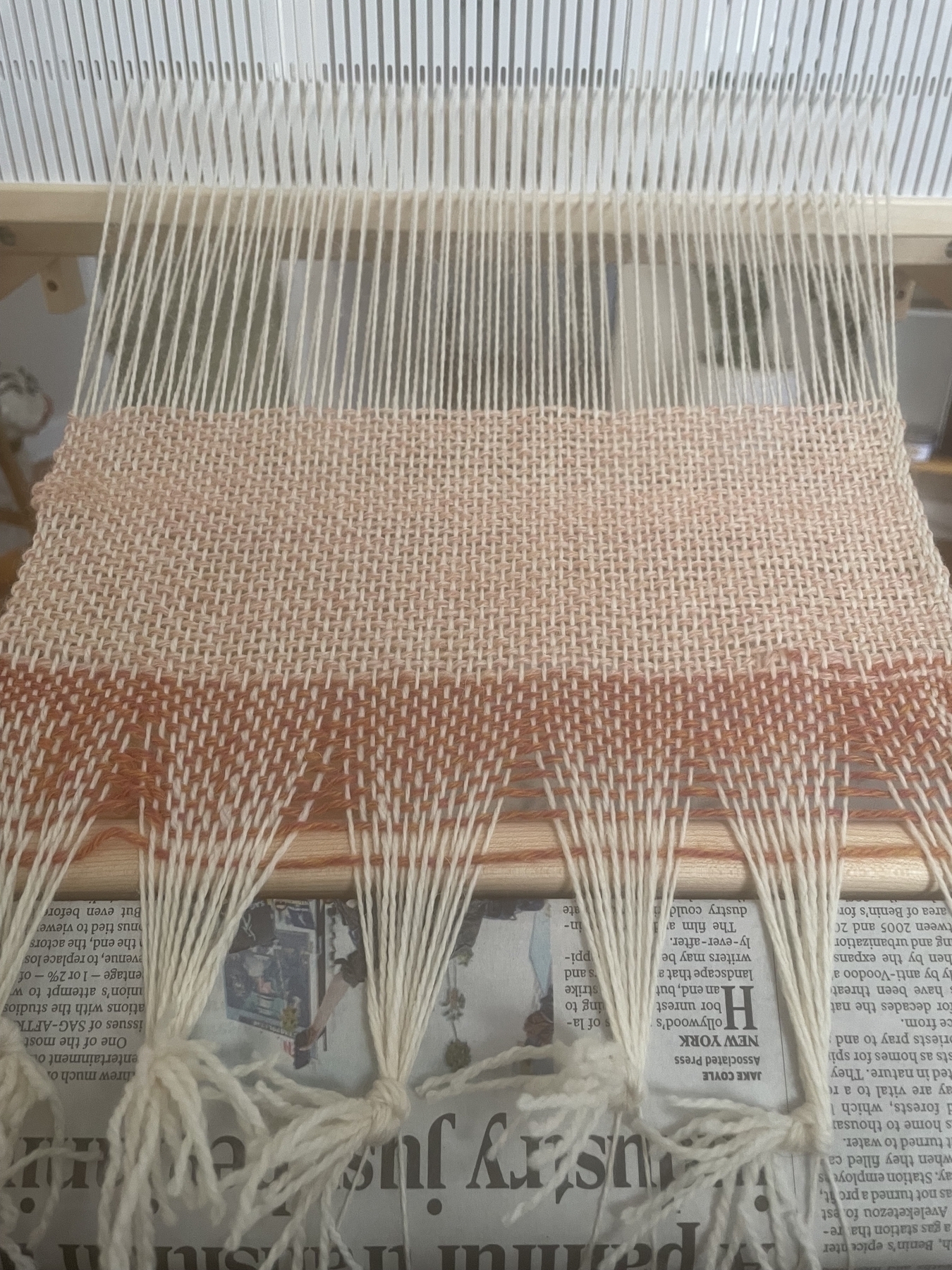
I immediately took that money and bought a rigid hettle loom. I had recently taken a class and loved it, and also needed a new way to use up some of my growing yarn stash.*
I’ve had the loom in a box since this summer and finally got it put together this week.
It took me a book, several hours and Youtube videos to properly dress the loom, and I got it mostly put together - with some tension issues, but good enough to start weaving - last night. I would guess I’ve had the yarn I put on it for twenty years, and it feels good to finally put it to use while I get started.
I’m still debating what to do for this year’s show. I want to do a Dril quote, but I’m also thinking of something more commercial. 🧶
I’m v excited about the PJ Harvey Tiny Desk concert out today. 🎵
PJ Harvey is one of my favorite musicians because she is a weirdo and an artist in the same vein as a Kate Bush, or even a Bob Dylan, who concentrates on mythology, atmosphere, artistry and sense of place. For a lot of my life, my fav album was “Rid of Me.” It was present in a lot of formative moments as a kid and still resonates for me as an adult, despite some of its flourishes not aging well. As an adult, “Let England Shake” genuinely moved me. She draws on music and poetry traditions to explore what it means for England to be an empire, sitting atop a throne of bones and bloodshed. It’s ambitious and dark and sounds incredible, in part thanks to her use of the autoharp (yes, seriously).
She’s also among the artists who made a hard left in my musical interests as a kid, when she and John Parish released “Dance Hall at Louse Point.” This album was called career suicide when it came out because it is so atonal and avant garde. As an album, listening from beginning to end, it’s delightfully sinister. It could be a sister or a cousin album to Nick Cave’s “Murder Ballads.”
Sometimes rules are useful
Monday, November 6, 2023
Created some artsy fartsy rules for myself where I have to finish something old before I start something new, just to keep some momentum going on existing projects.
I have several outstanding embroidery, quilting, knitting AND crochet projects, and a loom I refuse to assemble until I knock out one or two of these other ones. My two biggest priorities are a giant garter stitch shawl that I began pre-pandemic and really want to finish because it’s so beautiful - and so boring to knit - and a gigantic crochet mosaic blanket that is teaching me the ins and outs of crochet. After that, some half-hearted quilt pieces, a wholecloth quilt and two flimsies that need to be quilted and bound. And some lingering embroidery projects and a head full of new ideas. My friend gave me some antique glass she’d like me to engrave this winter.
Meanwhile I finished a hat for the kiddo last night and she was so pumped she wore it to school this morning. 🧶
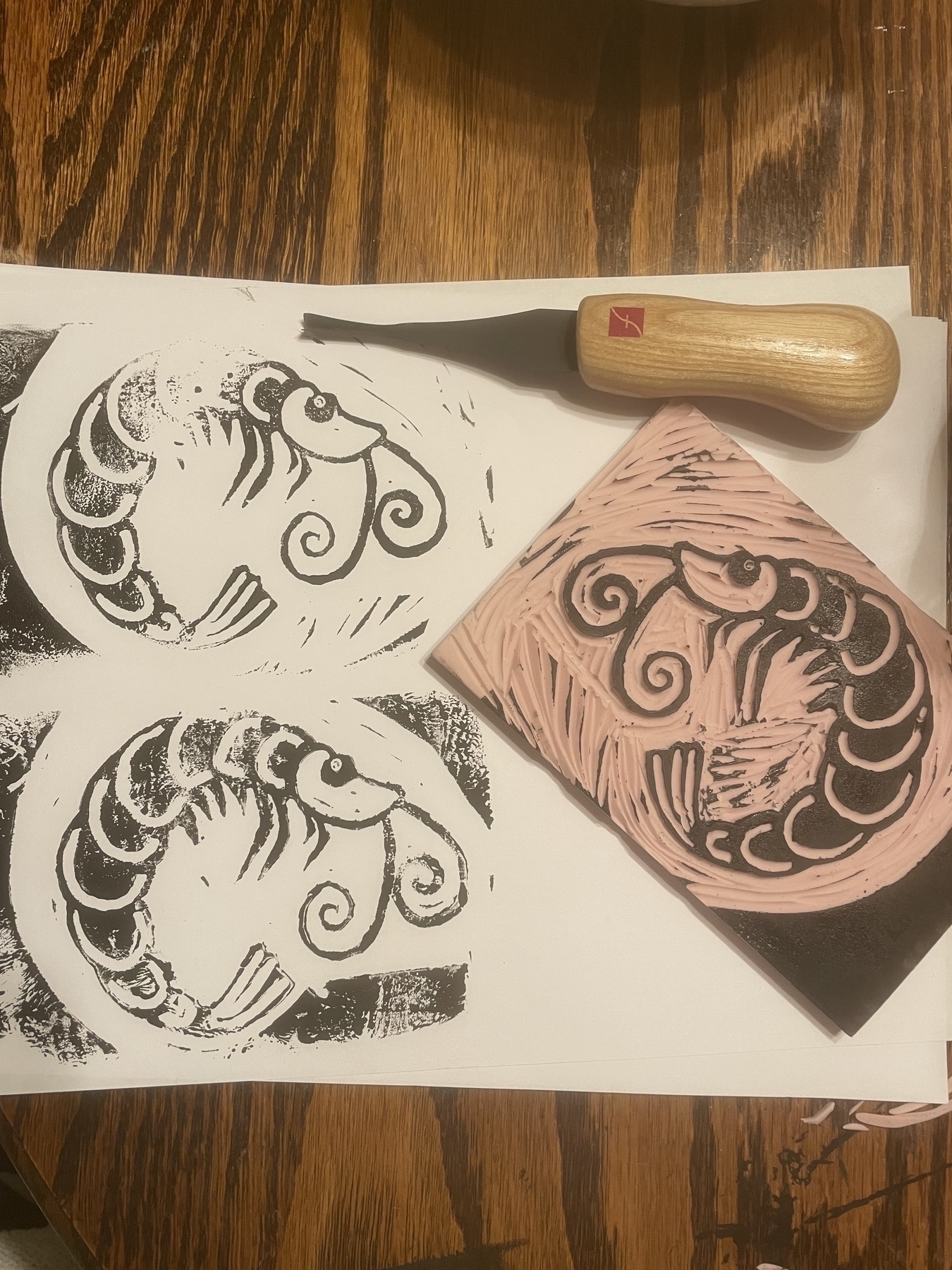
My daughter is into block printing at the moment, so I am too. I started carving this shrimp past weekend without a plan, and now I wish I had some background to it, so I’m going to play with making a second stamp that implies water. A shrimp’s gotta shkrimp. 🎨